

Your home is a work of art
You, time & entropy are the artists
We just published an intel-rich guide to How to Dress Well When It’s Too Hot
Why are we addicted to standing in line for treats? Blackbird Spyplane published a profound investigation last month, before everybody else, and kicked off “The Summer of Stories About Lines.”
Sip upon The Drink of the Summer.
Mach 3+ city tips for traveling the entire planet are here.
We don’t run ads and we never use affiliate links except for one-off secondhand gems we find on eBay, and books on the independent bookseller Bookshop. We laid out our position on affiliate links and spon here.
This means the only people we owe anything are our readers.
— Jonah & Erin
We enjoy looking through an issue of T or AD or WOI and coming across gorgeous photographs of people’s dope homes as much as the next style & culture sletter — even if we can’t always get over our sneaking sense that, if you open your homes to one of these shoots, you risk vainly “doing too much” while revealing that, for you, the experience of simply occupying your dope home does not give you as much happiness, pleasure and satisfaction as you thought it would when you splashed out on the crazy architect and baller interior designer, so now you feel a(n ironically) cheap compulsion to invade your own privacy and transform the place you live into thinly veiled “flex-on-these-hoes” ammunition.
There is one particular genre of house visit, though, real & virtual, that Erin and I (Jonah) are not alone in finding especially intriguing: visits to places that artists call home. Leslie Williamson’s books, which document the cribbos of architects, artists, and designers, speak to this intrigue, as does a book like Jill Krementz’s The Writer’s Desk, which, as the title suggests, captures the workspaces of authors. So does, e.g., the real estate listing for Robert Frank’s old East Village loft, which hit the market back in March and got shared & aggregated a bunch.
We’ve written about our own visits to artists’ homes multiple times in the Plane over the years — Donald Judd’s Soho loft; the vibiest house we’ve ever been to; the brilliant, under-the-radar woodworker’s home that inspired our “G.O.O.D. G.E.R.M.S.” (Gangs Of Objects & Décor Giving Eclectic Refined Motley Spirit) theory of home decorating, and others, all of which we’ve collected in our Home Goods Index.
What we love most about houses like this is when they undo any clear distinction between The Place the Artist Lives and The Work the Artist Makes, thereby 1) helping the rest of us to shake up the way we see our quotidien surroundings and 2) offering us nuts-and-bolts inspiration for ways to enviben our own living spaces accordingly…
Case in point:
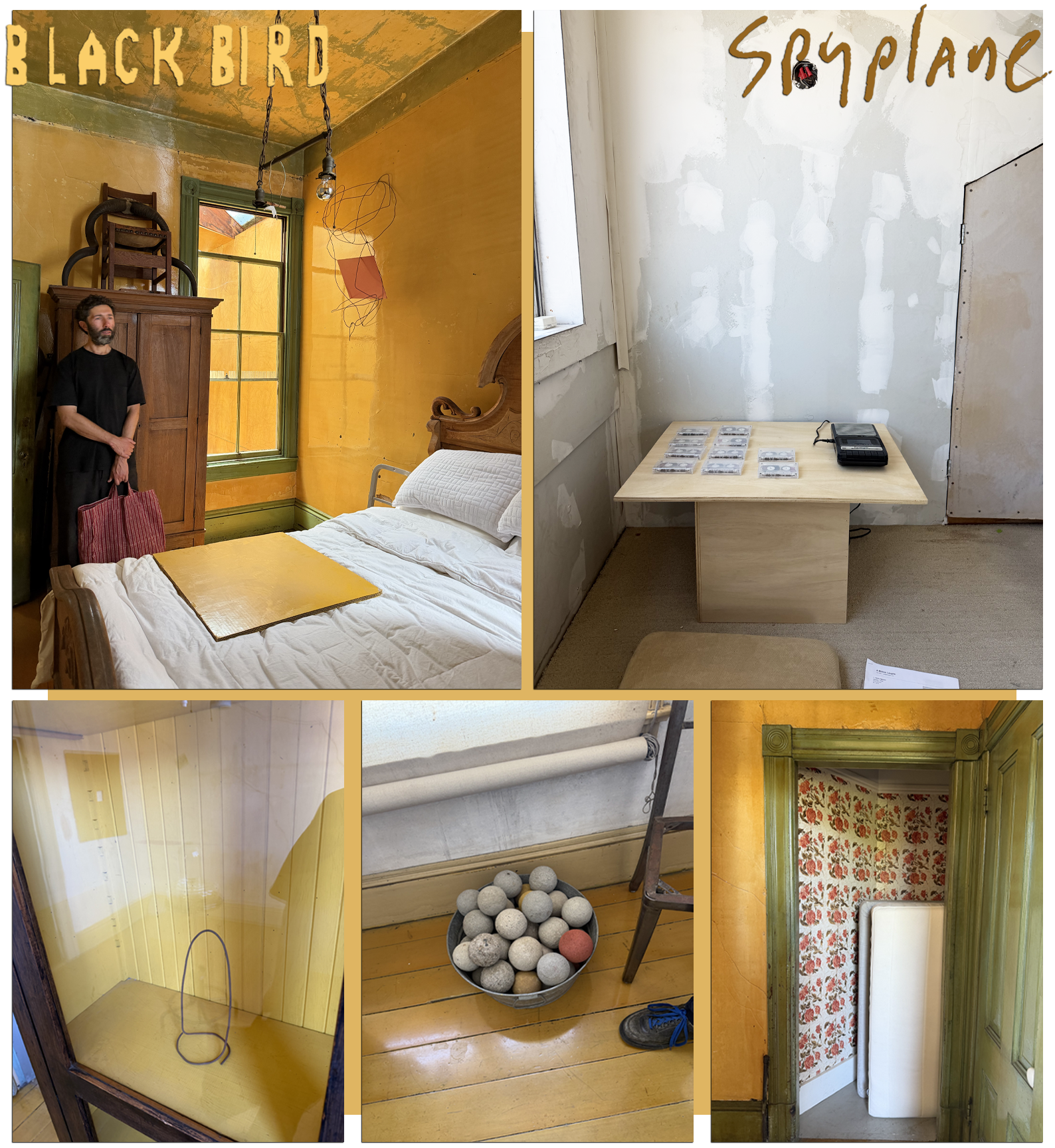
A few weeks ago we popped in on the very insane, very cool, onetime home of the late San Francisco artist David Ireland. Ireland was a key figure in the Bay Area’s ‘70s-era conceptual-art scene, known to chill with such Spyplane GOATS as Bruce Conner and Terry Riley.
At this point Ireland is likely best known for the 19th century Victorian he bought in 1975 at 500 Capp Street, in the Mission. He paid $50,000 for it, purchasing the house from an accordion maker whose logo still adorns a parlor-floor window.
He proceeded to turn the place into a sick and singular hybrid of Home & Sculpture, spending the following several decades working over every square centimeter of the house…
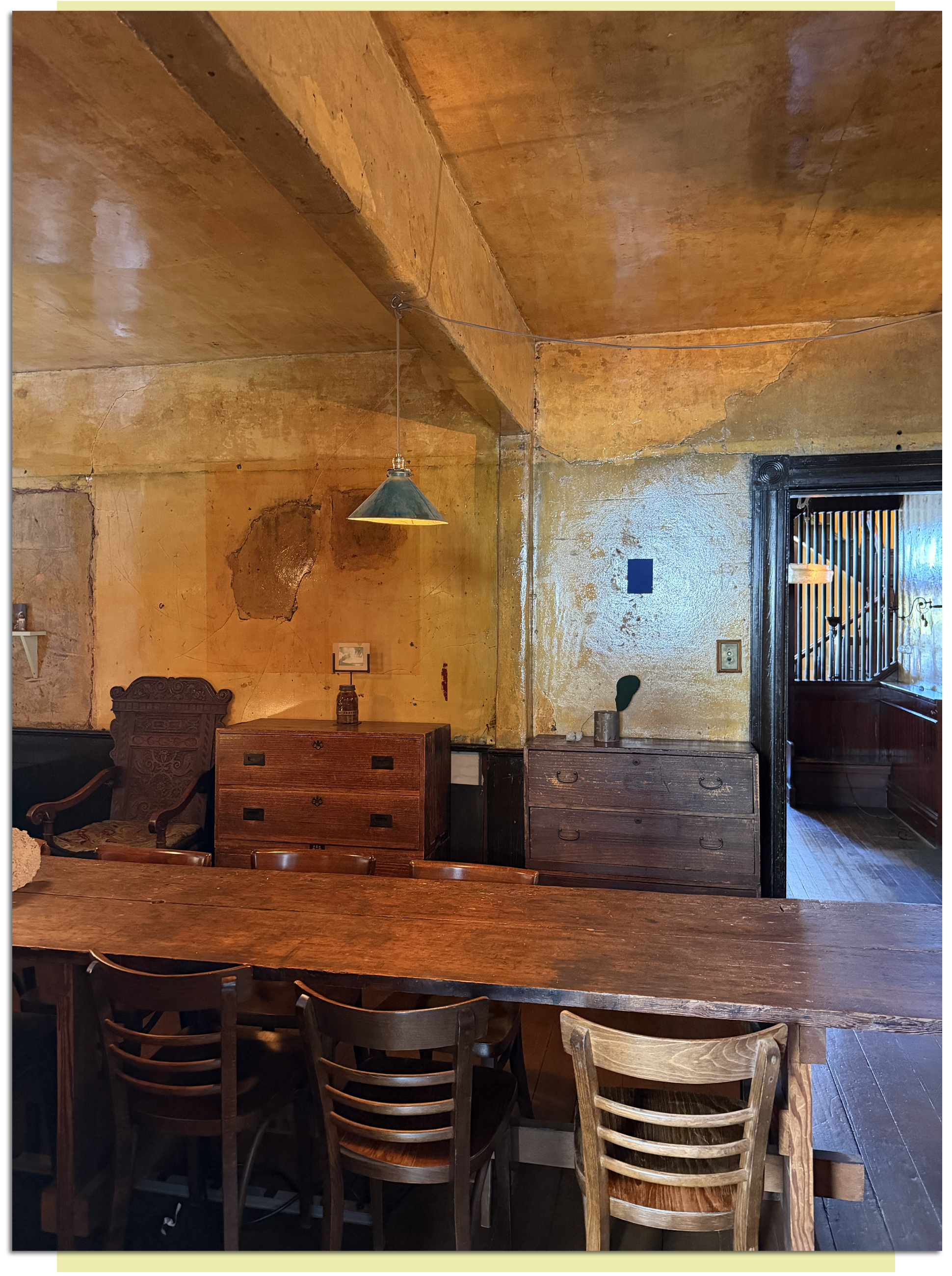
We got a tour of 500 Capp from Spyfriend David Wilson, a great Oakland artist who did a residency in the house a few years back and is now on its board.
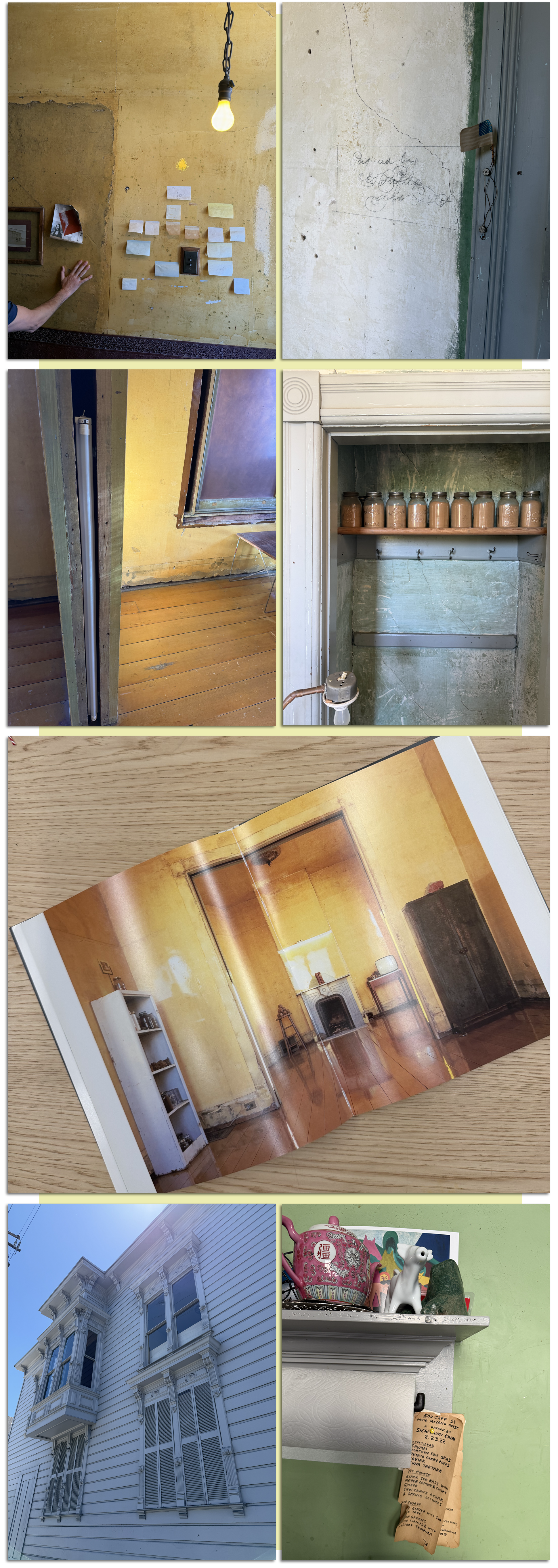
The first thing we noticed was the intense, pleasant, golden glow emanating from all directions in the late-morning light. David explained that Ireland had worked assiduously to strip untold strata of paint and wallpaper from the walls, then coated most of them with layer upon layer of glossy polyurethane. The bare, f--ked-up walls could feel punishingly austere and crumbly on their own, but instead, they’ve been suspended in a state of permanent warmth, made to shimmer, encased like a picture under glass…
“I reached a philosophical point where I realized that the lively presence I was looking for in my art was here on the walls, as I stripped away and cleaned off the surfaces,” Ireland once said. “Why do we have to fabricate a stretcher, a canvas— why not just make art out of an environment? I couldn’t go back to normal work.”
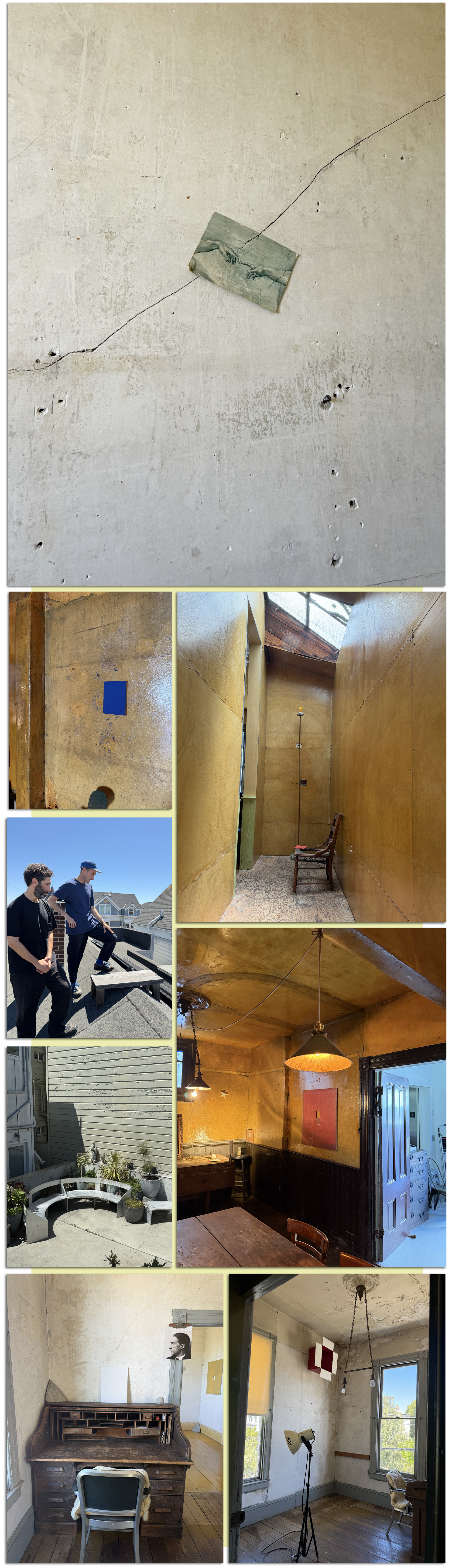
That motif of stripping-away persists throughout the house, in a way that goes well beyond minimalist and edges, compellingly, into obsessive-compulsively destructive … although in a way that feels leavened by a sense of slyness and humor, i.e. the little Sistine Chapel postcard that Ireland (or a buddy) strategically placed on a wall in his office, turning a real crack into a trompe l’oeil painterly gesture and then back into a real crack again…
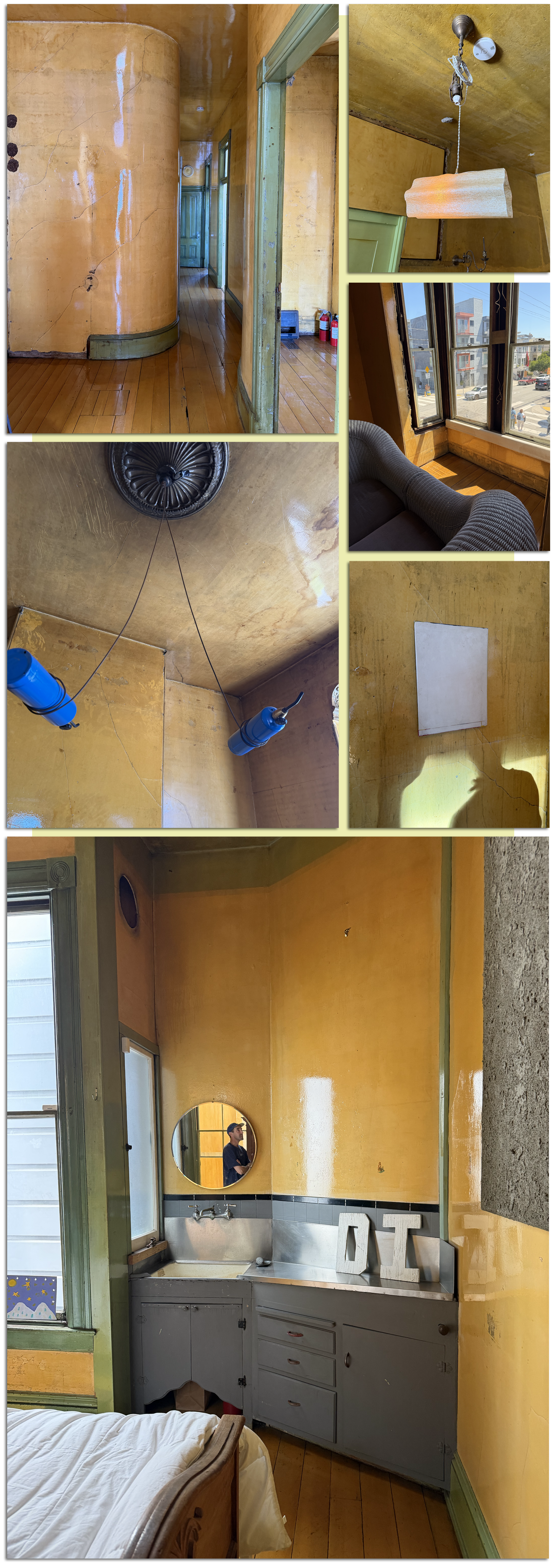
Ireland’s own art shares space on the floors, walls and ceilings with that of his friends, and with that of more contemporary artists as part of an ongoing curatorial program overseen by the house’s current stewards.
A “chandelier” fashioned from two propane torches hangs in one room… 9 identical jars full of sawdust line a closet shelf, collected while Ireland sanded the floor … The trim has been removed from several doorways, leaving its ghostly imprint… Scrawled pencil marks on the plaster harmonize with spidery cracks and Ireland’s twisted-metal sculptures… A pair of non-Flavin fluorescent bulbs stand sentinel on either side of a pocket door… Post-it Note reminders stuck up by the home’s entrance have long since transformed from utilitarian to decorative…
Throughout, it becomes impossible to identify what’s an intentional intervention, and what’s a “natural” sign of wear & tear.
The overall effect feels crazy, but invitingly so, airy, bright, and clever, rather than oppressive — the space doesn’t feel hostile to human life and comfort, even if “livability” clearly meant something different to Ireland than it likely does to you or me. (He apparently spent years obsessively digging a cave in the basement, creating a massive structural weakness that has since been fixed, at enormous expense.)
It’s especially wild to think about Ireland’s house in relation to San Francisco’s gnarly contemporary housing market: For a bunch of reasons, it’s hard to imagine anyone deconstructing a piece of “prime real estate” as giddily and as thoroughly as this today. (Except, I guess, someone like Kanye West, who as far as I know never cited David Ireland when he set about painstakingly dismantling a multimillion-dollar concrete Tadao Ando mansion in Malibu, but he kinda could have?)
“Creation” and “destruction” are closer than we sometimes realize. You don’t need to go as far as Ireland to feel emboldened by his work at 500 Capp and embrace aspects of it when it comes to your own home. We talk all the time in the newsletter about the virtue of not just getting nice clothes but then wearing the hell out of them, confident in the knowledge that the more you wear a garment, the better it looks and the less off-the-rack and fugazi you look.
Why not apply a version of this mindset to the place you live?
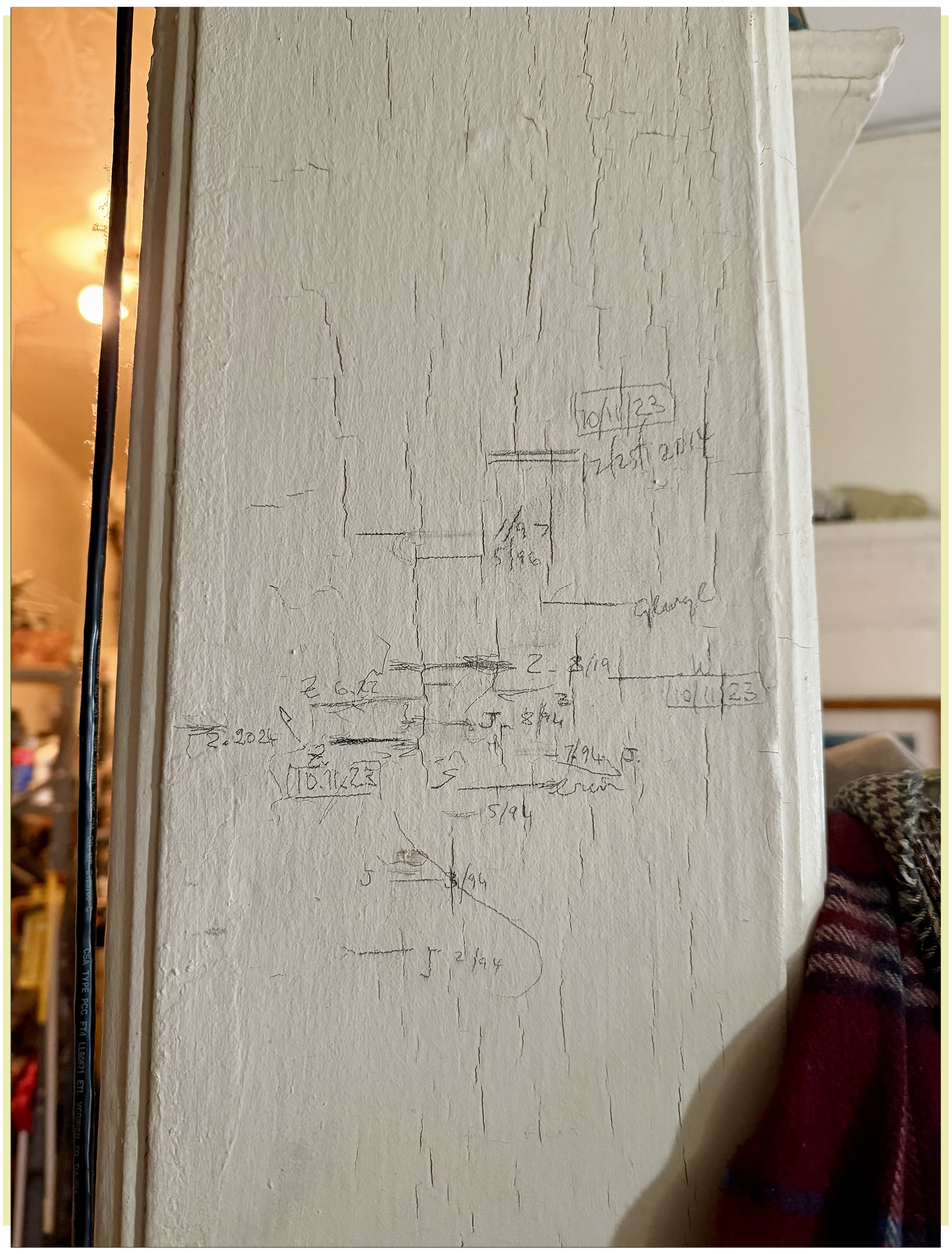
This doesn’t just apply to homeowners: My parents are lifelong renters, and they’ve been extreme “patina” creators & honorers in every single spot they’ve ever lived. Above is a doorway in their home in New York, where they’ve been measuring and marking my height in pencil, along with their heights and those of other friends and family, since they moved in back in the ‘90s. The initials, names, numbers and other assorted scrawls have long since coalesced into a beautiful piece of “organic” décor… a “durational”-style site-specific installation… both of and about the passage of time??
Look around your place, at those sections of mismatched touch-up paint and plaster on the walls, those chips in your doorways, those cracks in your ceilings, those gouges in your floors… Instead of seeing these as flaws to be irked by, and to eliminate, why not look for the beauty in them and seek out ways to actively honor it, and thereby make your home that much more yours?
The David Ireland House, at 500 Capp Street, is open to visitors every Friday and Saturday, for both guided and self-guided tours. It’s in our Ultimate Bay Area Guide, alongside a bunch of other local treasures.
Is Ambient Music Evil? A profound new Spyplane Essay.
Miuccia Prada is worth $4.8B. How good of a person do you expect her to be? Read our Spyplane Deep Dive.
Our Essay Archive, a curated selection of our Most Major Thoughts, is here.
Our interviews with Cameron Winter of Geese, Ryota Iwai from Auralee, SC103, Nathan Fielder, Michelle Williams, Sarah Squirm, Evan Kinori, Adam Sandler, Brendan from Turnstile, MJ Lenderman, André 3000, Matty Matheson, Laraaji, Tyler, The Creator, John C. Reilly, Father John Misty, Steven Yeun, Clairo, Pusha T, Conner O’Malley, Christophe Lemaire & more are here.
I love Leslie W and her books, so special. Have been hoping for a proper Spyplane interview w her. Lovely person, great to talk to. When it comes to artists homes, no one has done it better.
For more of that Capp St feeling, I highly recommend Artists at Work by David Seidner, large format photographs of artists in their studios. Jasper Johns, Louise Bourgeois, Richard Serra, John Cage, Joan Mitchell. Some really great spaces.
Also rec Calder at Home by Pedro Guerrero, absoluuuute slapper, showing his homes and studios in France and Connecticut.
Accidentally walked into this house some time in the summer of 2023 and I often think about the broken window upstairs and the tapes full of word associations of things he saw on the street