

Why are we addicted to standing in line for treats?
The rise of the QTBAT
Our new guide to “How to Wear Color Well: Vehicular Swag Edition” is here.
Miuccia Prada is worth $4.8B. How good of a person do you expect her to be? Read our Spyplane Deep Dive.
Mach 3+ city tips for traveling the entire planet are here.
Our interviews with Cameron Winter of Geese, Ryota Iwai from Auralee, SC103, Nathan Fielder, Michelle Williams, Sarah Squirm, Evan Kinori, Adam Sandler, Brendan from Turnstile, MJ Lenderman, André 3000, Matty Matheson, Laraaji, Tyler, The Creator, John C. Reilly, Father John Misty, Steven Yeun, Clairo, Pusha T, Conner O’Malley, Christophe Lemaire & more are here.
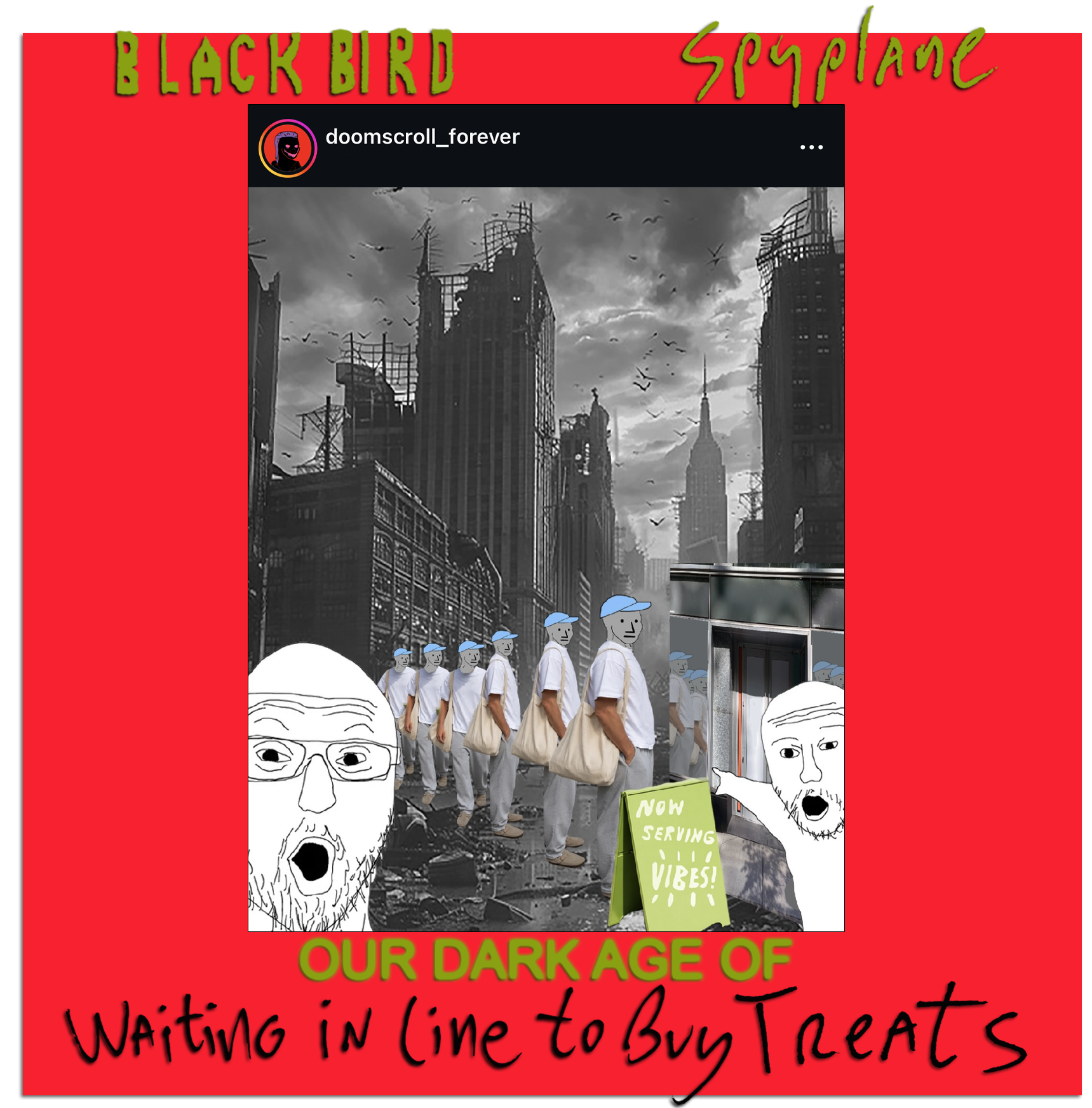
I (Jonah) did something stupid two weekends ago: Stood in line for an hour and a half to buy 4 pastries.
I used to do this kind of thing much more often in my twenties and early thirties. I loved riding bikes with friends out to Di Fara Pizza in Midwood, back when Domenico Di Fara was still alive, in his eighties and making every pie himself, cutting basil leaves and sloshing olive oil over each one from a spouted metal can, extremely slowly, like a gardener tending flower beds. On weekends, the wait for a slice could last an hour easy. This was both ridiculous and part of the appeal.
The early 2000s into the early 2010s were, in hindsight, the Dawn of Waiting in Long Lines to Buy S--t Nobody Used to Wait in Long Lines For. I never joined the legendarily long lines at Magnolia Bakery (don’t like cupcakes, didn’t watch Sex and the City) and I never camped out during the Cronut craze either (the concept didn’t appeal, the goofy name was prophylactic). I did wait in line for Pinkberry when they first arrived in NYC and people went cuckoo over them, ditto Mission Chinese Food, when they first opened on Orchard Street. On multiple visits to Portland, I waited in line to eat at PokPok.
I did not wait to sit and make eye contact with Marina Abramović at MoMA, but I did queue up several times to see Christian Marclay’s “The Clock” during its first U.S. run at Paula Cooper Gallery. Less flattering to my self-image, I once waited in line to get into the Union Square Trader Joe’s: Insanely, when that location first opened, in 2006, people were so stoked on the novelty of cut-rate peanut-butter pretzel nuggets they formed long, headline-making lines to enter the building.
Hordes queuing to get into a “buzzed-about” discount supermarket felt like an inflection point at the time, like society was crossing an obscene new Rubicon — or, I guess, waiting in line for the opportunity to cross it.
Today, the Queue to Buy a Treat (QTBAT) has become a pervasive and entrenched feature of civic life.
As uses of our precious time on earth go, the QTBAT remains patently dumb enough that it hasn’t yet grown entirely unremarkable. The other day I saw a new IG carousel of doomscroll_forever memes making fun of people who line up outside okonomiyaki spots drinking iced matcha lattes they waited in line to buy somewhere else.
But the QTBAT is absolutely commonplace. Want a bagel from Courage, or a slice from L’Industrie, or a smashburger at Dumbo, or a pour-over at La Cabra? Literally, get in line. Notorious non-food-related QTBATs include the lines to buy new iPhones, the lines for Supreme drops, the lines for bars of soap at Buly, and the lines for The Row sample sales. In recent years, more and more clothing shops have started limiting in-store capacity, even when there are no sales nor special drops on offer. This forces would-be shoppers to create a line down the sidewalk like it’s the Louvre and not the Stüssy store. When certain dark stars align — say in the case of a limited-edition Audemars Piguet x Swatch collab — the QTBAT can become a riot.
The queue becomes part of the broader experience of the treat for those waiting in it. For those walking past, the queue serves as a lure, or a red flag, depending on one’s disposition. As I write this, I’m visiting New York, where half of SoHo is people standing in lines. Yesterday morning I saw people lined up outside a Korean skin-care brand pop-up in Chinatown, a few blocks from people lined up outside a Nolita shop that seems to sell streetwear-inflected NYC-themed merch. Today I saw a line outside a lingerie pop-up on Mott, and I saw two separate lines outside Kith on Lafayette: one for gen pop, and one for an apparently elite tier of Kith shoppers called “Voyage members.”
The last time I was in town, I happened to be in midtown around 10 a.m. and saw a doorman at the Louis Vuitton store directing visitors to line up down 57th Street. This seemed to reflect an untenable degree of contempt toward the “luxury” customer, but then again, a company like LVMH is nothing if not fundamentally contemptuous of its customers.

Let me quickly sharpen the edges of the QTBAT concept. There have probably been lines as long as there have been people, and it’s worth emphasizing that not all queues to buy things are QTBATs — not in the way I’m using the term.
A line of shoppers waiting to check out at the grocery is not a QTBAT. Nor, of course, is a line of drivers waiting to renew their licenses at the DMV. Nor is a line of sedans waiting to pull into the car wash. Etc. Those are just normal lines.
Importantly, a line outside a small neighborhood bakery that people enjoy and which has been around for years consistently baking delicious croissants isn’t necessarily a QTBAT, either.
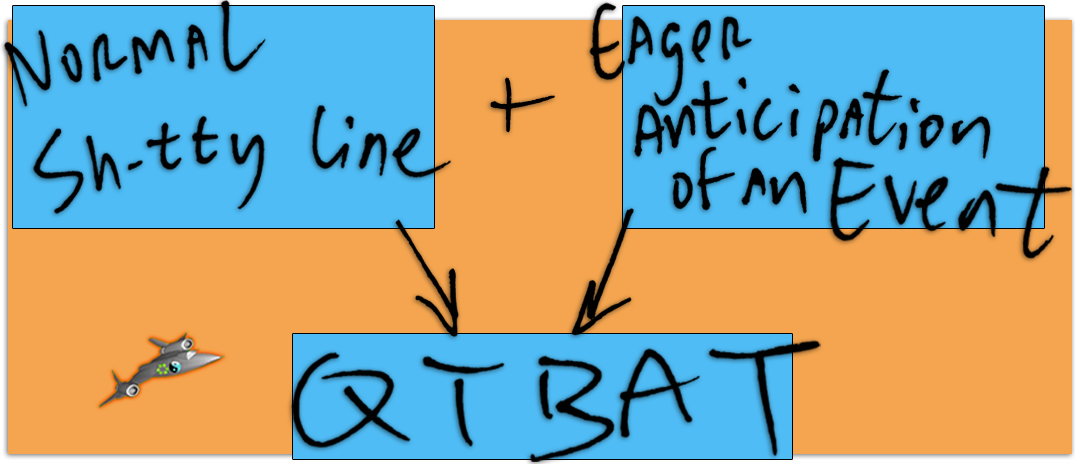
What distinguishes the QTBAT is that it takes that kind of normal, annoying line and introduces a crucial element of hype to the equation. It infuses a regular line with the sort of eager anticipatory energy that was once restricted to actual events — lines of giddy fans camping out to buy tickets to Radiohead concerts or Star Wars sequels; lines of hot clubbers dressed up and waiting to get into a cool party; lines of artgoers waiting to get into an Andreas Gursky retrospective at MoMA; lines of tourists waiting to get into the Vatican or Katz’s Deli.
The cursed innovation of the QTBAT, then, is that it takes a bagel and frames it as an Event. In the QTBAT logic, every place is Katz’s and everyone is a tourist. Even — especially! — in the city they call home.
Who is to blame for all these stupid lines?
It’s tempting to say that Millennials invented the QTBAT. But it’s more precise to say that QTBATs were invented by market forces during the rise of Millennial purchasing power, in tandem with a historic flood of economy-reshaping zero-interest-rate-policy funny money.
Zoomers, who have never known any other way, inherited QTBATs from Millennials and, using social media, spread them everywhere like dandelion fluff. Any business that sells treats and looks cute is one hit TikTok away from QTBAT Valhalla.
By contrast, stereotypical Gen-Xers never wanted much to do with lines, insofar as lines bespoke popularity, inauthenticity, and an overall unpalatable normie cheuginess back when it was still called “being square.”
Since Erin and I are mongrel Gen-X Millennials (formatively ~12 years old when In Utero came out, formatively ~27 when Obama bailed out the banks) we find ourselves split between worlds, alternately seduced and repulsed by QTBATs. The older we get, the more repulsive they seem. And yet here we were the other day, spending a gorgeous springtime Saturday morning standing in a QTBAT for the first time in ages.
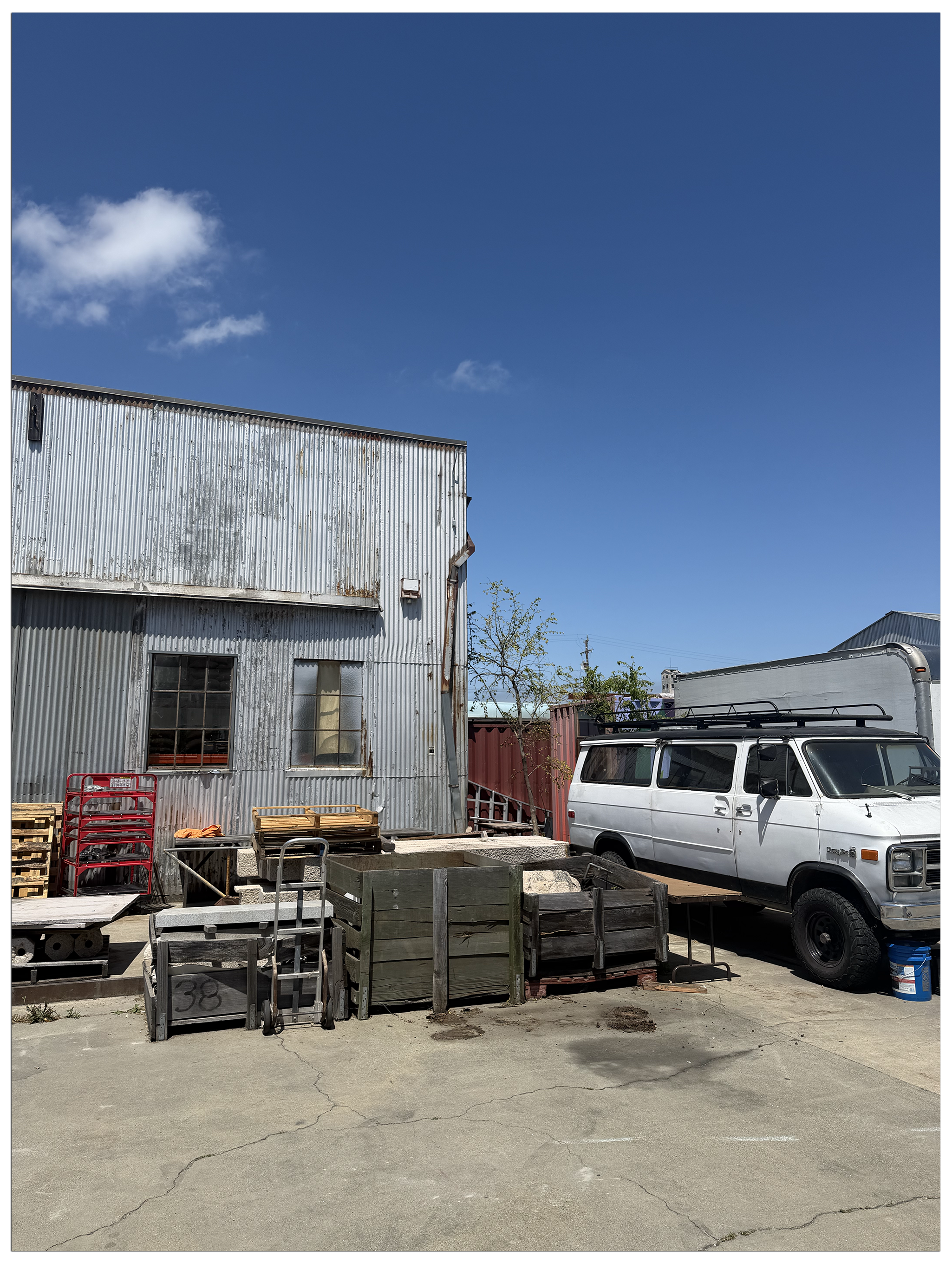
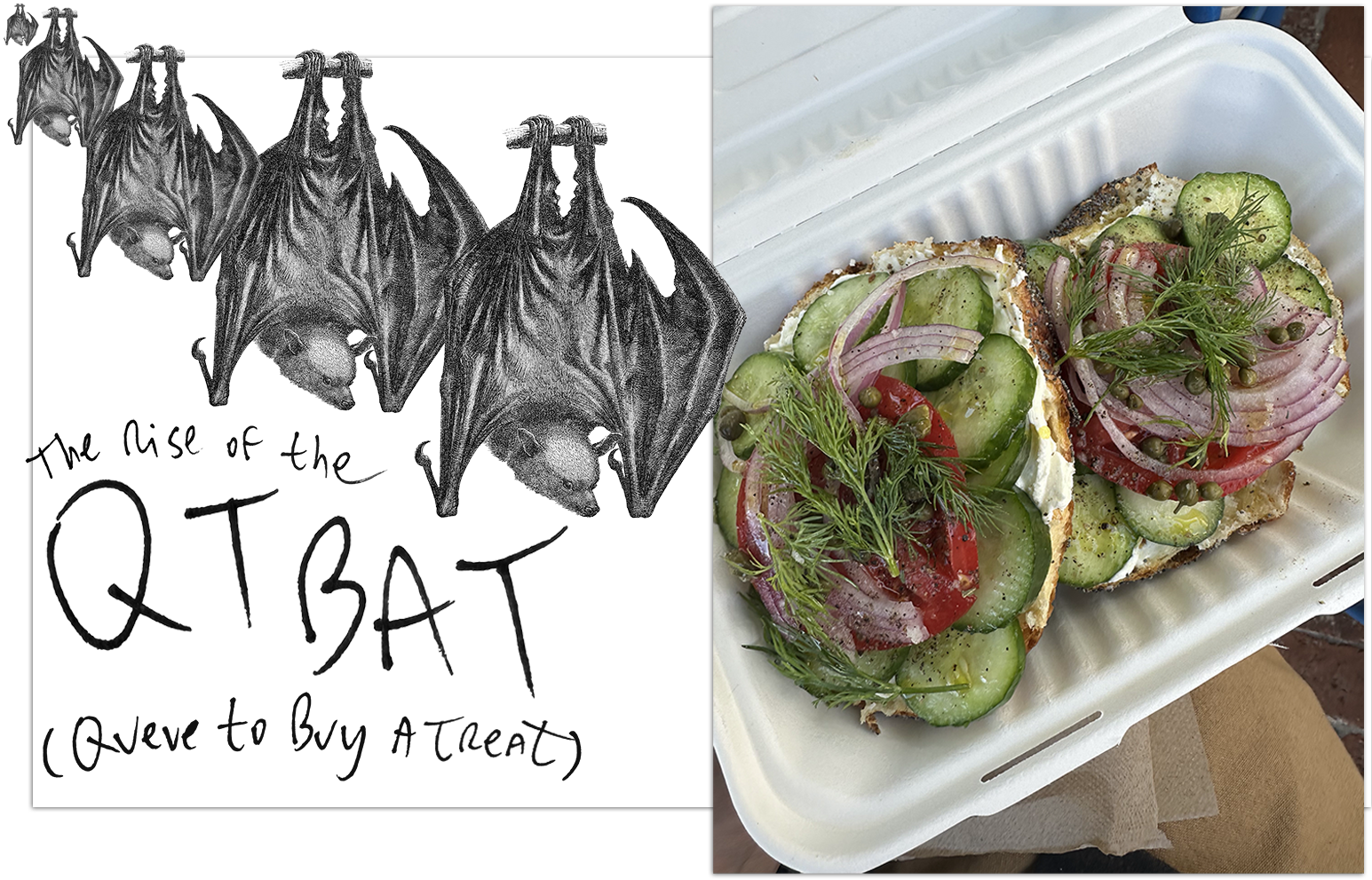
I’ll avoid the particulars except to say that, after a hike up in the hills that made what followed feel like way less of a waste, we decided to check out a hyped Oakland bakery currently in “soft launch” mode. The locale, as seen above, was picturesque in a grungey way. There was shade. And the pastries were — thank heavens — so smacking that we quickly updated the Food section of our Ultimate Bay Area Guide in order to salute it.
It was a perfectly charming place to stand around for 90 minutes, exactly once, and never again. And as I waited to enjoy baked goods with zero urgent demands on my time, I was able to ponder the weird ascension of the Queue to Buy a Treat into a pillar of contemporary urban existence.
While in this mode of pleasant contemplation, four main reasons for the QTBAT occurred to me:
1. The QTBAT is egalitarian. You don’t need a ton of money or elite connections to score a Japanese-style Basque cheesecake “everyone is talking about.” You just need to wait your turn. There are people who pay other people to wait for them, and there are entire resale economies centered on coveted non-perishable treats. But while that is bleak, it doesn’t undo the intrinsically egalitarian nature of the line. (At least until the airportification of all life is complete and they figure out how to put “platinum-tier” expedited lines everywhere.)
2. We aspire to spend our time meaningfully. And the QTBAT confers an aura of meaningfulness onto the experience of, e.g., buying a delicious frozen yogurt. What was once mind-numbing garbage time becomes an activity. You stood in line for that frozen yogurt for 32 minutes, coursing with frustration, impatience, excitement and purpose, the purpose being: To eat the treat so many other people clearly hold in such high esteem that I must wait in line behind them in order to eat it. That this aura of meaningfulness is so often a mass hallucination — self-evidently perverse, circular and illusory — is clearly not a deal-breaker.
3. The QTBAT is not virtual. It emerged in the early 2000s, coincident with the rise of the broadband internet and the profound changes it wrought on life. During the same stretch of time when “Third Places” and other ways to enjoy physical space in the company of others came under mounting threat, the QTBAT came into being and thrived. Even when we can join a hyped new ramen spot’s check-in list remotely, on Yelp, plenty of us neglect to do that and just show up and wait instead.
In a QTBAT we can see the beautiful human impulse to be out in public around other people. But we can also see the torched market prerogative that seeks to funnel all human interaction into vectors defined above all else by opportunities for commerce and extraction. Sitting in a park with friends doesn’t put money in anyone’s pocket. The QTBAT is business-friendly hanging — loitering with intent to purchase.
Dizzyingly, the distinction between virtual and IRL can blur in the QTBAT. How many people in line to buy a bagel from Apollo choose to pass the time on their phones, where various entities pop up on screen and try their best to get them to buy other things while they wait? And how many line-waiters feel compelled to open up Twitter or IG or TikTok and 🥴 whip up a little content about how they are waiting in line at Apollo 😵💫? (No shots at Apollo — truly excellent bagels.)
This blur notwithstanding, I think the QTBAT is at root a reaction against the rampant virtualization of life. And this leads into the final and most powerful reason, as I see it, for the power of the Queue to Buy a Treat:
4. The QTBAT speaks, however poorly, to our ancient desire for community, for gatherings, for pilgrimages, for fellowship. When I mentioned this to a friend the other day, his thoughts immediately turned to the decline of religious life under the secular neoliberal order. “People used to wait in line at church to take the Eucharist,” he noted: The weekend came, people gathered in a house of worship to pray, to sing, to ponder the eternal, then they got in a long line and waited for someone to serve them a baked good, which was a wafer, which was the body of Christ.
There is no singing and no praying at the new bakery downtown which sells the cute tote bags. The eternal we ponder as we wait in line there, if we ponder it at all, is a murky morass. At the end of the line, if we’re lucky, a perfectly laminated, perfectly photogenic salted-cherry kouign amann awaits us.
Who leaves which line hungrier?
Our Essay Archive, a curated selection of our Profoundest Thoughts, is here.
Check out our monumental list of the 50 Slappiest Shops across the Spyplane Universe.
Our Cool Mom Style Guide is here.
Enjoy the Definitive Spyplane Guide to the Best Japanese Clothesmakers, here.
I disdain those lines with a passion (that New York or Nowhere line you alluded to makes me laugh and smdh in equal measure every time). And yet, thinking back over the last few weeks, I’ve waited in line for La Cabra, outside the New Balance store before it opened for the Auralee collabs, at the Met briefly to go into the Raphael show (highly recommended while you’re here, if you haven’t seen it yet), and probably a bunch of others that I’m purposely forgetting. So yeah, I hate them but somehow let myself be drawn into them when they lead to something I think I need. (But I’m a Gen X-er, so at least I have Fugazi’s “Merchandise” running through my head while I wait, I guess.)
I think the four reasons you ID for QTBATs make sense, and they do give the line waiters a somewhat noble purpose, in a way, but the overlay of the virtual world on those lines does make them feel a bit fraught. I stood on a very short line for matcha a while back, at a place near CHCM that normally has lines down the block, and every single person who got their matcha ahead of me pulled their phone out to document and presumably post its latte art. I have to admit, I really enjoyed my brief conversation with the woman preparing my matcha, but when I left the place and took my first sip, I wanted to throw it away; it tasted chalky and terrible. But at least it looked nice.
For line-waiting devotees and despisers alike, I recommend Vladimir Sorokin's 1983 novel, The Queue, as a peak into Soviet version of the QTBA Unknown Item.