

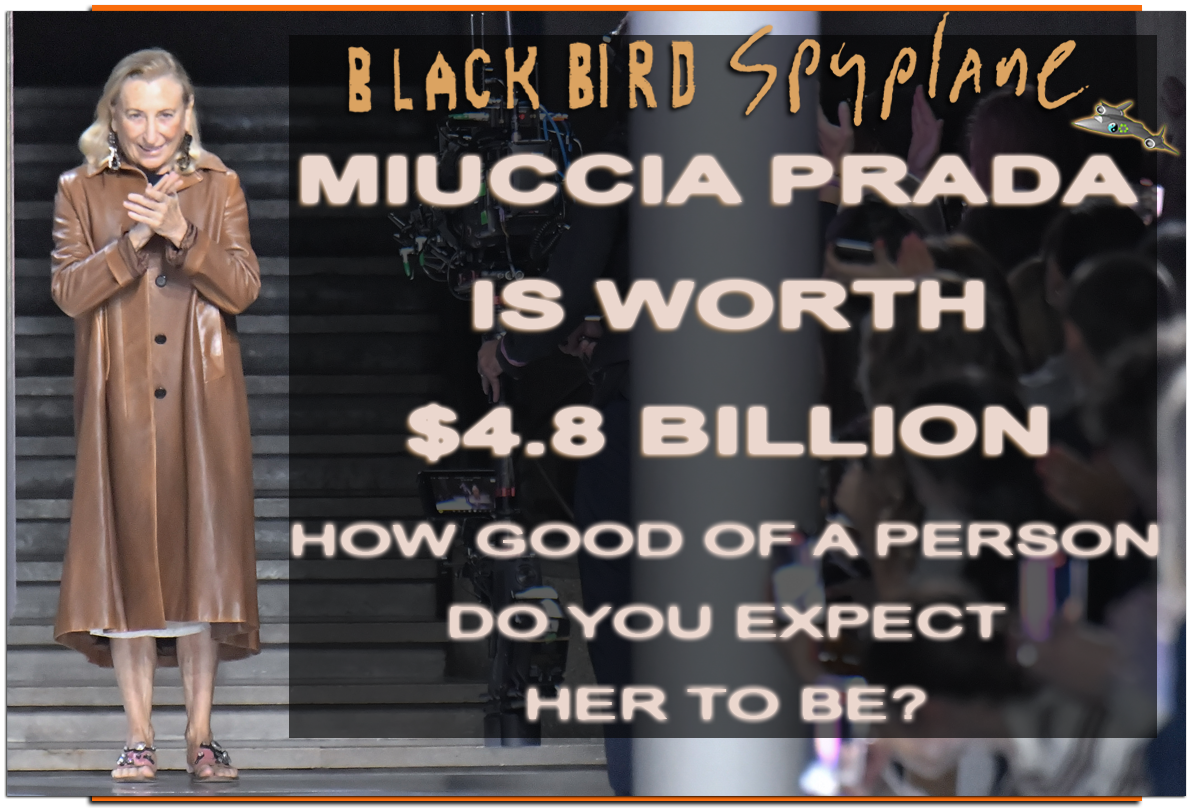
Miuccia Prada is worth $4.8B
How good of a person do you expect her to be? A Spyplane deep dive.
Our interviews with Cameron Winter of Geese, SC103, Nathan Fielder, Christophe Lemaire, Ryota Iwai from Auralee, Sarah Squirm, Adam Sandler, Matty Matheson, Evan Kinori, Brendan from Turnstile, MJ Lenderman, Laraaji, Maya Hawke, Camiel Fortgens, Bon Iver, André 3000, Eckhaus Latta, Tyler, The Creator, John C. Reilly, Father John Misty, Michelle Williams, Steven Yeun, Conner O’Malley, Clairo & more are here.
Blackbird Spyplane’s Classified Tier Subscribers make this independent reader-powered miracle possible. Upgrade your subscription if you haven’t already, and enjoy a better life in the Inner Sanctum.
— Jonah & Erin
We don’t run ads and we don’t use affiliate links except for some one-off secondhand gems we find on eBay and Etsy, plus books on the independent bookseller Bookshop. We laid out our position on affiliate links and spon here.
1. Miu Miu & Zuck
When people in fashion talk about politics as relates to clothes, there’s a tendency to limit the conversation to the realm of the symbolic, and to ignore more material questions.
You can see this play out in all kinds of ways. To illustrate it at its most cognitively dissonant, I (Jonah) can’t think of a better example than when the topic of feminism in fashion arises.
A critic might celebrate the revolutionary implications of a given designer’s clothes for the women who wear them — the way these clothes “challenge conventional notions of femininity,” say, or accommodate and amplify women’s feelings of “power.” This critic might take another designer to task for the oppressively sexualized aesthetics of their garments, the misogynist undertones of their ad campaigns, etc. Faced with the blurrier case of a designer whose work seems radical here yet reactionary there, whose marketing imagery seems so sexist that it might in fact be a refutation of sexism, etc., the critic is prone to “unpack the contradictions” at play.
This is all legitimate discourse, as it goes. The problem is that this kind of symbolic engagement with politics narrows our thinking to questions about who designs the clothes and who buys the clothes. It grants no space to the elephant-in-the-room question of who makes the clothes: a global workforce consisting overwhelmingly of very poor women.
What is the actual revolutionary potential of a male-gaze-subverting knee-length skirt sewn by women paid piece rates in L.A. and NYC? What is the true liberatory power of a dad cap embroidered with feminist and anti-racist slogans by nonwhite women working 80-hour weeks in a Bangladeshi sweatshop?
Estimates vary, but there are as many as 90 million garment workers worldwide. Some 60-80% are women. As few as 2% earn a living wage. These women don’t represent compelling contradictions — they are real people suffering real material wrongs. And there are material mechanisms available to right them: strengthened labor laws, an international minimum wage, universal healthcare, tenants rights, worker-ownership models, and so on.
I got to thinking about all this the other day while mulling the curious, oft-repeated fact that Miuccia Prada was, in her 1960s youth, a Communist.
Prada, 76, is not merely a (the most?) totemic living fashion designer. She is a tremendously talented, important, and enigmatic one, up there with Yohji and Rei in the Actively Relevant Living Legend Pantheon. Erin and I don’t care much about big design houses, but we always look at what Prada does. Her decades of collections include canonized classics and unheralded gems, and we like to put vintage Prada finds in the sletter every now and then. When I visited Milan on a magazine assignment a few years ago, I popped into a Prada store, said f--k it, and got myself a black worsted-wool overshirt as a souvenir.
To get an idea of the outsize respect Miuccia Prada commands in the fashion industry, look no further than the weirdly obsequious insider convention by which not just her paid staff but many fashion journalists refer to her as “Mrs. Prada.” For a rough equivalent, imagine if Apple employees, fanboys and tech critics all agreed to call Steve Jobs “Mr. Jobs. ”
It’s in this reverent context that I’ve heard Prada’s youthful political radicalism invoked over the years. Her ‘60s-era communist period tends to crop up as a sort of biographical decoder-ring, helping us to make sense of Prada’s semiotically dense designs. People also use her former radicalism as an implicit bona fide of her intrinsic goodness — evidence that she still “gets it,” that amid the ethical murk of the fashion world, a fundamentally pro-social outlook informs her actions.
However! Until late last month, when Mark Zuckerberg appeared front row at Prada’s FW26 show in Milan, I’d somehow never heard that Miuccia Prada also has an estimated net worth of $4.8 billion — an incontrovertible bona fide of her actual, practical badness.
Zuckerberg is worth an estimated $222 billion. He is a high-profile, uncharismatic dude whose project is self-evidently hostile to human dignity. This makes him abundantly easy to dislike, and his appearance inside the glamorous, putatively hallowed temple of a Prada show sent waves of discomfort rippling through fashion enthusiasts, including NYT Styles editor and Spyfriend Stella Bugbee, who kicked off an IG story thread about it with a screenshot of Prada’s Wikipedia page, billionaire status highlighted. This came just a few weeks after Jeff Bezos was photographed hanging out backstage with Jonathan Anderson at a Dior show, to boot.
That the ultrarich enjoy designer products is news to nobody. Doubtless many billionaires we’ve never heard of have been invited to runway shows for years.
But Zuckerberg’s and Bezos’s appearances (along with Amazon’s sponsorship of the Met Gala) seemed to represent two novel developments:
A symbolic incursion of some of the world’s most powerful, despised and swagless elites into a demimonde that — for all its associations with vanity, greed and excess — we’d still like to think of as a haven for creativity, a fertile ground for swag, and a refuge for the misfit dreamers on the right side of history.
A symbolic failure, if not outright betrayal, on the part of two particularly beloved designers, whom we’re inclined to regard as fabulously successful yet fundamentally sympathetic creative-class strivers. To put it in sports terms, we see designers as players, not owners. Their creations bring a potent mix of joy, beauty, humor, elegance, desire and fantasy to our lives — but here they were, entertaining tech overlords whose creations actively drain life of its joy, beauty, humor, and elegance!

But are these developments really that surprising? And are they really that novel?
If we only conceive of fashion’s political dimension along a symbolic axis, they may feel like it.
But the life, work, and gargantuan wealth of Miuccia Prada — a player and an owner — tell a different story.
2. The black bag
Prada was born into an haute-bourgeois Milanese family that sold luggage and other fine goods to aristocrats and royals under the name Fratelli Prada. In a 1994 New Yorker profile, Ingrid Sischy wrote that, in the early part of the 20th century, Prada suitcases — “fabricated from walrus skin” with “toilet articles made of tortoiseshell, ivory, and gold” — were “so heavy that you needed servants to carry them.” They were ruling-class accoutrements, consecrated with the official patronage of Italy’s royal family.
In Miuccia Prada’s twenties, she was a card-carrying Communist. She also earned a doctorate in political science and, along the way, studied mime. This last detail is often treated as odd trivia, but mime, like fashion design, sits at the nexus of physicality, performance, truth, and illusion, so why not?
Prada initially resisted joining the brand her grandfather founded. This wasn’t because she didn’t care about fashion — she was known to wear YSL dresses to Party meetings. But she had to quiet the voice in her head that told her caring about fashion was frivolous.
Prada is perceptive about the fraught psychology of clothes-rocking. “When you get dressed, you are making public your idea about yourself, and I think that embarrasses people,” she’s said. When she overcame her own misgivings, though, Prada didn’t just join the family business. She took it over, and in the 1980s, with her husband and business partner Patrizio Bertelli, she set about building it into the global behemoth we know today.
The single most powerful engine of that transformation was a simple bag. It was made not from walrus skin, nor crocodile, or any other exotic luxury material Fratelli Prada might have used circa 1913. Instead, it was cut from a silky, durable and, relative to fine leathers, crucially inexpensive nylon originally developed for military parachutes.
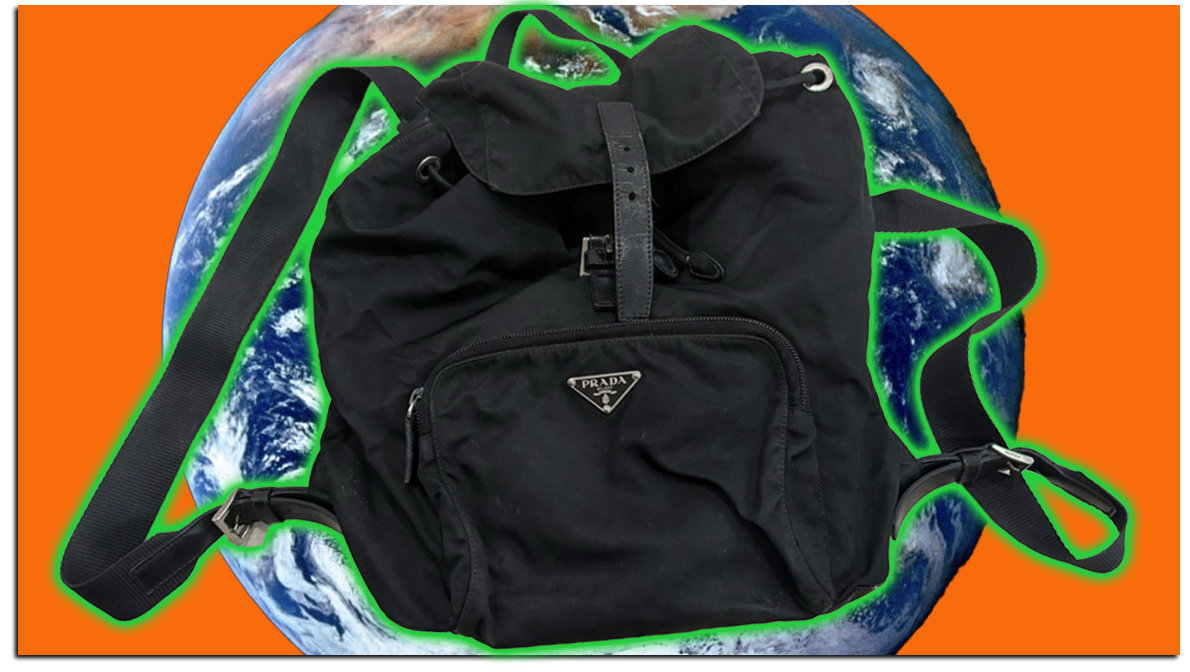
The bags were initially logo-free but, after those didn’t sell, Prada branded them with what would become her signature enamel triangle. In the ‘90s, Prada sent them as gifts to influential editors to build buzz, they became an epochal hit, and they remain popular to this day.
There’s a case to be made that any big fashion house is a handbag company masquerading as a clothing company: What are the outfits on runways, when we get down to brass tacks, but elaborate ads for the margin-rich accessories (and beauty products) that make the real money? Prada is no different. But the brand has sold so many kilotons of nylon junk — not just bags, jackets, hats, shorts and skirts but also wallets, phone cases, key chains, scrunchies, belts, bandanas, neckties, laptop sleeves, hair clips, headbands, lunchboxes and beyond — that it’s tempting to call Prada a petrochemical firm masquerading as a fashion company.
In accounts of Miuccia Prada’s rise, her nylon bags are commonly described as elegant but versatile, elevated yet unprecious — and, for these reasons, as revolutionary. Writing about Prada for the Times in 1999, Ginia Bellafante was sharper in her assessment of this supposed revolution. Some observers believed the black nylon bag “stood in stark opposition to status,” Bellafante wrote. But in reality, this product “was simply tapping into what status would ultimately become: work, so much cooler in the Palm Pilot, high-tech, I.P.O. ‘90s than in the Charlie Sheen ‘Wall Street’ era before.” Prada, she concluded, “speaks to the chic dream of putting in 100-hour weeks at a new-media start-up.”
Delete “new media” and swap in a 17 Pro for the Palm Pilot and damn it if that doesn’t sound like it could have been written yesterday. It’s a fantastic read of what the black nylon Prada bag meant symbolically: a proto-grindset-girlboss must-have.
But what did the bag mean materially? In Dana Thomas’s excellent 2007 book, Deluxe: How Luxury Lost Its Luster, she demonstrates how Prada’s nylon accessories embodied “the radical change that luxury was undergoing at the time” — namely, “from small family businesses of beautifully handcrafted goods to global corporations selling to the middle market.”
No one figured out how to bring neoliberal-age industrial capacity to bear on the newly “democratizing” luxury market, in other words, more cannily than Miuccia Prada.
3. Terror-stricken
She couldn’t have done it without Patrizio Bertelli, her businessman husband and partner. When Prada met him in the late 1970s, Bertelli was a factory owner producing leather goods in Tuscany. Together, they hatched a plan for world domination. First they introduced a womenswear line, then menswear, then the (initially) lower-priced diffusion lines Prada Sport and Miu Miu. The company piled up monster debt building starchitect-designed flagships in cities like New York and Tokyo, and buying stakes in rival labels like Gucci, Fendi, Alaia, Jil Sander and Helmut Lang.
These bets paid off lavishly, all in all. And in 2011, after several abortive earlier IPO attempts, Prada went public on the Hong Kong Stock Exchange. It was then that Miuccia Prada crossed the billionaire mark, many times over. And this is also a good place to mention that, in 2016, Italian authorities closed a yearslong tax investigation into her and Bertelli, after the couple “repatriated assets it held in Luxembourg and the Netherlands,” per Reuters, and paid “more than 400 million euros” — $530 million USD at the time — “to settle their tax positions.” They had the half-billion to spare.
Who is Patrizio Bertelli? A 1999 profile in Fortune reported that when he was “still a teenager he started his own business making and selling bags and belts,” and “by 20 he had three people working for him.” The magazine also noted that, “according to former employees,” Bertelli was “a nightmare of a boss: a micromanager with a temper” known for “shouting at anyone who doesn’t follow his instructions or at, well, anyone who is around at the wrong time.” A Prada recruiter described the company atmosphere in that piece as “very unprofessional” and “terror-stricken.”
Tales of Bertelli’s public screaming matches with Prada are legion. She herself has described their relationship, with affection, as combustible. The fruits of their partnership are inarguable, but its terms are nuanced: Bertelli’s business-brain purview can extend into Prada’s turf, affecting minute design details, like a Hollywood exec giving an auteur notes. In 2014, one Prada footwear designer told The Cut that Bertelli “has an instinct for what will sell,” explaining that “often he’ll change a heel height to make it more practical — like from 120 millimeters to 110.”
4. Being left-wing was fashionable
In interviews, Miuccia Prada frequently gestures to her “politics,” which she’s characterized as broadly left of center, but she does so with a studied vagueness.
“Because of my politics — being a designer but having thoughts that are not allowed if you are a rich person — it means that I am always struggling with myself,” she told the Independent in 2004.
When she opened the doors of her Palazzo in Milan to Cathy Horyn for a 1997 Vanity Fair profile, Prada described a second Palazzo she owned but pointedly kept empty, because, “I hate it! I always hate the bourgeois rich.” She explained that she’d “inherited this idea that showing money is really vulgar,” before adding, cryptically, “I also have my own political ideas.”
Horyn interpreted this as a reference to Prada’s onetime communism. Since the topic at hand was décor decisions across multiple Palazzos, that feels like a stretch. In fact, Prada has explicitly framed political radicalism as a phase she conclusively outgrew: “I was a Communist, but being left wing was fashionable,” she’s said. “I was no different from thousands of middle-class kids.”
She describes herself, point blank, as a saleswoman and pro-growth industrialist. “My job is to sell,” Prada once said. “And I like very much my job.” In conversation with Robin Givhan last month, Prada declared that, “as an industrialist, growing is the nature of the business.”
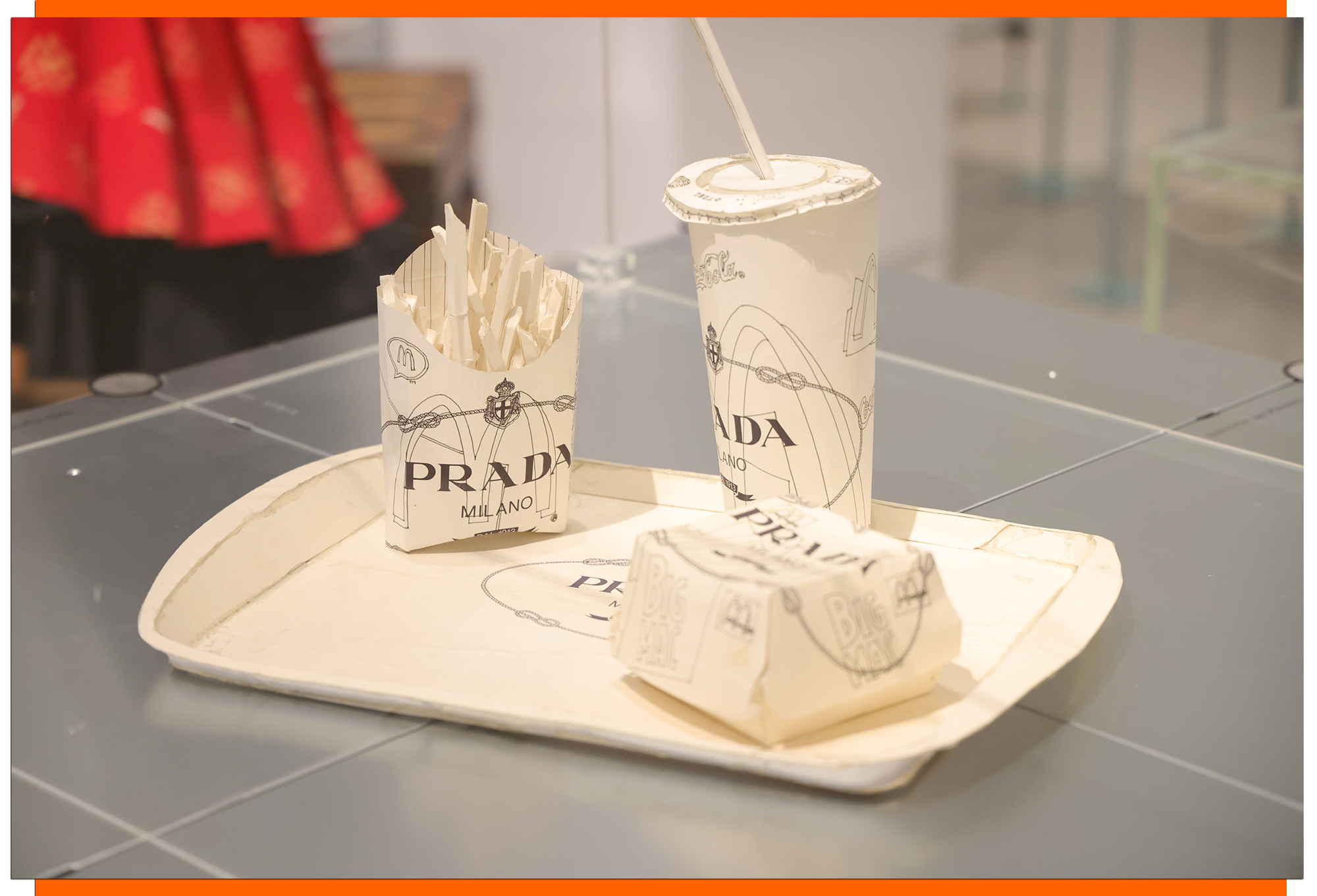
If you want concrete proof that Prada has long since abandoned the collectivist principles of her twenties, and that her politics are primarily aesthetic in nature, simply consider the fact that she went on to become a factory owner. And not one factory, but 26 of them.
Of those factories, 23 are in Italy. Prada’s products are also made using contractors in countries where labor costs less, like Vietnam, Turkey and Romania. Before arriving in stores, some of these pieces are shipped to Italy for finishing, where a “Made in Italy” label might be attached, too.
This practice is alluded to deep within Prada’s 589-page 2011 IPO prospectus. As of that report, “our products were made in our ten in-house production facilities in Italy and one in the United Kingdom, and also through a network of approximately 480 external manufacturers, approximately 390 of which were located in Italy,” the company declared. It added that “approximately 20% of our finished products were produced in our in-house production facilities (which include products where at least one important phase of the production process was performed internally)” — emphasis mine — “while the remaining 80% of our finished products were produced by our external manufacturers.”
In 2011, according to the Wall Street Journal, Chinese factories, in particular, were responsible for making 20% of Prada’s collections. Notably, Patrizio Bertelli once derided Chinese manufacturing, pointing during a 2004 Times interview to his Italian-made Prada loafers and bragging about “a quality you can’t reproduce in China.”
Despite this derision, Bertelli was publicly considering moving a portion of production to China the next year. And in Deluxe, Dana Thomas reports that “in fact, Prada had already been producing leather goods in China for at least six months when Bertelli made that statement.”
It goes without saying that “Made in Italy,” much like “Made in USA,” is no panacea. By the same token, “Made in China” is not by definition “bad.” And Prada is far from alone in producing goods in Chinese factories.
But the company’s labor record is spotty. In 2016, the Guardian reported that Prada had been “found wanting in assessment of forced labour safeguards” by an industry watchdog group, scoring a “nine out of 100” when judged on “the quality and transparency of efforts by 20 major apparel companies to safeguard against forced labour from their supply chains.”
In 2017, Forbes reported that Prada ranked in “the bottom 10%” of a different watchdog’s supply-chain transparency review, along with Dior and Armani.
And just this January, Prada announced that it had cut ties with 222 of its suppliers, after an internal audit “found evidence of serious labour law breaches,” as the FT reported, including “the presence of dormitories inside the factories where workers slept.” The company made this announcement after Milanese authorities requested information about Prada’s supply chain, investigating abuses throughout Italy’s domestic fashion industry.
Which brings us to the conclusion…
5. Factory girls
Over the years, Prada has touted new initiatives into sustainability, including a full transition to recycled nylon in 2021. It has invested in some Hermès-style artisan-forward infrastructure, like an historic leather tannery it bought in Limoges, and a training academy that teaches Prada employees traditional handwork.
But Prada’s core proposition, production-wise, remains factories. And, to be clear, even if internal audits have purged particularly heinous vendors, a communist will regard any factory in which workers do not participate democratically in the profits generated by their labor as fundamentally unjust.
What makes Prada singularly interesting on this score is that she is not only a generational design talent with an avowed interest in politics and a communist past: She is also a factory owner, with the power to practice those politics materially, in the way her products are made, and not just symbolically, in her designs — if she actually wanted to.
And she clearly does not want to.
Quite the contrary — like Ralph Lauren, Bernard Arnault and, until his death, Giorgio Armani — she is the billionaire head of a global fashion conglomerate, and that comes with its own prerogatives.
With vanishingly few possible exceptions (maybe some musicians, maybe some filmmakers) you can not amass a billion dollars without committing yourself to a system of immiseration and environmental degradation.
“Billionaires” and “the social good” exist in an inverse relationship.
Prada likes to pretend otherwise. At the Miu Miu SS26 show, last fall, she sent models down the runway in designer aprons, among other takes on workwear. The show looked sick, but she made clear that it contained a political message, too: “We in fashion always talk about glamour or rich people, but we also have to recognize that life is very difficult,” Prada said afterward. “To me the apron contains the real life of women in history, from factories to the home.” Acknowledging the obvious conceptual tensions here, she added, shruggingly, “I use the instrument I have.”
She was, of course, being disingenuous. Design is not the only instrument Prada wields when it comes to addressing the difficulty of real women’s lives. She also has literal ownership of, and exerts immense influence over, a vast supply chain in which millions of women are employed.
Take another look at Mark Zuckerberg and Miuccia Prada. What if their material, class-based affinities more than overpower their symbolic differences?
What if the designer behind decades’ worth of hit handbags knows something about engineering addictive products, stoking unhealthy compulsions, and getting rich off other people’s labor, much like the owner of Facebook and Instagram does?
Maybe it’s not that Zuckerberg is sullying hallowed ground when he steps into a Prada show. Maybe it’s that the ground has long been sullied, and that “Mrs. Prada” never deserved anyone’s deification in the first place.
This is a brilliant piece! There's no such thing as an "ethical billionaire". The externalities are always ignored whether it's underpaid and unsafe labour, limitless resource extraction or the unfettered pollution of the natural world.
One of the best you've written. Unsolicited editorial suggestion: Given the amount of research and citation that went into this piece, you could easily expand it into a full-length essay. So good! <3