

Is ambient music evil?
Darkness in the clouds
We just published an intel-rich guide to How to Dress Well When It’s Too Hot
Why are we addicted to standing in line for treats? A profound Spyplane investigation.
Sip upon The Drink of the Summer.
Mach 3+ city tips for traveling the entire planet are here.
We don’t run ads and we never use affiliate links except for one-off secondhand gems we find on eBay, and books on the independent bookseller Bookshop. We laid out our position on affiliate links and spon here.
This means the only people we owe anything are our readers.
— Jonah & Erin
Can music be evil? I never really thought about it until a few years ago, when I listened to an interview with Nick Cave during which he asserted that it cannot — “that music in itself has a moral dimension. That it’s essentially good. That it works to improve matters.”
Cave argued that this is true of music even at its most hateful, violent, inflammatory, abject, nihilistic, etc. — true, for instance, of the misanthropic music he himself made early in his career. Starting out, he explained, he’d sought the “transcendent impulse in chaos.” He’d been “a drug-addicted young guy” with a “jaundiced, contemptuous view of humanity,” and although this view was “extreme,” it was “also the way a lot of young people see the world, and in many ways, from their perspective, quite rightly so.” Jaundiced and contemptuous music, Cave said, contains the same “potential for doing good” as any other kind.
I think back to this interview whenever I encounter music that seems saturated with malevolent energy. Filosofem by the Norwegian neo-Nazi black-metal band Burzum… “Happy” by Pharrell Williams… brat by Charli xcx … I hear music like this and I wonder if, in its foul and airless vision of the human soul, it counts as evil. But I return to Cave’s absolutist stance, that there is a radical, salutary potential in the act of making and listening to music, and that even the most antisocial, insipid, cynical, narcissistic, and otherwise evil-seeming music is, for that reason, good at its root.
I do think it’s possible to affirm this essential goodness, however, while allowing for cases where music can be twisted to evil ends. And recently, I’ve been wondering whether one of my favorite genres — ambient music — is especially well-suited to evil purposes, albeit in a banal and sneaky way that has only become clear in the past few years.
Ambient music, both the style and the term, was famously pioneered by Brian Eno on Ambient 1: Music for Airports, a 1978 masterpiece he put out after some preliminary explorations on Discreet Music, Another Green World, and Before and After Science.
In interviews, Eno has acknowledged ambient’s debt to the Muzak corporation and, more nobly, to Erik Satie and John Cage, who worked decades before him to investigate the idea of background music that was, as Eno defined it, “as ignorable as it is interesting.”
He’s also acknowledged a debt to post-minimalist classical composers like Terry Riley, Steve Reich and La Monte Young, though their music tends to be more droning, rhythmic, polyphonic, and/or psychedelic than ambient, which in its textbook form aspires to a smoother, simpler, cloudier drift.
Ambient music, and music that behaves in ambientish ways — blurring the distinction between a groove, a drone, a melodic figure, and a single sustained tone — is extremely my s--t. I love Eno, I love Satie, I love Cage’s proto-ambient Satie homage “In a Landscape.” I love canonized ambient albums by Hiroshi Yoshimura, Laraaji, William Basinski, and Aphex Twin, and I love more obscure ones by Satoshi Ashikawa and Warren Sampson.
I love ambient-adjacent compositions, old and new, by Roedelius, Manuel Göttsching, Joanna Brouk, Tim Hecker, Oren Ambarchi, Nala Sinephro, and Laurel Halo. I think a big part of what I’ve always loved about ‘90s-era Wu-Tang and Mobb Deep production has to do with an element of ambientness in it, too: “Shook Ones Pt. II” revolves around a distorted tape loop as transfixing as any William Basinski ever constructed.
Marquee names, like Eno and Aphex Twin, are the exception in ambient music, a genre that privileges background over foreground. Almost by definition, most ambient artists are obscure.
This has remained true despite ambient’s explosion in popularity over the past few years, transforming from a heads-only niche into a post-pandemic streaming-era phenomenon. Ambient compositions rack up millions upon millions of monthly listens across the major platforms, on playlists themed around varieties of healthful innocuousness: “focus,” “meditation,” “relaxation,” “sleep,” “cognitive calm,” and “mood.”
If the walls between ambient (rarefied, philosophical) and New Age (woo-woo, naff, hucksterishly oriented toward “self-actualization”) were always porous — as a proliferation of hit ‘90s-era mail-order CD compilations from “Pure Moods” and Windham Hill Records demonstrated — today’s streaming playlists have all but demolished the boundaries. If your primary goal as a listener is to achieve a semi-aware state of sonic relaxation, after all, then Eno isn’t much different from Enya.
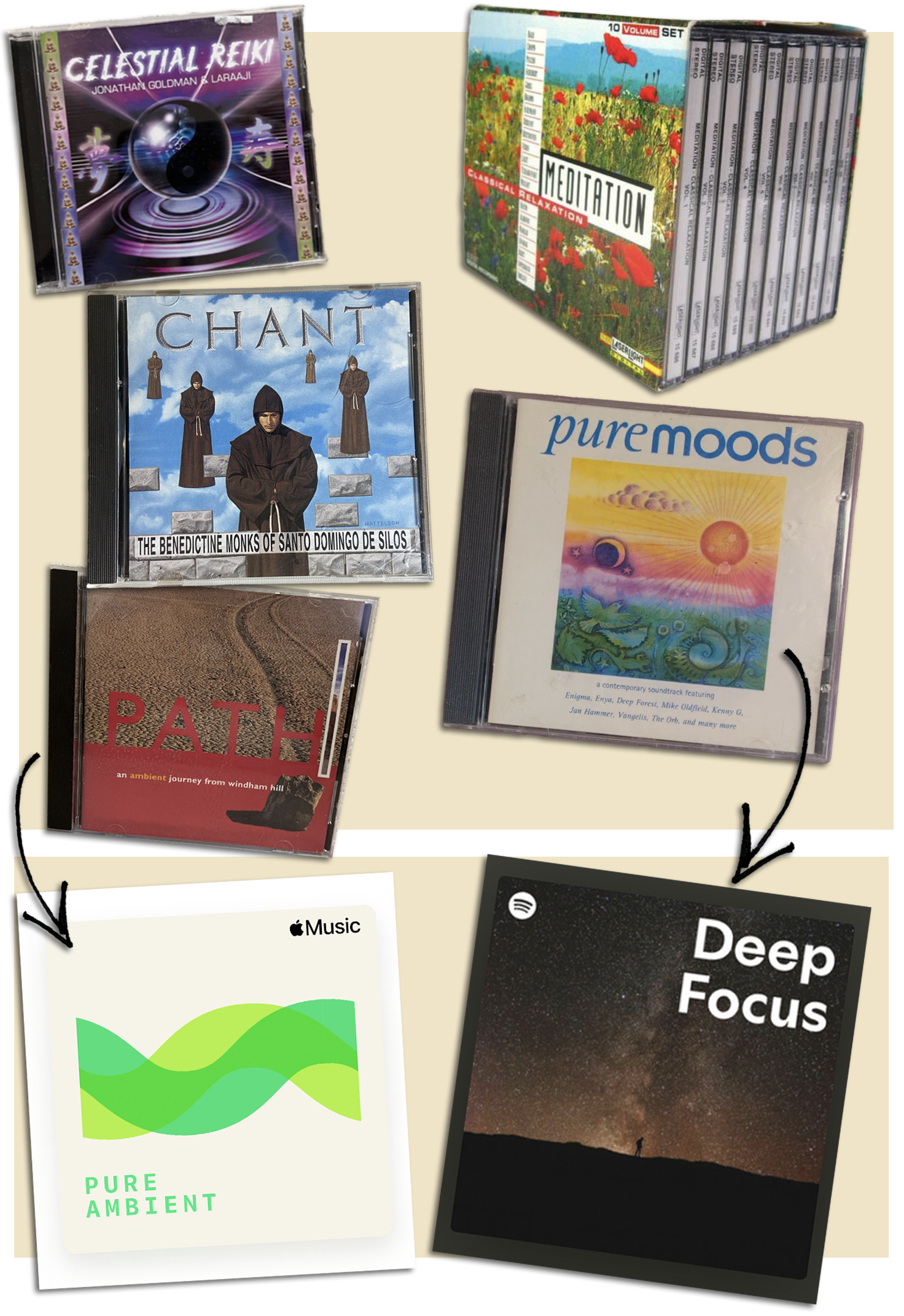
And neither musician is much different from, say, “Victor Mancuso,” one of a disconcerting number of artists with zero detectable presence outside of ambient playlists, leading some to theorize that these artists don’t actually exist, and were in fact created by streaming platforms in cahoots with stock-music companies to save money on royalties, as Andy Cush has reported at Pitchfork. Not unrelatedly, it’s hard to imagine a genre more vulnerable to AI grifters than ambient.
Which only becomes an issue for the listener, of course, if you bother to look at the artist name attached to the music shimmering through your headphones as you preoccupy yourself with other things.
This brings us to ambient’s unique amenability to evil, which I see arising out of 3 interconnected truths…
1. Streaming is an affront to God. I continue to believe that, for all its convenience, streaming threatens to wipe out a rewardingly inefficient, friction-filled, locked-in, ritualistic mode of engaging with music — a mode by which people have long opened themselves up to transformative experience. I continue to suspect that when music is compressed into the same omnipresent and infinite digital non-time as every random piece of internet garbage, we’re left feeling incomplete on a deep level.
2. No musical genre has proven better suited than ambient to the fundamental logic of streaming technology, where the wallpaper of “vibes” has proven as good for business as (if not better than) the discrete and oblong contours of “songs,” much less “albums.”
3. I’m all in favor of artists deconstructing the conventions of songcraft, but the streaming-era triumph of “vibes” over “songs” feels less about deconstructing conventions and more about creating and maintaining a potent, profitable, addled passivity in the listener.
I feel myself beholden to this passivity in my own relationship to ambient music. I routinely find myself turning to it not in the hopes of traveling somewhere new and compelling but, rather, in the hopes of “turning off my brain.”
Or even worse, “soundtracking my productivity.”
Or — worser still! — soundtracking prolonged bouts of braindead scrolling, melting down my capacity for attention that much further, in a way that feels not just inane but annihilating.
There’s an interesting parallel here with weed. People used to get zooted off mids in order to pry open a little woozy horizon of weirdness in their world — to proverbially lay back on the hoods of their cars, gaze up at the starry night sky and pontificate on some cosmic, outré and/or absurd classic stoner s--t.
But right around the time THC was legalized, its potency went weapons-grade, and the whole prying-open-an-imaginative-horizon thing was replaced by an anesthetizing mind-wipe.
More and more, I feel myself drawn to ambient for its own anesthetic, mind-wipe effects. And I find myself less willing to deal with music that challenges me, that asks something of me other than that I sit back and vibe out.
Which makes sense. Who voluntarily opts to feel discomfort when comfort is a click away? I think this helps to explain ambient’s post-pandemic ascendancy: It is music thoroughly equipped to soothe us, offer us solace, and set us in a warm bath, when the times feel as anxious, fragile and uncertain as ever.
But I’ve grown mistrustful of my own attraction (addiction?) to this swaddling aspect of ambient. Operating on a sort of autopilot, I’ll put on a beloved ambient piece — say, Hiroshi Yoshimura’s “Water Copy” — then let the algorithm take it from there, generating a playlist of music it deems similar. An hour or so later, I realize I’ve entered a sort of fugue state, and I’ve long since stopped being a remotely active participant in the creation of the music’s meaning.
I’m not alone in my distrust of this placid, foggy, eerie feeling. The music writer and Spyfriend Philip Sherburne has written about a new wave of “dark ambient” musicians working to unsettle listeners, to challenge ambient’s “stereotypically analgesic ideal.”
“Spyplane,” I can hear you saying. “Your analysis is sharp as always, and I’m so grateful the sletter exists. But is weed the best metaphor for what you’re describing? What about the natural-wine craze, where something that started off meaningful grew so hyped and lucrative it created a pretext for all kinds of opportunists and amateurs to dump their funky subpar product on the market, giving the entire scene an undeservedly bad name?”
Thank you — this is the kind of astute observation I’ve come to expect from the most trenchant readership across all media. Yes, the best ambient music, whether it’s “dark” or not, transcends the anodyne stereotypes that the lesser work common on streaming playlists reinforces.
But even so, I think the issue goes deeper, and that we are seeing something come into fuller flower that’s been in ambient’s DNA from the very start.
Consider Music for Airports, the genre’s foundational text.
The potted history of this album is that Brian Eno set out to create reassuring music for a stressful environment. That isn’t wrong, but it risks making his ambitions sound more milquetoast than they were. Here’s how Eno put it in an interview on German TV decades ago:
“When you went into an airport or an airplane, they always played this very happy music, which was sort of saying, ‘You’re not going to die, there’s not going to be an accident, don’t worry!” And I thought that was really the wrong way around, that it would be much better to have music that said, ‘Well, if you die, it doesn’t really matter.’ I wanted to create a different feeling: that you were suspended in the universe and your life or death wasn’t so important. Rather than trivialize the thing, I wanted to take it seriously.”
This is a great explanation, borne out in the music’s profound ambivalent power. In hindsight, though, Eno misidentified the true nightmare of the airport, which is not dying in a fiery plane crash but, rather, finding yourself squeezed tight between overlapping layers of price-gouging cartel commerce, punitive class stratification, ever-worsening services, omnipresent surveillance, and the near-total subjugation of the self to an unaccountable amalgam of state and private-sector control.
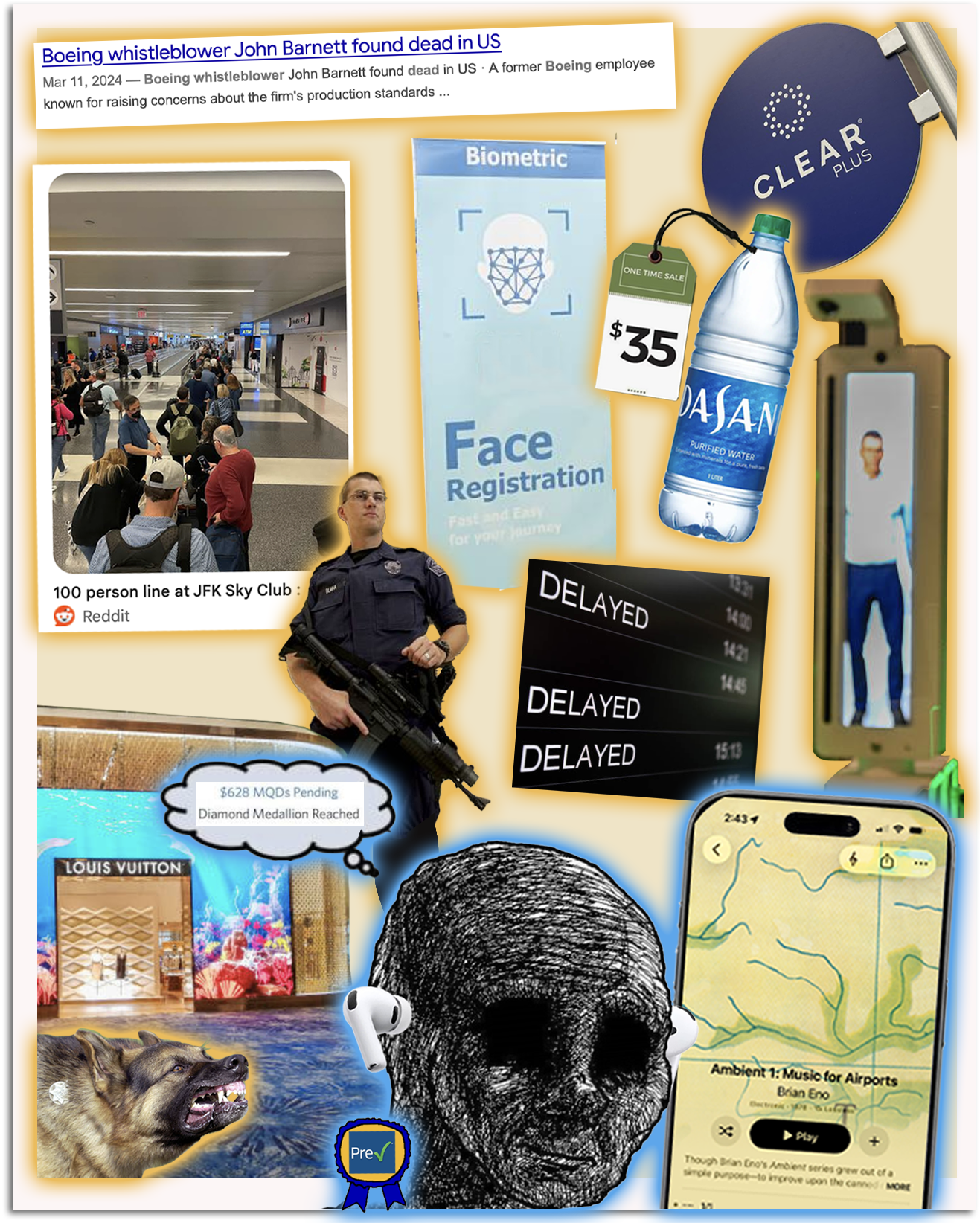
This nightmare only compounds when you realize that there are very powerful people trying to turn the airport into the unholy blueprint for contemporary life at large!
Considered in this light, the idea of music that says, “If you die, it doesn’t really matter” takes on a different, more demoralizing flavor.
What is music for airports, circa 2026, if not music for softly succumbing to the prerogatives of a seemingly genteel yet seethingly hostile environment? What is it if not music for submitting to that hostility, and doing your best to cushion the psychic fallout?
Drawing a line from Music for Airports to other ambient touchstones, you can chart the way the genre has always paired smoothly with a kind of undead corporate liminality, offering a lulling accompaniment to the encroachment of cold, globalized commerce into our lives, long before the streaming era.
Think of Haruomi Hosono’s (incredible) “Watering a Flower,” which he composed around 1984 as part of a soundtrack for shoppers at Muji stores. Think of Yasuaki Shimizu’s TV commercial jingles. Think of Suzanne Ciani’s miniature synth compositions and “audio logos” for brands like Coca-Cola and Energizer.
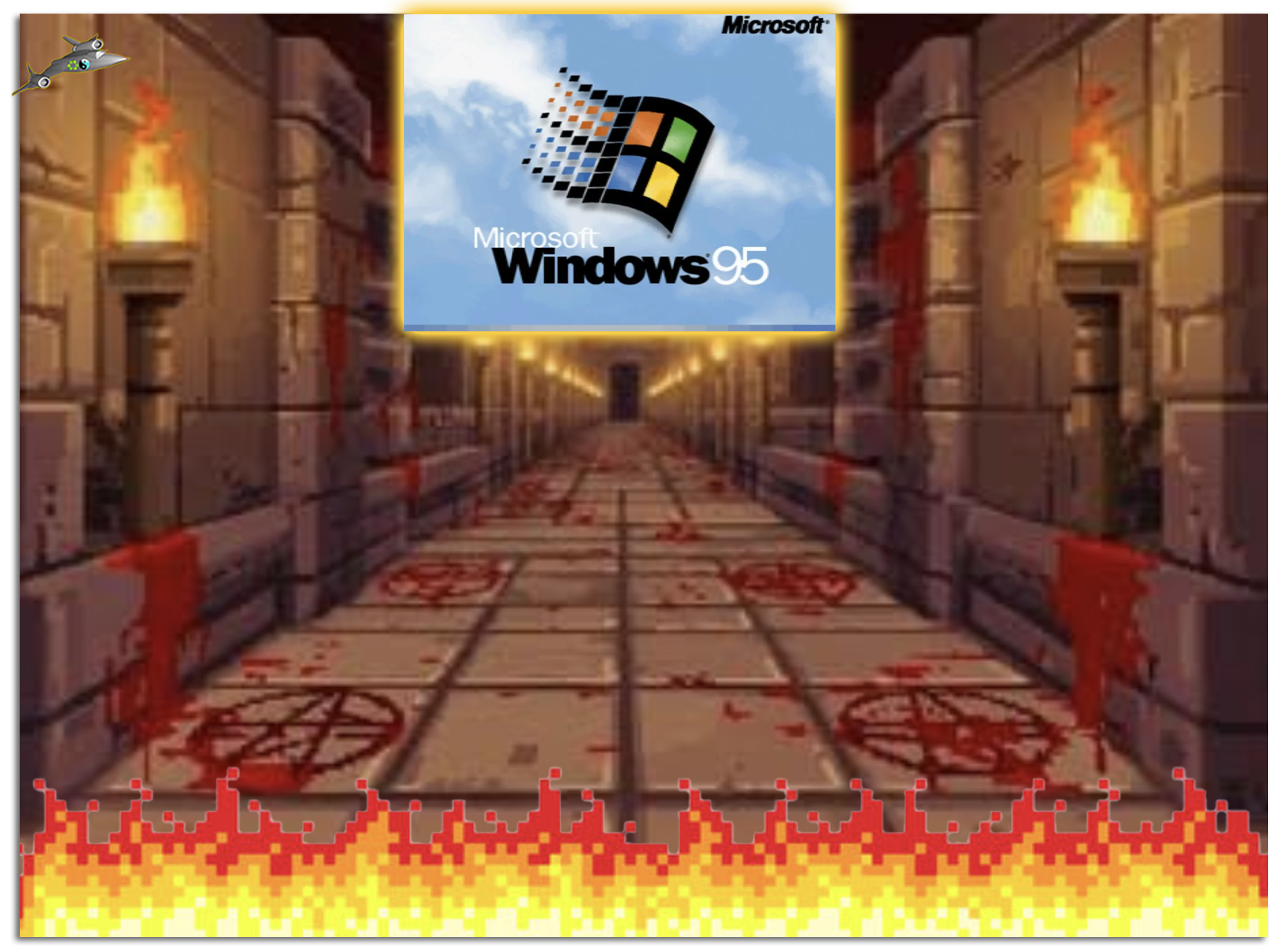
And think of Eno’s own iconic, 3.25-second-long Windows 95 start-up theme: The operating system, like the airport, represents a cursed site of concentrated corporate power that Eno, in his techno-optimism, saw as a place of wonder, and gave an ethereal score.
The best ambient music is complexly beautiful, deceptively simple and, very often, soothing. Increasingly, though, I fear I’ve been treating this soothingness less as a recuperative force, and as something more along the lines of a hospice-care palliative.
Contemporary life is full of mounting existential horrors, but nothing is to be done, the music seems to assure me. The horrors don’t matter anymore. The situation is terminal. Just put on this playlist, and close your eyes. Float off on a warm dissociative current as the future slowly but surely consumes you.
I didn’t realize quite how dependent I’d become on these dissociative currents until a few weeks ago, when I saw that a new album had dropped from YHWH Nailgun, a fascinating young post-punk band with a sparse, jittery, singular sound.
They formed in Philly before moving to NYC, which is tight, and I thought their 2025 single “Sickle Walk” was awesome. So I eagerly threw on the new album — and found myself fighting a powerful impulse to turn it off less than a minute in, despite the fact that the whole thing is only 11 minutes long.
The music felt too rough and scaly. Too spastic, too hoarse, too heaving, too misshapen. I reflexively longed for the pillowy feel of an ambient fugue instead. Thankfully, I pushed through that reflex, and let the YHWH rock on its own crazy terms.
The band helped shake off some of my stupor, and its strange intensity has stayed with me. We come to art, after all, to feel things besides “soothed” — and to encounter futures that haven’t already been written.
P☁️E☁️A☁️C☁️E till next time,
— J & E
Enjoy our Spyplane Ultimate Bay Area Guide.
Miuccia Prada is worth $4.8B. How good of a person do you expect her to be? Read our Spyplane Deep Dive.
Our Essay Archive, a curated selection of our Profoundest Thoughts, is here.
Our interviews with Cameron Winter of Geese, Ryota Iwai from Auralee, SC103, Nathan Fielder, Michelle Williams, Sarah Squirm, Evan Kinori, Adam Sandler, Brendan from Turnstile, MJ Lenderman, André 3000, Matty Matheson, Laraaji, Tyler, The Creator, John C. Reilly, Father John Misty, Steven Yeun, Clairo, Pusha T, Conner O’Malley, Christophe Lemaire & more are here.