

This life gives you nothing
Your attention is all you have. Wasting it is annihilating. Blackbird Spyplane saves literacy in a monumental Year-End Essay.
Blackbird Spyplane exists thanks to our readers.
We don’t run any ads, we don’t use affiliate links on new clothes, we don’t do any spon. You’re the only people we owe anything, so we keep some of our best material for Classified Tier Subscribers.
Upgrade today if you haven’t yet, support greatness and enjoy a better life in the inner sanctum — Jonah & Erin
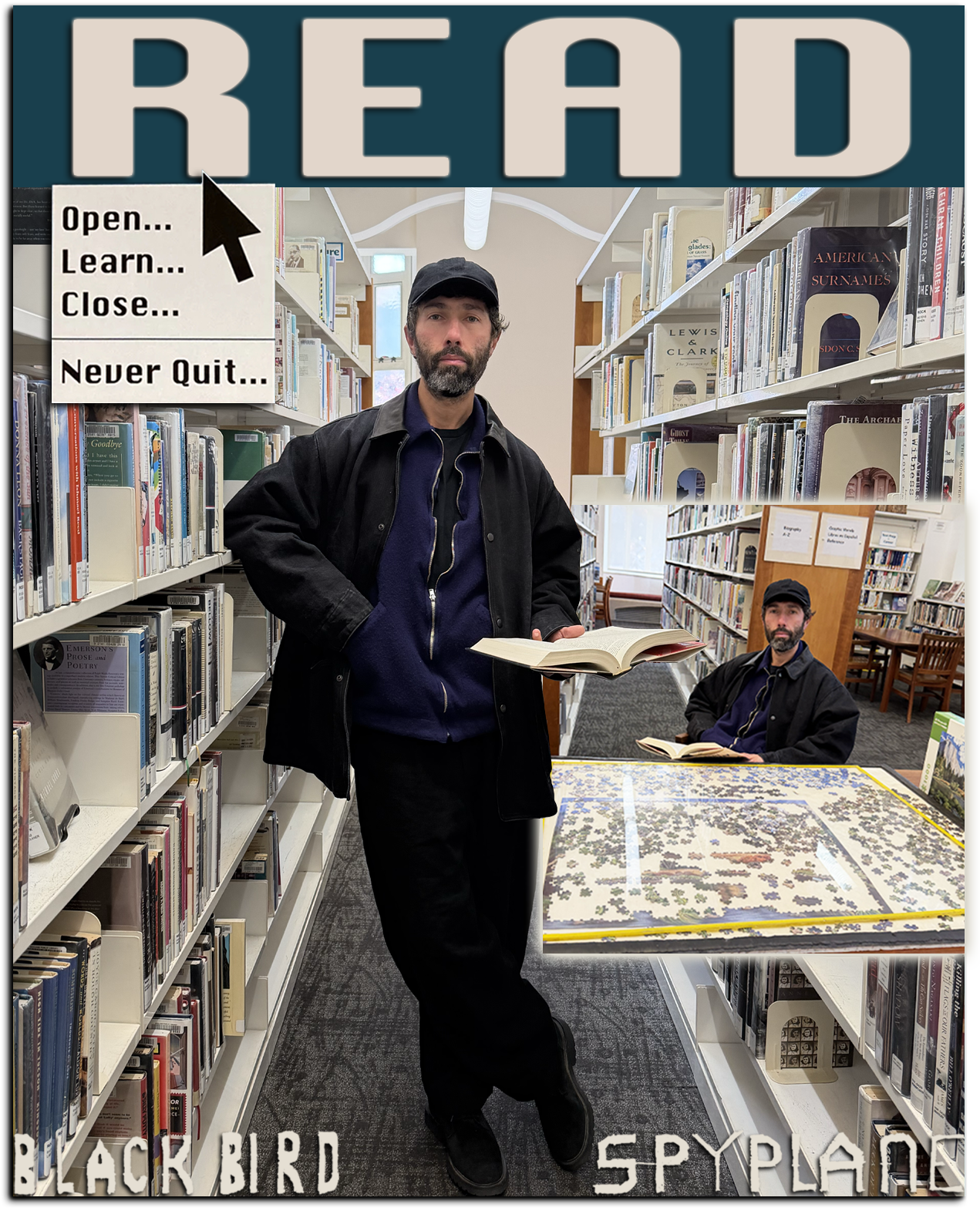
Our interviews with Nathan Fielder, Sarah Squirm, Cameron Winter and Geese, Adam Sandler, Brendan from Turnstile, Patrick Radden Keefe, MJ Lenderman, Evan Kinori, Maya Hawke, Bon Iver, André 3000, Sandy Liang, Matty Matheson, Laraaji, Ryota Iwai from Auralee, Tyler, The Creator, John C. Reilly, Father John Misty, Kate Berlant, Clairo, Steven Yeun, Conner O’Malley & more are here.
Check out our monumental new list of the 50 Slappiest Shops across the Spyplane Universe.
Our brand-new G.I.F.T.S. List is here.
2025 was The Jacket’s Year — the 21 best are here.
1 — All is full of Screen
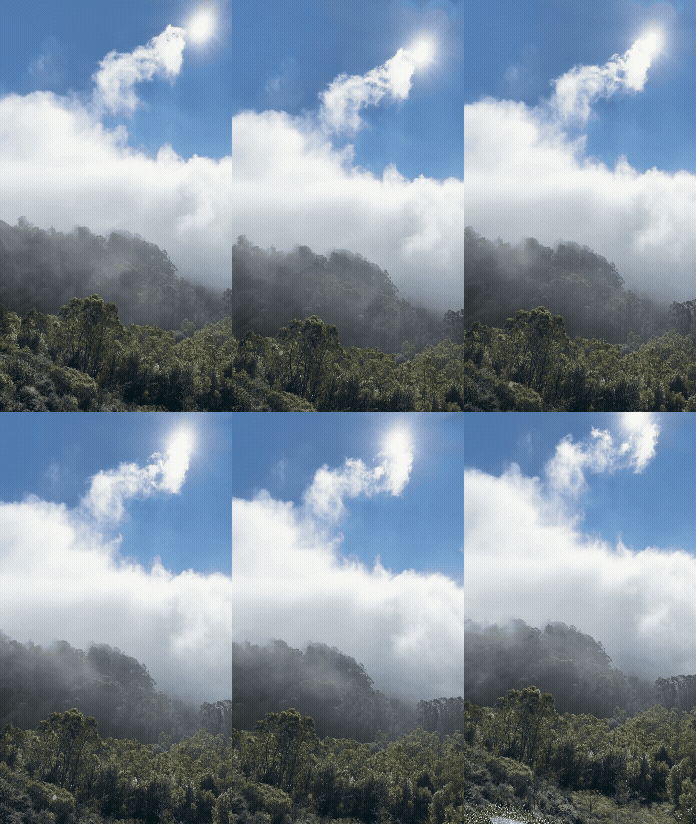
A disconcerting question strikes me alarmingly often these days. I’ll be out in the world, and I’ll see something … let’s call it picturesque. Say I’m walking along a nature trail as a white wall of fog avalanches over a ridge, down a canyon of pine and oak, toward the blue waters of the Bay. I will find myself thinking, “My god, that is beautiful.” And then — even if I manage to keep my phone in my pocket, resisting what’s become a powerful instinct to reach for it — I will feel a strange tremor of uncertainty: “Am I looking at a screen right now?” I wonder.
In the moment, this uncertainty is not fully articulated, nor, thankfully, does it emerge from some extreme delusional state where I’ve lost my hold on reality. It’s more of a pre-cognitive kind of category confusion. And at the core of the confusion is this: As my life has come to consist so overwhelmingly, and for so many years, of looking at images on screens — and of looking at the world through a camera, which is also a phone, which is also a screen — the distinction for me between the screen and the non-screen can wobble.
I still know the difference intellectually. But I don’t always necessarily feel it. That is the disconcerting part. I stare at the hillside, try to pick out individual details and weave them into a living, breathing totality that also includes the cool air on my skin and the birdsong in my ears. As I do this, I tell myself, “This is a real place, this is not an image of a place,” and I repeat that a few times, trying to will back the border dividing the two.
Here’s how I make sense of this wobble between world and image.
For a time, when I was much more active on Twitter than I am now, I’d find myself, e.g., washing dishes and, without wanting to, thinking about various mundane things in the form of tweets. Some nascent half-kernel of an idea would come to me and, like a hack comedian for whom every banal thing is material, I would immediately start working it over for any and all tweet-like potential.
Maybe there was a tiny bit of dish soap left at the bottom of the bottle, and I considered diluting it with water to get it out more easily, and make the bottle last longer. I wouldn’t simply think that. Thanks to Twitter, I’d think something exponentially more inane and annoying, such as, “The masculine urge to water down the dish soap…” or “The two genders [picture of brand-new dish soap vs. picture of old diluted dish soap]…” or “Choose your fighter [same two pictures again]…” or “Wake up babe, new diluted dish soap just dropped,” or “Men will dilute the last millimeter of dish soap rather than go to therapy…” or “No but the way I just diluted the dish soap…”
And so on. Just cycling through a procession of dumb, Twitter-borne phraseologies as they ran through my head, like a radio on the fritz skipping stations. It was a bit like I was idly playing a “brain teaser” puzzle, and a bit like my brains were oozing out of my ears. I’d spent so many hours of so many days reading tweets — encountering other people’s thoughts filtered through the specific character limits and idiomatic conventions of that site — that the seams between my own experiences, thoughts, and tweets began, on some level, to delaminate.
I worry that something analogous has happened in my relationship to looking. The same way that an idea would occur to me and I’d immediately reach for a Stock Twitter Phrase to give it form, whenever I see anything that interests me now, there’s a looming sense in which my phone is there with me, framing and constituting the sight, even if I never post the picture, even if I never look at it again and, weirdest of all, even if don’t take out my phone.
The same way I once conditioned myself to think in tweets, I’ve conditioned myself to see in “posts,” in “grid pics,” in “stories,” in flicks texted to the group chat, in .HEICs, and so on.
This is the underside of what people mean when they describe an extremely “sticky” piece of technology: It can stick to you, like the facehugger from Alien, even when you’re not using it.

How to get yourself unstuck?
2 — Your attention is all you have
One afternoon this fall I found myself “thinking in Instagram reels.”
I had an idea for a video I wanted to make for the Spyplane IG, which I hoped people would find funny. The premise isn’t worth describing except to say it involved me reading from some book broadly coded as “smart,” as a prop. I scanned our shelves for something that fit the bill, until my eye landed on Swann’s Way.
I don’t know how Erin and I came to own this copy, but we’ve had it for ages. I’d never read it, nor had she. That didn’t matter: This was a perfect “smart book” for the video I wanted to spend the next ~hour improvising, shooting and editing. I pulled the novel down and started searching for a passage that sounded appropriately “high-flown.”
And it was at this point that I enjoyed two unexpected, interconnected revelations. The first was that the opening pages of Swann’s Way are beautiful and captivatingly trippy. The second was that I did not want to die, whenever that day comes, having made an IG reel with a throwaway punchline about Proust, but not having actually read any Proust.
There’s a lot of talk these days about the death of literacy. No one reads, video’s eating everything, we’ve grown stupid, and our alienation from written language is only making us stupider.
For me, this isn’t distant, theoretical hand-wringing. I feel it firsthand, in the erosion of my own ability to concentrate on a piece of writing of any significant seriousness and length.
I am, of course, not alone in this. Our attention has been transformed into one of the few remaining reliable “growth markets” by a parasite economy much better suited to sucking and siphoning than it is to building new things. This means that everything wants to get into our eyeballs, and it goes without saying that there are far more effective technologies for getting in people’s eyeballs — and turning a profit there — than books.
But your attention is, on a foundational level, all you have. This is why it feels worse than bad to waste it. It feels annihilating.
And so I decided not to make an IG reel, and instead, to finally read Swann’s Way.
3 — Magical mornings with the anti-phone
Every morning for ~6 weeks, from late September to early November, I got out of bed early, put on some coffee, and sat with Proust for an hour or so in the quiet of predawn.
I moved slowly. The sentences in Swann’s Way are long, at times comically so: stuffed with asides, nested clauses, digressions, and spiraling detours into metaphor. There might be all of three sentences on a given page, and it was not uncommon for me to make it through just 10 pages in the course of that predawn hour.
This was fine with me, because the point wasn’t to burn through the book at 1.5x speed. The point was to sink into it, to stretch out, and along the way, to remind myself that I’m an adult and my attention is my own.
In that light, Proust was perfect for the job. Swann’s Way requires total concentration. If your mind wanders 1/6th of the way through a sentence, you will lose your bearings, and the sentence will spit you out. And yet the book isn’t punishing or difficult in the way of Ulysses or Derrida. It just moves at its own speed, and if you decelerate, and lock in, it’s a delight.
The story takes place in the 19th century, and unfolds at the speed of carriage rides, long walks through the countryside, and letters dispatched across Paris. There is no immediacy in it, or at least much less than we’re used to. There is a plot, but the book is less about that than about trying to render the experience of being alive in language as vividly, granularly, abundantly, comprehensively and encompassingly as possible.
There’s an extravagance of words, devoted to capturing interior and external life in detail, whether it’s the way a shaft of sunshine looks as it passes through the windows of a provincial church and lands on a patch of stone, or the foolish, contradictory behavior of a man who grows infatuated with a woman he does not seem to love, and who does not seem to love him, either. (I read this translation.)
To actually read Swann’s Way, it was necessary that I start the day with it, and that I didn’t look at my phone first under any circumstances. Getting in some scrolling beforehand would have been like waking up before sunrise, driving to the gym, and then saying, “I’ll just eat this box of donut holes before I get on the treadmill.” Nothing doing. On the few days when I made this mistake — thinking, against my better judgment, ‘I’ll just check the weather real quick’ — the spell was broken, I was still on the phone 40 minutes later, and my concentration was shot. I couldn’t get any traction when I tried to switch over to the novel, if I managed to pick it up at all.
Despite the gym metaphor, I don’t want to instrumentalize reading into something you should do for “gains.” You need absolutely no reason to immerse yourself in a great book beyond the vast intrinsic pleasure of doing so.
But in my case I was reading Swann’s Way not only for that pleasure, but also because phones have trained my brain to work in a way I don’t like, and I wanted to re-train myself: To rebuild my capacity for sustained attention like a muscle, to diminish the desire to scroll, to reclaim time spent within myself, uncoerced, undistracted, imagining and creating, in the particular way that only happens when you’re reading.
This hour of predawn Swann time became a ritual I depended on and eagerly looked forward to. You can analogize it to runner’s high, you can analogize it to core strength, but at the end of the hour, I came away with something more than just my normal nagging feelings of dissatisfaction with the way the internet organizes our thoughts. I’d done a set of Proust reps to failure — something actively pleasing, and actively fortifying, that would be with me for the rest of the day.
4 — The good in flicking up everything
Why do we pull out our phones at concerts instead of just watching the show?
Why do we pull them out at the beach instead of just watching the sunset?
I don’t think it’s because we’ve become automatons. I think the widespread impulse to take a photo of everything is in fact, at root, a creative one. It reflects a desire to not just receive life passively, but to intervene in it creatively: To frame the shot, to find the most compelling angle, to draw out the emotion, to honor the light… to participate.
The problem is that the cameraphone, connected as it is to our online lives, doesn’t just serve the creative impulse and stop there. It risks cannibalizing that impulse, co-opting it, colonizing it, and ultimately thwarting it. Because the cameraphone allows us so readily to stop noticing the thing we’re photographing, and instead to outsource our experience of experiencing to the phone, much like we’ve outsourced our sense of direction to Google Maps.
What’s more, when you start shooting video at the concert, your experience of watching Spyfriend Cameron Winter perform in real time is captured and subordinated by your desire to commemorate that experience for some vaguely imagined Future You, and/or to post the footage for the benefit of some vaguely imagined Impressed Other People.
This ultimately makes you more absent, and less present, to your life. And yet, again, I suspect that trying to rack up faves on a pic stems from something wonderful, which is our communal urge to share our experiences with other people: Are you guys seeing this sunset??
Our appetite for life is so big that living just one life doesn’t always feel like enough. We want to know what other people’s lives are like, and we want other people to live some of our lives, too.
A book is, we know, an unrivaled technology for living more life.
The contemporary internet-abetted image, on the other hand, is a highly potent yet f--ked-up technology for living more life. It comes with all kinds of strings attached, and it has a way of leaving us feeling lonely, lacking, unsatisfied, and jittery.
This is not thanks to creeping moral rot on our parts. Quite the contrary, it’s because these feelings of loneliness and dissatisfaction serve the twisted prerogatives of the people who design and make money from the technology sucking up our attention.
And those are not the prerogatives of people who write great books.
5 — The remedy
When I felt my thoughts morphing into tweets, the remedy was to spend less time on Twitter. The remedy for seeing everything as a digital image of itself is, similarly, to see less screen.
Avoiding screen is harder to do than avoiding a single app, but there are ways.
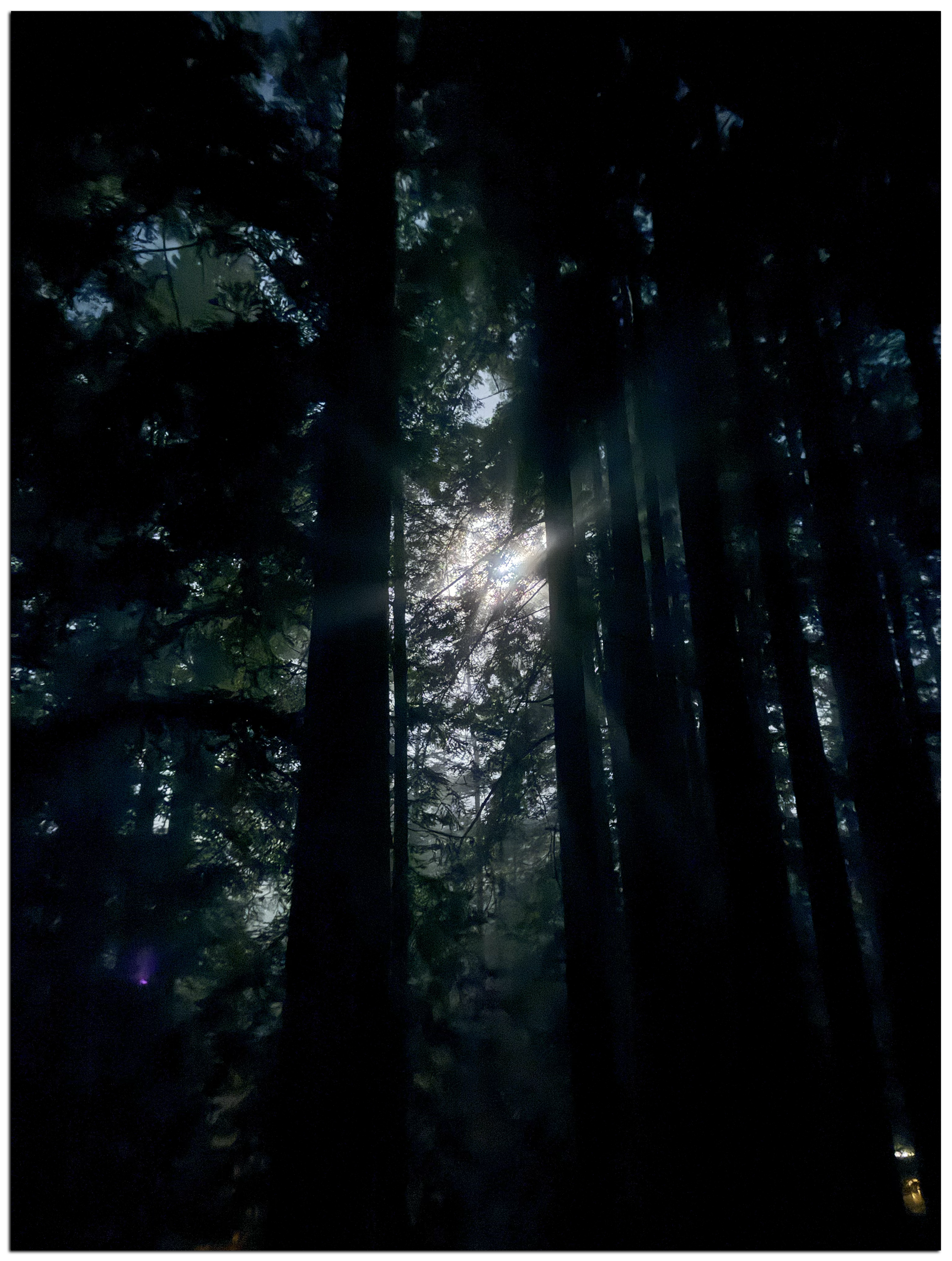
Early one morning in early November, I finished Swann’s Way. I sat there in its afterglow for a while, looking out a window. I was at a house on the Sonoma coast, where the sunrise was pushing through the fog, which itself pushed through a stand of redwoods. I didn’t need to assure myself that this sight was real and not a screen. The book had left me in a state similar to one I’ve enjoyed on psychedelics: my attention felt focused, even as my mind was free to wander.
It felt good to sit there and let thoughts blossom slowly, and instead of taking a picture of the redwoods, the way I’d normally do, I wrote down what I saw as I looked at them: the drops of water clustered in the boughs, the particles that drifted past in dense enough concentration that they counted as “fog” but were also perceptible as individual instances of moisture. Grains of sand, and also the beach, at once.
Then I took a picture, which, when I consult it now, looks dramatically different from what I saw, and from what I remember.
Every morning since then, I’ve continued the ritual of waking up early and devoting an hour or so to reading before the day begins — and, very importantly, before looking at any screens.
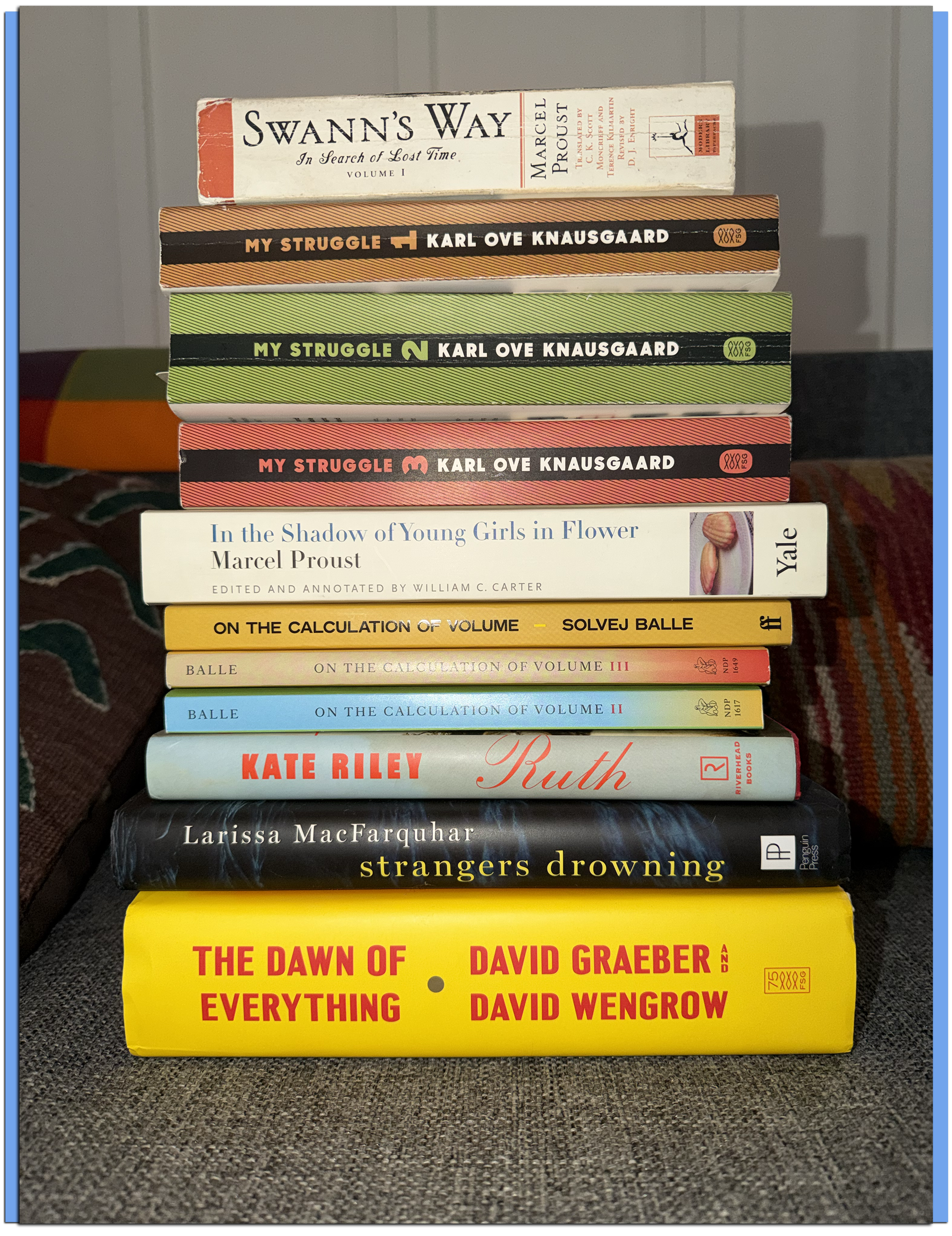
I moved on from Proust to Karl Ove Knausgaard’s famous My Struggle novels, which I’ve been meaning to read for more than a decade, and which felt like a good segue for a few reasons. Knausgaard is overwhelmingly concerned with memory, and he applies an abundance of language to capturing quotidian experience and expansive insights alike.
In the second book of the series, set in the mid-2000s, there’s a passage where he writes about settling into the sofa with his wife to watch a DVD. His real subject is attention:
…we wanted to be entertained. And it had to be with as little effort and inconvenience as possible. It was the same with everything. I hardly read books anymore; if there was a newspaper around I would prefer to read that. And the threshold just kept rising. It was idiotic because this life gave you nothing, it only made time pass. If we saw a good film it stirred us and set things in motion, for that is how it is, the world is always the same, it is the way we view it that changes.
Twenty years later, things are the same, but more so. The threshold just keeps rising. And it is worse than idiotic, because not only does this life gives you nothing, not only does it make time pass — it steals life from you.
In his books, Knausgaard often finds himself among other people, wishing he was alone. Proust, for his part, was a severely asthmatic child, this left him frail into adulthood, and by the time he wrote Swann’s Way he’d largely withdrawn from society, sticking to his rooms and writing. This isolation may have been maddening and painful — you need to spend time chopping it up with the f--king homies to thrive. But it also cleared the field for his imagination to flower, for him to dig into himself, open himself up and, in so doing, to push outward. In other words, by writing, he broke confinement.
Today we are all of us lonelier, and more alone, than ever. But we’re never alone, either, because our attention is hijacked, our time feels crunched, and our cells travel with us everywhere we go, padded with layer upon layer of endless, overlapping digital distractions. The Goon Cave is becoming life’s organizing principle.
And yet I know we still have more time on our hands than we realize: our phones take lots of it from us, yes, but there’s lots of time we surrender to our phones, too. We’ve grown accustomed to filling our time with scrolling because scrolling is diabolically easy. We can find ways to engineer away some of that scrolling, however, and replace it with things that do not merely distract us but speak far more resonantly to the questions we’re trying to ask when we start scrolling in the first place.
When we do this, we don’t just find ourselves with more time on our hands, but with more life on our hands, too. Because we set things back in motion. The world remains the same, but the way we see it changes.
P🌅E🌅A🌅C🌅E until next time,
Jonah & Erin
A couple of days ago, I sang Handel's Messiah with a local church choir. I'm not religious, but I am a former chorus nerd; it had become part of my past, and I missed it. So, for a few weeks I rehearsed with the choir, learned the part, and refamiliarized myself with what it means to sing with a group. The concert on Sunday was glorious: a room full of human beings singing, playing gorgeous instruments, responding to each other synchronously in a collective effort to bring to life something that was written almost 300 years ago. It was a thrill. Later, I realized I hadn't taken a single photo of my time with the choir, I had no recording of the event. And, although I was initially saddened by that, I realized that -- instead -- I actually had the music I had sung at the concert playing in my ears. A most beautiful kind of reminder.
Here's to having more life on our hands.
Hey Jonah, thanks for this truly great piece. I’m the chair of the English Department at Fordham and a longtime BBSP subscriber (and have actually taught BBSP pieces to students for a few years now in a course on fashion and literature). We actually just revised our vision for our department to center “the arts of attention: reading, writing, conversation.” Would it be possible for me to share this piece with our English majors? Appreciate the consideration.