

It's just clothes, and the stakes are enormous
Ornament vs. utility and the definition of Good Design
Enjoy our extensive new Natural Fiber Workout Gear Report.
We just dropped the smash-hit Spyplane Ultimate Bay Area Guide.
Miuccia Prada is worth $4.8B. How good of a person do you expect her to be? Read our Spyplane Deep Dive.
We don’t run ads and we never use affiliate links except for one-off secondhand gems we find on eBay and Etsy, and books on the independent bookseller Bookshop. This means the only people we owe anything are our readers.
— Jonah & Erin
A few weeks ago, the dudes behind the NYC clothing line Small Talk Studio went on Throwing Fits. Toward the end of the conversation, they gave a candid answer to a thorny question: “What are you sick of in menswear right now?”
Small Talk, a.k.a. Nick Williams and Phil Ayers, design and produce their clothes in New York’s garment district. The line feels like a product of contemporary NYC in more philosophical ways, too. Their vision is expansive enough to allow for subtle, classically indebted details, like a slight cowboy curve on the hand-pockets of a no-nonsense zip jacket, alongside bolder, you might even say sluttier, flourishes, like lace-crochet vents aerating the upper thighs of split-seam short-shorts. They use drapey brown wool gabardine here, lime-green linen-rayon mesh there. They’ll style a lordly double-breasted linen suit with a hot-pink cap modeled on Times Square gift shop junk. Walk past any number of quirked-up downtown crews and these are the sorts of signifiers you’re likely to see in play.

Small Talk are interested, across it all, in scrambling together the “refined” and the “tasteless.”
So I understood where Nick was coming from when he replied that, when it comes to menswear these days, he’s sick of too much refinement, and wants more tastelessness. He lamented what he called “this residual, quiet-luxury narrowing of people’s conception of what looks good. I feel like a couple years ago, people were a lot freer and looser with how they were getting dressed,” whereas now they’re drawn to “stuff that’s a lot more monochromatic and minimal.”
“I definitely look up to some of those brands,” he said. “There’s things that are great achievements in fabric development or silhouette and feel great to put on.” But he didn’t like seeing a pared-down aesthetic become dominant to what felt like the exclusion of other, wilder approaches to style. He praised the brilliant cacophony of New York’s SC103, whose designers work with “a much freer, more expansive template, that doesn’t have as many codes,” he said. “Whether I’m wearing it or not, it’s exciting to see.”
Which brands was Nick thinking of? I haven’t called him up to ask. But several may readily occur to you as representative of the aesthetic he’s referring to, among them designers whose clothes Erin and I love, wear, and write about a lot, e.g., Lemaire, James Coward, Lauren Manoogian and Comoli. In addition to making excellent, fabric-forward pieces that broadly fit the muted / minimalist bill, these lines have lately become more popular than ever, inspiring copycats and eating up enough of the “cool clothes” discourse that they can feel not simply ascendant but (in our little slice of the universe, anyway) hegemonic.
My own excitement about these clothes derives from the lived experience of rocking them for years, talking to the designers behind them about how they make them and, most importantly, feeling good when I wear them. So for me the unprecedentedly loud buzz around them — positive, negative, imitative, aggrieved — can feel strangely disconnected from the garments themselves. And I can imagine that, if you care a lot about clothes but “muted” isn’t your thing, then the buzz could feel annoying… possibly oppressive… or at the very least boring.
I bring this all up because Small Talk has been one of our favorite lines since before they started designing their own clothes, when their stock-in-trade was hand-drawn customs— and because Nick was pointing to a broader shift in values across the Cool Clothes Landscape that we’ve been trying to suss out ourselves.
Back in February, we wrote about the transition from a recent era marked by “a prevailing interest in what’s on the cloth” into our current era, marked by an emphasis on what’s in the cloth. That’s one, granular way to make sense of the swing from, e.g., logomania, bright colors, tie-dye, graphic tees and lavishly embroidered shirts (which ruled from roughly 2017-2023) to unadorned, utilitarian-minded garments cut from natural fibers knit and woven in arcane ways (anno regni 2023-present).
But a great little book just came out that provides another, much bigger-picture way to understand this swing, and why it matters.
Going back at least as far as the Arts & Crafts movement of the 1850s, there’s been a war in design between champions of Ornament and champions of Utility, with one periodically rising up to repudiate the other.
You may yourself be a hardliner, or you may find your allegiance distributed across both camps, valuing utility in design, but stoked on some ornament for ornament’s sake, too.
It’s an engrossing debate either way, because its combatants have very different, equally impassioned answers to a fundamental question the rest of us don’t always think very clearly about, if we think about it at all: What Should Good Design Do?
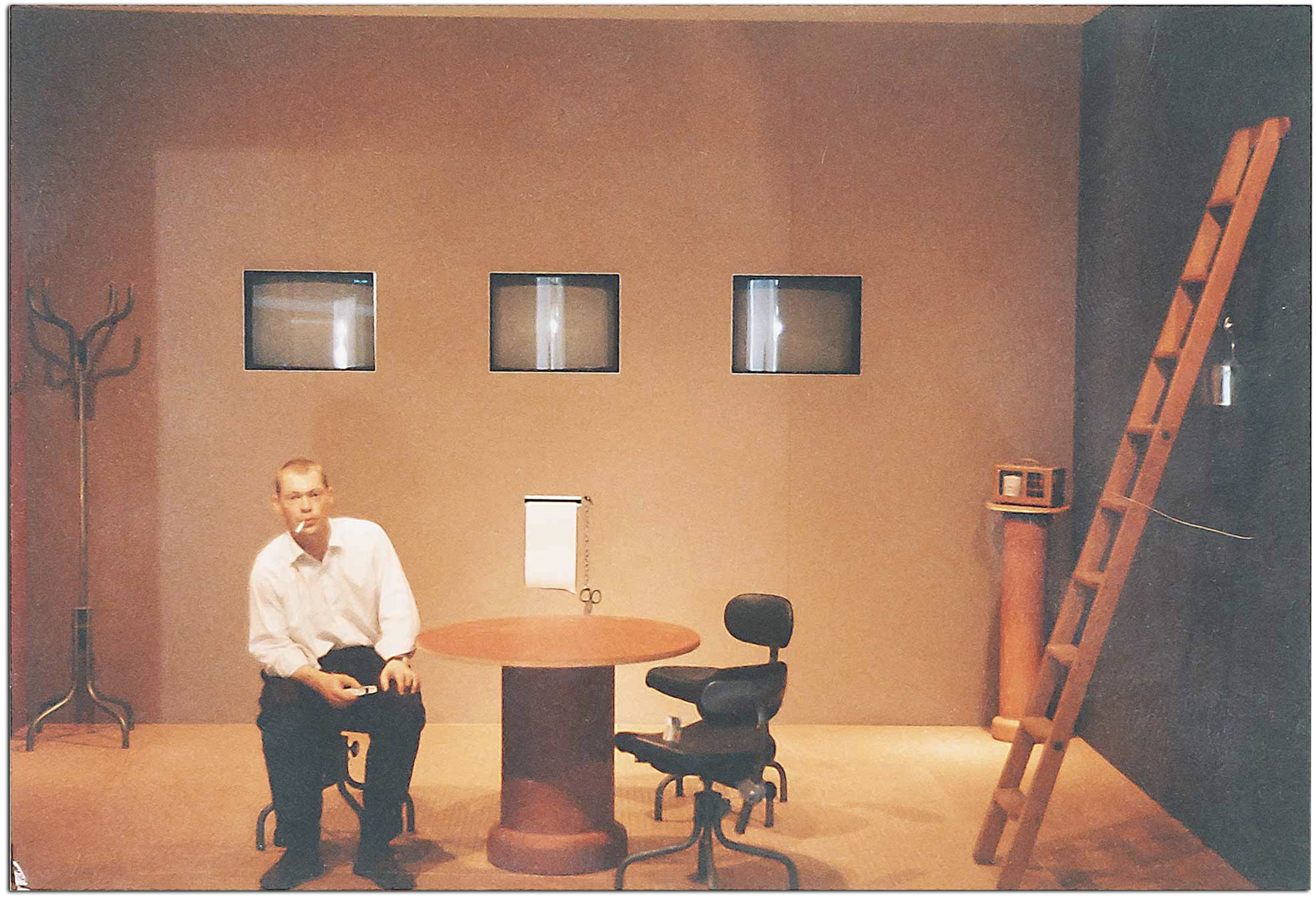
The new book is The Unimportance of Form and Other Arguments…, a collection of short, snappy writings by the immensely influential British industrial-design GOAT Jasper Morrison.
It was published by Apartamento and edited by industrial designer and Spyfriend Sina Sohrab, who kindly sent us a copy. I grabbed it before Erin did, and read it in three sittings, cerebellum crackling.
Lots of gifted designers, like so many other creative people, aren’t great at talking in especially illuminating language about what they do. But some, like Morrison, are gifted communicators, too. Since their métier is “the made world” itself, they can help us better understand not only their work but the garments we wear, objects we live with, and spaces we move through more generally.
Morrison, by his own description, “declared war on ornament” at the start of his career. People have called him a Minimalist, but while he appreciates “the visual economy of Minimalism,” as he put it in 1992, “I’ve always denied that label.” He loves curves and “strange” details, for instance, and “a curve is not Minimal, because a straight line is more easy to achieve,” and “a strange detail is not Minimal, because it’s an addition to what is more minimal. Minimalism is much too hard-edged to be applied to useful objects.”
He prefers a term along the lines of “simplism,” which reflects his belief that “simple things are much easier to live with,” “communicate their purpose more easily,” and “tend to have a character and charm which complicated things don’t have.”
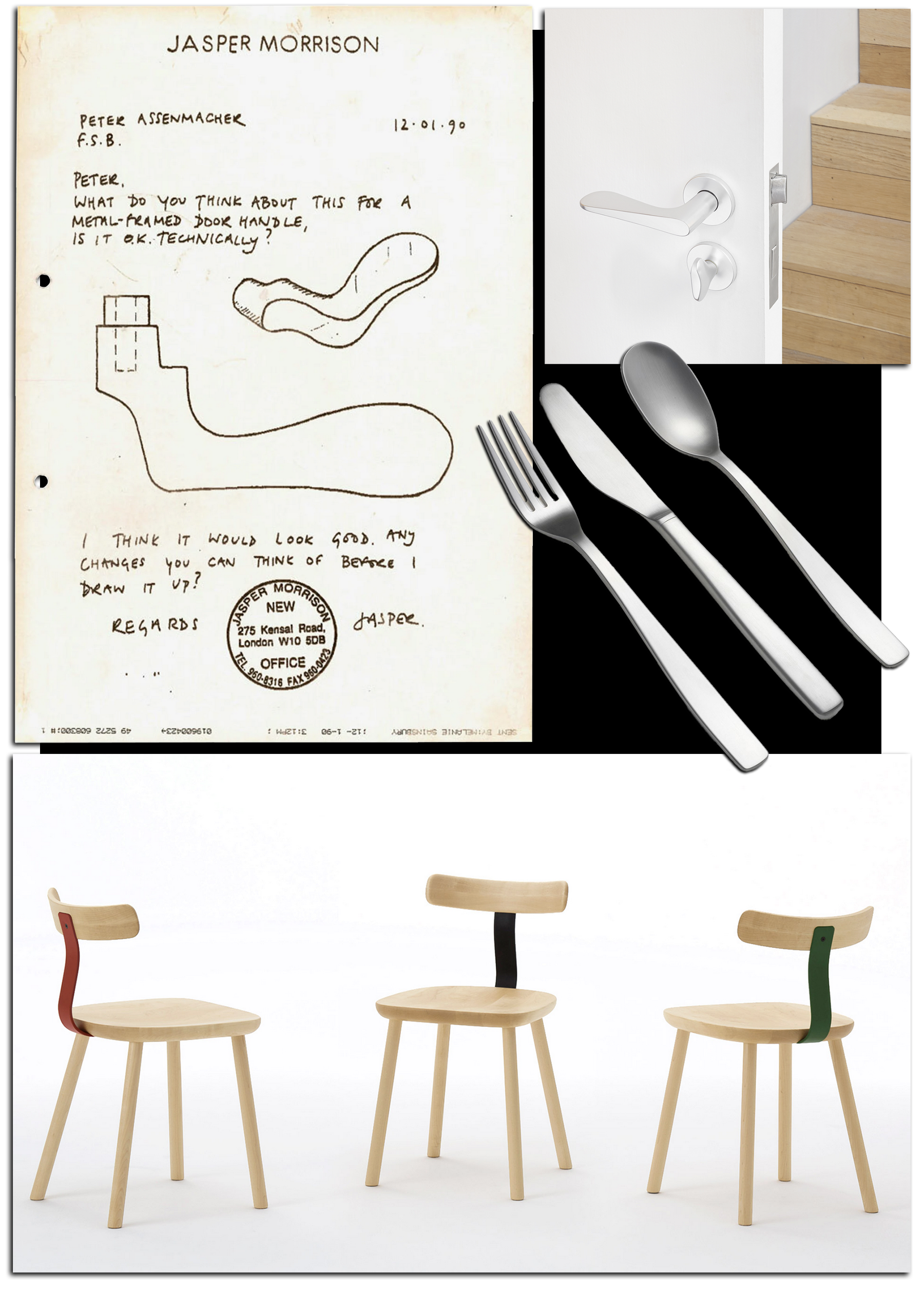
A designer shouldn’t go to the trouble of designing a door handle, Morrison argues, if it “doesn’t in some way simplify the process of opening a door.”
Morrison’s design thinking was born in a context of scarcity. He graduated from London’s Royal College of Art in the 1980s, and had to figure out how to pursue industrial design in “Thatcher’s rapidly deindustrialising Britain,” as Sina writes.
He tackled that problem with youthful optimism, recombining existing industrial processes and products in a way someone today might call “hacking.”
Morrison contracted with a laundry-basket factory to help him make chairs. He glimpsed a stack of terracotta flowerpots in a hardware-store window and came up with his “Flowerpot Table.” He tucked two sets of swivel-chair legs into either end of a long, slender air-conditioning duct to form a coat rack. Inspired by Duchamp’s Readymades and Breuer’s bent tubular steel, he fashioned a table out of bicycle handlebars, a diagonal slab of wood, and a circular tray:
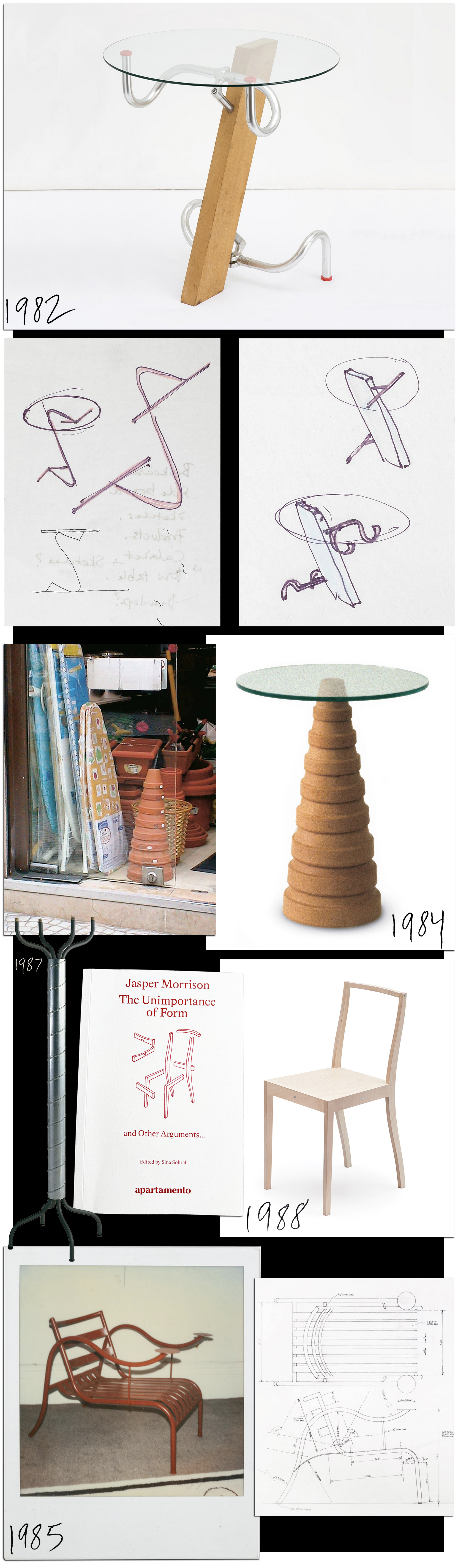
Rather than kitsch, “upcycled” novelties, these early creations have an appeal that outshines any gimmickiness. Even as Morrison’s designs and his interest in “strange details” grew more refined, he was never a dullard. Which comes in handy when you want not only to design things, but to devise and proselytize for fundamental tenets, like he did.
Morrison defines design, crisply, as “an equation for getting more from objects.” He notes that usefulness is what “separates design from art.” But for a piece of design to be good, he adds, it must also “provoke desire,” the “single most important ingredient in the creative mind,” because “it is in satisfying this desire that we are able to perfect a design or harmonize a structure.” He suspects that “it must be very similar designing hats, shoes, and clothes. Just as a painter tries to reinterpret what he sees, a designer attempts to reshape his desires.”
Elsewhere, in a similar register, Morrison describes design as the “pursuit of rare exuberance brought on by the strange completeness of a moment or place.”
How fantastic is that! He believes a good designer should remain sensitive not just to the specific material form of a given object but also to the “quality of atmosphere” that the object enmeshes within and contributes to. To that end, Morrison has little interest in “innovatory design.” He’s argued that materials should be used in their “self-colour” whenever possible, because “there are very few colours for a given material that will not destroy its integrity.” His ideal objects are the often-anonymous kinds “that came to exist through genuine utilistic development.”
In his own work, he’s aspired to eliminate not only the distracting effects of authorial ego but the “slightest hint of conscious design” itself. One of Morrison’s proudest achievements was to simply remove travel-company stickers from the window of a bus-station café in Graz, Austria, so passengers could enjoy the café free from anxiety that their bus was about to pull off without them being able to see it. With this project, “the driving force of our thinking was the human experience of the situation.”
That aliveness to presence, strangeness and human experience underscores the fact that while Morrison values simplicity, he isn’t an ascetic. He’s attuned to our emotional relationships to things, to the texture of a vibrant social fabric, to the vital services of “winemakers, cheesemakers, and restaurants.” He salutes “the poetry of thought involved in creating a useful thing,” and how that poetry “lives on in the use of it.”
So what’s poetry, and what’s “mere” ornament?
This brings us to Morrison’s bête noir. Today there’s a widespread appreciation — which Erin and I share, even if we don’t necessarily want the stuff in our house — for the geometric, squiggly, colorful, ultrawhimsical 1980s design of the Milan-based Memphis Group.
Morrison loathed it from the start.
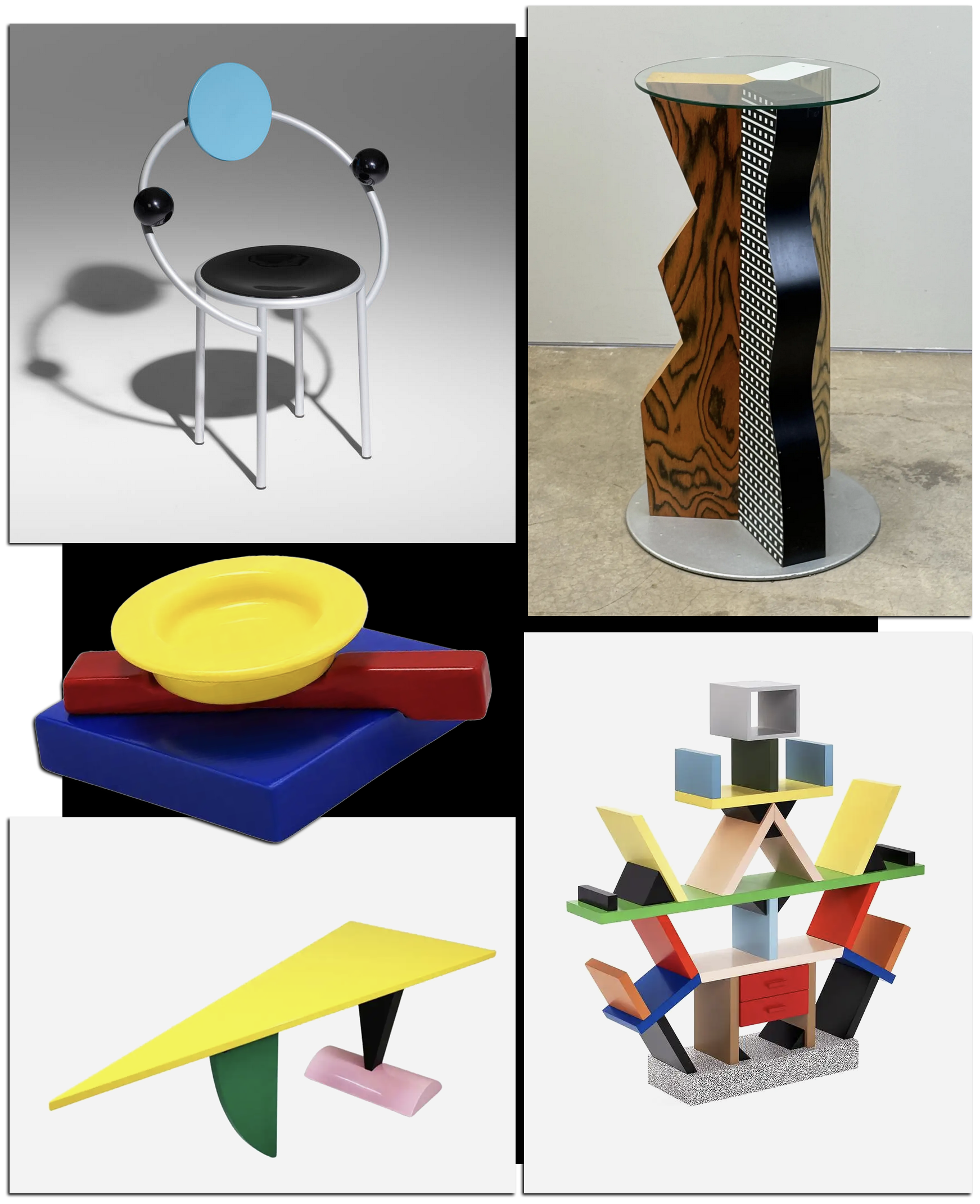
Ditto flashy ‘80s spaces like Café Costes, Phillipe Starck’s buzzy, coked-up-proto-Saved-by-the-Bell-looking Paris bar, and what Morrison calls “grotesque postmodern furniture” coming out of America at the time. He criticized the work of Memphis and its broader cohort as “highly decorative and unambitious,” embodying a “reckless uselessness.”
Uselessness, for Morrison, is a grave sin. And “decorative objects are useless,” he writes, “because they seek to disguise their own purpose, pretending to be something they are not.” He abhors “dishonesty” in design, and Memphis was Exhibit A.
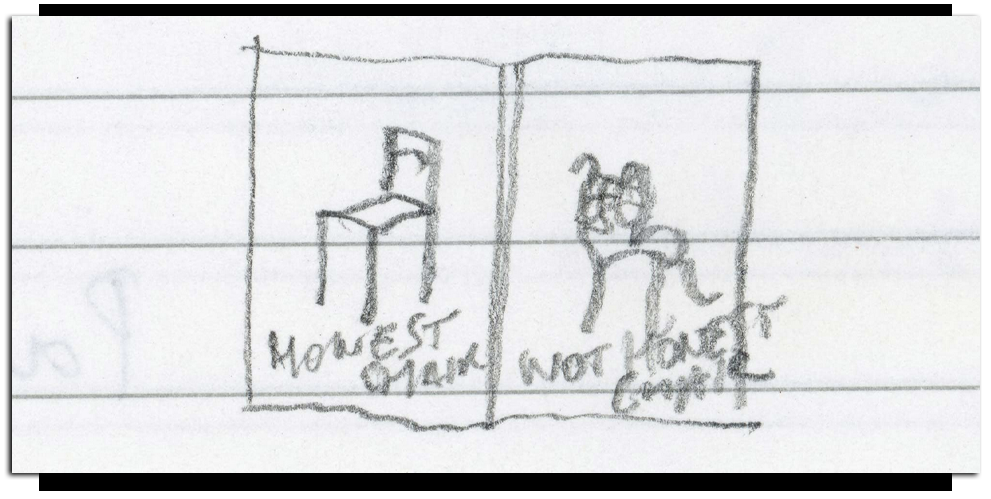
“Long live the practical people and down with decorators,” he wrote in 1993. Rather than get on board with postmodernism’s outright rejection of modernism, Morrison wanted to find ways to reinvigorate what he saw as the inherently honest principles of modernist design.
He was inspired in his thinking by the pioneering, Eurocentric, sexually deviant Czech-Austrian architect Adolf Loos, whose landmark 1908 essay “Ornament and Crime” rejected the decorative excesses of Art Nouveau. In prose that is very funny, even as it captures its author’s baldly racist and elitist attitudes, Loos argued that “the evolution of culture is synonymous with the removal of ornament from utilitarian objects” and that “ornament does not heighten the joy in life of any cultivated person.”
Here in 2026, Loos’s basic framing still holds sway. We’re inclined to read mutedness and subtlety as dignified, cultivated, evolved. Loudness and ornament, by contrast, are gauche, unrefined, stunted.
Also — while this isn’t how Morrison ever talks about design — there is obvious overwhelming potential for a certain kind of gendered thinking here, casting good design as a serious, utilitarian, masculine pursuit, and implicitly dismissing mere ornamentation (embroidery, quilting, filigree, color, etc.) as zesty, frivolous, and feminine.
But the divide between utility and ornament turns out to be an impossible one to keep from collapsing in on itself. And over the years, a long line of perfectly cultivated designers have explored strategies of intentional collapse. A piece of art on a restaurant wall can improve that room’s atmosphere — why shouldn’t the staircase banister at that restaurant be art, too? Why shouldn’t a mirror-frame ripple? Why shouldn’t a designer get a little Auntwave with it and render something as prosaic as a cord cover in electric-blue organza?
I don’t think this weakens Morrison’s arguments. Quite the contrary, the Quest for Purity is almost always more about establishing and trying to adhere to a firm set of values than it is about actually realizing the supposedly perfect state those values point toward.
Morrison is talking, like any good prescriptivist, about ideals — breaking design down to component principles, developing a code amid all the squishiness, and sticking to it. You can disagree, you can argue, you can call it doctrinaire. But another way of describing this is “having a strong perspective.” And that’s what you want in a designer.
What does this have to tell us about the current moment in Cool Clothes?
42 years after Morrison declared war on ornament, and 118 years after Loos did the same in “Ornament & Crime,” the war between ornament and utility is still raging. When it comes to clothes, this helps us contextualize the recent menswear pivot from cool, ostentatiously decorative lines like Kapital, Online Ceramics, and Bode to cool, rigorously restrained ones like Margaret Howell, Evan Kinori, Auralee, and Man-tle.
And if the ornament / utility binary wobbles when you’re talking about industrial design, the wobble is seismic in the case of clothes. After all, once you get past the rudiments of “protection against the elements,” clothing’s primary function is aesthetic.
We want different things from a great pair of pants than we do from a great coffee maker. We want the coffee maker to make good coffee with a minimum of hassle while beautifying our countertop. We want the pants to beautify us.
This connects to another important distinction, between the public and the private. It would be ridiculous to carry around our appliances to announce our discernment and broadcast our flattering tribal affiliations, but we do use garments for those purposes.
Is an extravagantly roomy drop-shoulder sleeve functional, because it allows for ease of movement, or ornamental, because it creates a useless yet pleasing sculptural form? Is that crocheted insert on the Small Talk shorts decorative Sexy Boi s--t? Or is it a utilitarian ventilating feature, perfect for a hot summer night cycling across the Manhattan Bridge while the Q rattles beside you?
That’s a physical-world use-case. Increasingly, though, the social internet has moved the site of much clothes-rocking to IG and TikTok feeds, Discord servers and other virtual spaces. In response to this reality-warping de-materialization, we’ve seen a contravening emphasis on material surge up — a desire for things that exemplify their physical (as opposed to symbolic) thingness in the extreme. A few years ago there was a bizarre microtrend where cryptocurrency collectors became obsessed with amassing ultra-dense, ultra-heavy tungsten cubes. Does some similar impulse underlie my appreciation for an ultra-dense cotton?
There’s another crucial set of concerns at play here, which Morrison didn’t begin to grapple with until later in his career: obsolescence and waste. In 1993 he passingly invoked “the ecological argument” for good design, bemoaning products with “disposability designed into them.” In the early 2000s, he observed that “marketing is often the motor of unnecessary change, replacing satisfactory products with products which may be less efficient but which are easier to sell.” As a result, “the experience of living with an object seems to have cheapened.”
Morrison worried that even if designers proceed “with the best intentions,” they are, “in a way, just glamorising the ownership of things.” And he argued that, with the rise of globalism, “we are losing the sense and meaning of local activity, of the carpenter who makes something for his neighbour.” The remedy he suggested was “doing less things but doing them better, and with a care for detail.”
“Fewer better things” has by now become a familiar mantra for the conscientious clothes-rocker, not to mention the savvy marketer. Designers and customers seek physical durability and aesthetic durability. And a huge part of an understated garment’s promise is that it will be, if not trend-proof, far more resilient to obsolescence than a garment marked by bold colors, crazy graphics, elaborate patterns…
Does resilience to obsolescence mean stasis? How can design keep evolving to meet the moment without adding to kilotons of industrial waste, abetting the dark prerogatives of marketing departments, and slipping into empty novelty?
The seams on Levi’s 501s are where they are. The seams on Carhartt Detroits are where they are. We like them there. Yet some of us wonder: Why are they there? Do they have to be? What revelatory delight — and what unholy hell — might we unleash if we move them elsewhere? It’s “just clothes,” and the stakes are enormous.
Morrison, for his part, acknowledges that we require “something more than simple use” from a great design, insisting on “an extra quality of presence,” too. He eventually theorized this as “Super Normal.” But the moment you move past pure, unadorned functionalism and open the door to an abstraction like “presence,” you usher in the ineffable, the artistic, and the useless.
I see that as a good thing. Shut the door entirely and the room grows airless. But take the door off the hinges and chaos reigns.
So maybe war is the wrong metaphor. Maybe a better way to think about ornament and function is that they feed off of each other in a fascinating, productive, unending tension. At any given moment, more of us will find ourselves drawn to one than the other. But without both, the whole thing falls flat.
Peace til next time,
— J & E
Our interviews with Cameron Winter of Geese, Michelle Williams, Ryota Iwai from Auralee, SC103, Nathan Fielder, Sarah Squirm, Evan Kinori, Adam Sandler, Brendan from Turnstile, MJ Lenderman, Jockum from Our Legacy, Camiel Fortgens, André 3000, Eckhaus Latta, Matty Matheson, Laraaji, Tyler, The Creator, John C. Reilly, Father John Misty, Michelle Williams, Steven Yeun, Conner O’Malley, Clairo, Christophe Lemaire, Pusha T & more are here.
This is something I think about constantly. From an architect's perspective, the ultimate irony of modern and 'minimalist' design is that it's actually much more difficult to build. What looks effortless on the surface is actually the result of incredibly rigorous coordination, impossibly tight tolerances, and highly disciplined detailing and craftsmanship. That's where it derives its power.
Stripping a building or design down to its essentials removes the layers that traditionally conceal imperfections. No crown molding here! Ultimately minimalist design is less about "doing less," and more about a tireless dedication to execution, craft, materiality, and precision. Sticks in the craw of every architect I know. Minimalism's hard!
Jonah fucked around and sold me another book with this one.