

Connoisseurs vs. con men
Your favorite shirt doesn't have a 22 S.P.I. count. Is it garbage?
Enjoy our extensive new Natural Fiber Workout Gear Report.
We just dropped the smash-hit Spyplane Ultimate Bay Area Guide.
Mach 3+ city tips for traveling the entire planet are here. Spyfriends just came through with recommendations for Puglia and Dublin. We need intel for Beijing, Mérida and Cannes!
We don’t run ads and we never use affiliate links except for one-off secondhand gems we find on eBay and Etsy, and books on the independent bookseller Bookshop. We laid out our position on affiliate links and spon here.
This means the only people we owe anything are our readers.
— Jonah & Erin

The first time Instagram showed me a video from the semi-anonymous garment reviewer known as the Fabricateuralist, I was intrigued. A self-professed apparel expert who says he’s spent 20 years visiting factories and workshops, he’s won a following — or the fleeting favor of the For You algorithm, anyway — with a series of hands-on, point-by-point assessments of whether a given garment justifies its price tag.
People who call themselves things like “Fabricateuralist” tend to approach clothes with a different set of interests than I do, operating in a fine-tailoring idiom I respect but don’t get too excited by. There is a robust corner of the menswear internet devoted to this idiom, exemplified by sites like The Rake (“the modern voice of classic elegance”) and Gentleman’s Gazette (“website and shop for classic gentlemen”). You will enter this zone if you do a search for, e.g., “How to Fold a Pocket Square” or “King Felipe VI of Spain’s best bespoke suits.”
And yet, “quality” can be a maddeningly vague term, subject to debasement by under-informed enthusiasts and marketing con artists alike. So I’m always curious about anyone who promises genuine, insidery, nuts-and-bolts bywords of top-notch garment construction.
Perhaps you’ve never heard of this particular poster. His reviews start with an overhead shot of a gridded cutting mat, as though we’re in a patternmaker’s atelier. The garment under scrutiny flops onto the mat, its price flashes on screen, he names the brand and asks, “Is it worth it?”
To produce videos at the volume demanded by circa-2026 social media, the Fabricateuralist (who gives his name as Marc in interviews, declining to share his surname) has developed a standardized checklist he deploys in every review.
If he’s inspecting a shirt — a process he likes to illustrate with footage shot, impressively if incomprehensibly, through a microscope — he will add points for features like a high stitch-per-inch (S.P.I.) count, button shanks, split yokes, side-seam gussets, horizontally sewn bottom buttonholes, and so on.
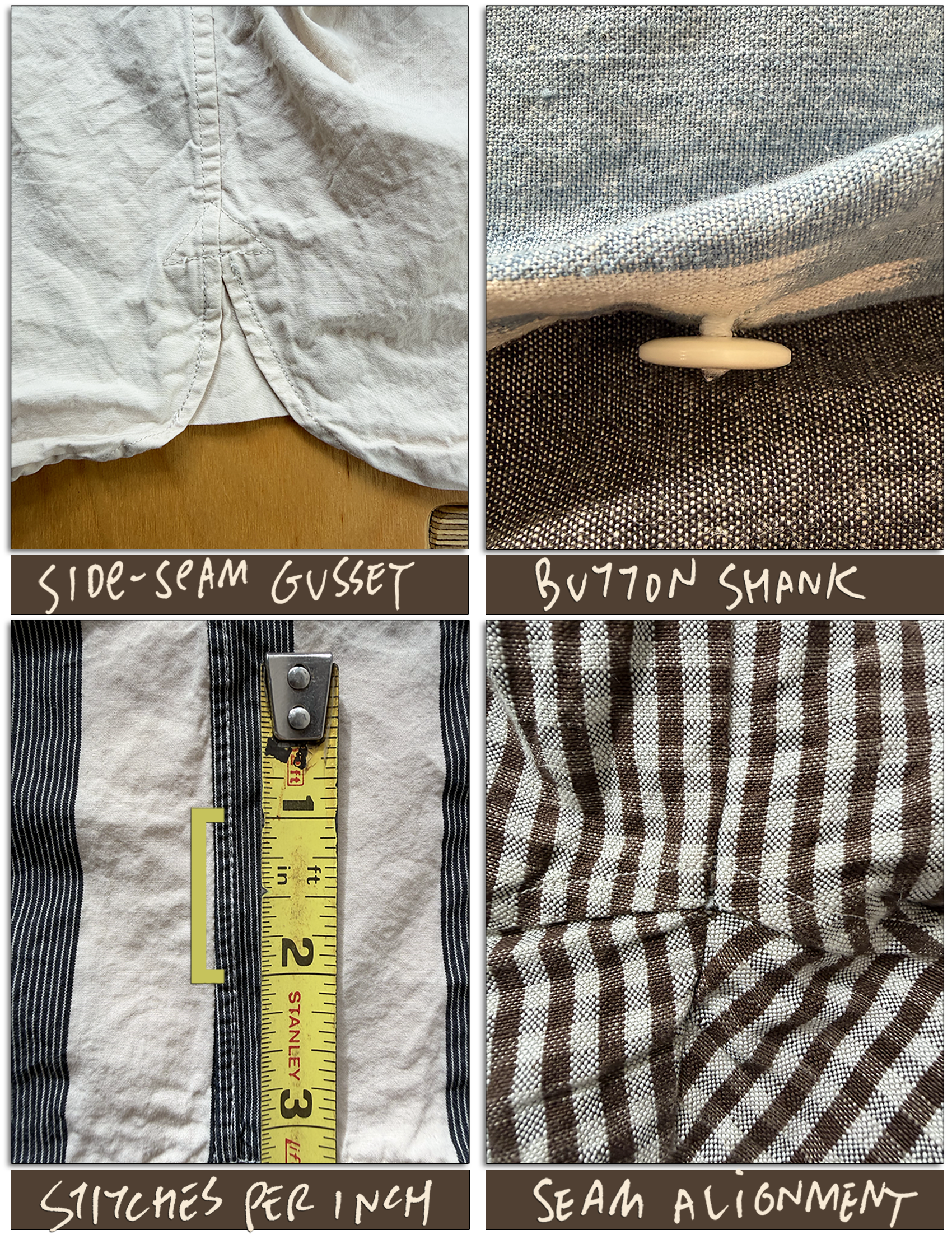
He docks points for seams that show puckering, ditto underarm seams whose junctions do not form a perfectly aligned “+” — except in those cases where the sleeve has been purposely rotated forward using a Neapolitan tailoring technique he refers to as scarto manica.
Some of the Fabricateuralist’s criteria, like handwork, are intuitive. Many, like rotated sleeve-heads and split yokes, are much more arcane. For this reason, watching one of his videos might remind you of listening to an investment banker recite a barrage of dizzying lingo and acronyms for supposedly complex financial instruments whose meanings are the domain of putative specialists.
But it’s fully debatable what each factor on the Fabricateuralist’s checklist actually contributes to the worth of a shirt. For instance: Go check out your three favorite button ups. It’s likely that one, or all three, lacks button shanks, side-seam gussets and horizontally sewn bottom buttonholes. And it’s equally likely that you do not care, and that you have never once thought about whether your shirts have these things or not.
When you’ve appraised a shirt, consciously or otherwise, you’ve probably weighed things like fit, silhouette, hand-feel, drape, color, and comfort — considerations that the Fabricateuralist is prone to avoid in his videos, because they blur the line between objective and subjective in a way his review format isn’t equipped to handle.
Instead, he emphasizes visual markers of labor. “Every detail costs money,” he recently told an interviewer, “and the fewer details you find on a shirt, the cheaper it is to produce.” You might associate “fewer details” with clean design, and therefore avoid shirts with locker loops and contrast cuffs. But in his calculations, those details add to the objective worth of a shirt because they required extra steps during construction.
I don’t find this a satisfying measure of worth. And, even more unsatisfying, his formula has no room for an array of other important, thoroughly objective factors, such as the cost of fabric, the wages paid to garment workers, the import tariffs paid by designers, the rents and utilities paid by stockists, and so on.
Finding out those things would contribute to a far more meaningful understanding of a garment’s worth, but it would also require reporting.
All the same, confronted with one of these videos, you might find yourself at a crossroads: If you discover that one of your favorite shirts has misaligned underarm seams, should you re-assess its worth?
It’s tempting to just say, “of course not.” But the question is deceptively tricky, because when we receive new information about something we like, it can and does affect our feelings for that thing, all the time.
This helps explain why the Fabricateuralist strikes a chord, and why he has 86k followers on IG and 73k on TikTok. He frames his videos as neutral rundowns of objective metrics, but what he’s really doing is starting a provocatively messy argument about what constitutes “true” value.
I call it messy because he doesn’t always apply his criteria consistently and clearly, and because his conclusions are contestable. According to one gifted veteran patternmaker and sewer I consulted, misaligned underarm-seams can actually offer evidence of a higher grade of work than perfectly aligned ones, because it “means you are setting the sleeve after sewing the side seam, which is technically more difficult.” When the Fabricateuralist criticized a pair of Lemaire trousers because the bottoms of its belt loops weren’t tucked into the waistband, designer Antonio Ciongoli, of the brand 18 East, correctly pointed out in the comments that the trousers had Hollywood waists, meaning there was literally nowhere to tuck the bottoms of the belts loop into — a strange mistake for a would-be tailoring expert to make. The Fabricateuralist has since removed that video from his IG feed, though it’s still on his TikTok.

“Wise King Spyplane,” I can hear you saying. “This has been a fantastic sletter as usual. But there are tons of menswear posters basically putting out explainer content like this — why spend so much time talking about this guy?”
It’s a fair question. I don’t mean to single him out. Quite the contrary, his popularity reflects 3 broader phenomena that I find fascinating and worth contemplating.
1. Lots of people who don’t care much about clothes believe that expensive garments are a rip-off by definition. It flatters their biases to encounter “proof” that a $500 shirt “isn’t actually worth it.”
2. Expertise is in a crisis. We’ve reached the point where a well-packaged performance of expertise can do the trick: You can hit record on your phone, recite some quick, AI-summarized, half-understood research, and if you’re sufficiently skilled at navigating the specific conventions and incentives of a platform, the algorithm will reward you with views.
Your ideas might even trickle upwards to legacy institutions. An article published at The Cut in March posed the question, “Is Auralee Worth It?” and, in attempting to answer that, used several Fabricateuralist criteria, checking for stitch density, side gussets, button shanks, and underarm-seam alignment.
There are, to be clear, interesting things you can learn about garment construction from a Fabricateuralist video. But speaking generally, clothes have proven especially susceptible to ersatz expertise.
Which brings us to the third and, to me, most fascinating phenomenon:
3. Alluring clothes are full of ineffables. These include brand halos and other abstractions, such as nostalgia, status signaling, etc. Many people are content to pay some premium for these ineffables, but they don’t want to pay only for ineffables, because that would transform them from connoisseurs, enjoying rarefied artisan products, into marks, forking over good money for undiluted snake oil.
Instead, they want a garment’s ineffables to coexist with materially grounded excellence. Certain clothes are provably better-made than others. Who wouldn’t want to wear those?
Adding to the mindf--k, though, is the fact that good craftsmanship can indeed produce materially observable effects, like fit, drape, and durability, but it can also yield an aura of “intentionality,” an appearance of “elegance” … in other words, good craftsmanship can produce its own ineffables!
Anyone who claims they can machete through this material~semiotic jungle with authority stands a good chance of finding a following.
To sharpen my own machete, the other day I called up the Big Homie Spyfriend Keith Henry, of the great Toronto line Henry’s. Keith is a self-taught designer, patternmaker, cutter & sewer. He has a deep knowledge of 20th century workwear and militaria, and he keeps up on the construction techniques of top-tier contemporary lines like Comoli, Margaret Howell, Evan Kinori, and Man-tle.

Keith wouldn’t call himself an expert, but I will, because he’s spent years hunched over cutting tables and sewing machines, making sick clothes and amassing hands-on expertise.
Crucially, Keith also has great taste, and is opinionated yet extremely chill. So I wanted to know what he thinks about side gussets, underarm-seam alignment, S.P.I., and what makes a garment “worth it.”
For starters, he helped me put stiches-per-inch in perspective. A higher S.P.I. does tend to “show a higher level of skill and care on the garment,” Keith said. “With something more mass-produced, you’ll see lower stitch density, whereas greats like Margaret Howell talk about, like, ‘beautiful close stitching.’ It comes from when everything was hand-sewn back in the day. Stitches that are wide and loose don’t look as cared about, but really close stitches look more professional and crisp.”
He noted, however, that different materials warrant different S.P.I.s. “Denim tends to have a wider stitch per inch,” Keith said, “while dress shirts have closer stitches per inch.” Some particularly fine fabrics won’t sew well at very high stitch-densities and will instead look terrible. So it’s a mistake to think that higher stitch-density necessarily equals higher quality. “A tighter stitch might hold better, but it’s not really about durability,” Keith said. “Workwear generally isn’t sewn as close as a dress shirt, because a high stitch-per-inch is more of an elegance thing.”
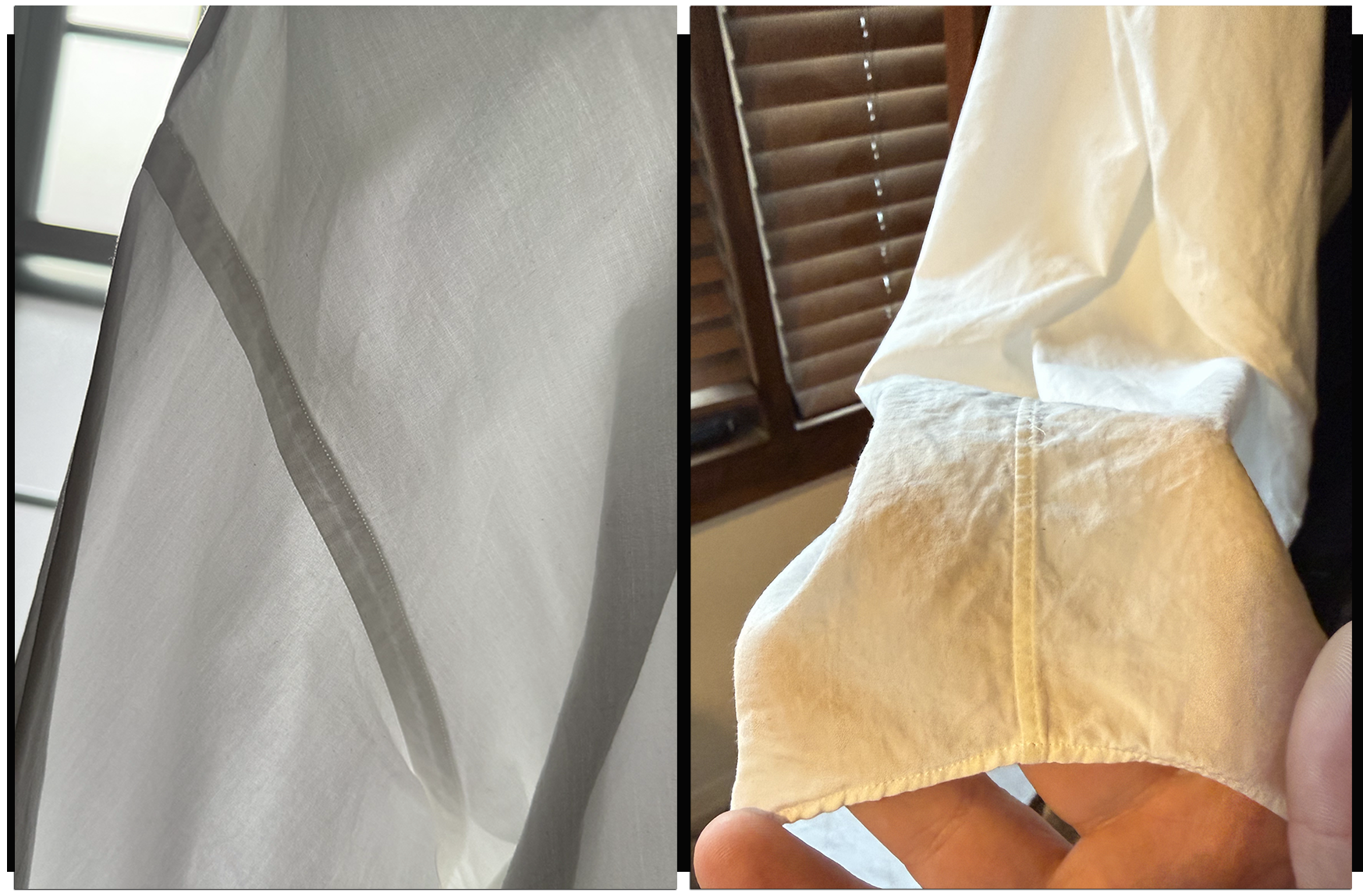
He also sent me pictures of a Comoli shirt he owns, above, whose shoulder construction and thin, gusset-free side-seams he admires. “There are brands like Niceness that do a hand-sewn gusset, and it’s cool, but it’s not for me,” he said, adding that there’s zero structural need for a side gusset.
Similarly, while it’s technically easier for un-shanked buttons to come loose, he explained, he sees “no real need for a button shank unless you’re working with really thick materials.”
Keith brought up labor costs, too: “You gotta keep in mind that if the maker is paid by the garment” — in a wage-theft arrangement known as piece rates — “they’re not gonna pay as much attention as if they were paid by the hour.”
Also? “I have vintage shirts where the underarm alignments are absolutely atrocious,” he said, “and I’ve never noticed.”

This led to his overarching point, which was that “a shirt should feel comfortable on the body and make you feel and look good — and that’s all it needs to do. Tailoring is a punishing world of rules and regulations. Knowing rules is cool, but sometimes I don’t agree with them, and I just think it looks funky and weird. Ultimately I go off what I feel is visually pleasing.”
I can’t think of a better way to put it. We are a pro-rules newsletter, and we believe that knowing more about the ins & outs of construction can help you deepen your appreciation of a piece. But there’s something irreducibly alchemical to our relationship to clothes, and to our sense of their true worth. Holding a ruler to your shirts and counting up the stitches is never gonna capture that.
P📐E⚖️A📊C🧵E✨ til next time,
— J & E
Our Essay Archive, a curated selection of our Profoundest Thoughts, is here.
Miuccia Prada is worth $4.8B. How good of a person do you expect her to be? Read our Spyplane Deep Dive.
Here’s what you learn about getting dressed when you wear black for a month straight.
Our interviews with Cameron Winter of Geese, Ryota Iwai from Auralee, SC103, Nathan Fielder, Michelle Williams, Sarah Squirm, Evan Kinori, Adam Sandler, Brendan from Turnstile, MJ Lenderman, André 3000, Matty Matheson, Laraaji, Tyler, The Creator, John C. Reilly, Father John Misty, Steven Yeun, Clairo, Pusha T, Conner O’Malley, Christophe Lemaire & more are here.
Finally, it was high time that someone discussed this notion of easy judgment, but also how quickly someone becomes a “master” simply because they have a large following on social media with power. Please excuse my English, as I am a native Greek speaker. As a small brand owner in Athens, my heart hurts when I know that a garment produced in 1,000 pieces or even more can cost, for instance €500 while for us producing 1–3 shirts per fabric and per style in a family workspace I still have to hear people visiting Athens say, “Can you make me a discount?” just because we’re in Athens and they feel the need to ask for it.
I am very disappointed lately that people think the more expensive the better just because big brands can mark up the prices due to their name. Also, we see the same brands everywhere now, again and again. Even the “niche” brands no longer produce only 1–10 shirts/garments, but much more than that, since they wholesale and are present in thousands of online and physical stores.
Only a few people who are genuinely interested in fabrics and garments are truly looking for a special shirt and not only to check the seams and the heaviness of the fabric or the origin of the buttons but also where it is produced, from whom, how and in how many pieces it is available and where they distribute.
We are probably living in a time when the more followers and retailers someone has, the wiser and more successful they are perceived to be. But aren’t we all tired of judging a piece of work, an artist, or a brand based only on that? I wish sometimes social media wouldn’t exist and we could learn only about creators by exploring, traveling and discussing or exchanging experiences. Thank you Spyplane for this chance to talk about all these and gathering human beings from all around the world with different perspectives and not guided by TikTok! Reading this today made me think of 100 issues at the same time and this is good, food for thought and for dressing.
I watched a few videos by a channel I won't mention by name, because I'm not trying to start anything here. In each the person was thrown a box, took out a garment, and then proceeded to take it apart on a cutting mat, discussing what they liked and found questionable. At the end they did a little round up and offered an opinion on if the garment was "worth it".
It was all pretty chill and I think an ok way to engage with clothing. It also left me feeling totally empty, even sad. Like if a restaurant reviewer just went through all the ingredients on a plate and then the method used to cook them, delivering a final grade on whether the meal was worth it. I mean, maybe someone would like that—ugh—content. But would it contribute anything meaningful to our appreciation of food? (Please don't @ me with examples of this very thing.)
Sidenote: on my last trip to Japan I picked up an Auralee quarter-zip top. It is a lovely, muted yellow, undeniably well-made, but it was the fabric that sold me. I've never touched cotton like this, and maybe should never again because it will ruin all other cottons for me. I know there's multiple levels of privilege operating in this anecdote so I'm not going to say, AURALEE DEFO WORTH IT. Only that I hope to own it til I get cremated.