

How’d you get that shape?
Industry secrets and Turbo Design Talk with the slow-clothes masters of London's Sono
Our interviews with Cameron Winter and Geese, Ryota Iwai from Auralee, Nathan Fielder, Sarah Squirm, Adam Sandler, Evan Kinori, Brendan from Turnstile, MJ Lenderman, Maya Hawke, Camiel Fortgens, Bon Iver, André 3000, Eckhaus Latta, Matty Matheson, Laraaji, Tyler, The Creator, John C. Reilly, Father John Misty, Clairo, Steven Yeun, Conner O’Malley & more are here.
Our brand new Home-Goods Recon Spectacular has intel on furniture, shower curtains, dish racks, rugs, ceramics and more.
Mach 3+ city intel for traveling the entire planet is here.
Check out our monumental new list of the 50 Slappiest Shops across the Spyplane Universe.

Sono is one of the very best small clothing lines on earth. Designers Stephanie “Sono” Oberg and Simon Homes founded it together a few years ago in London, after a couple decades working at places like Bless, The Row, and Lemaire.
They started their own label from the premise that the world didn’t need any more clothes, so if they were going to make them, they had to earn the right.
What did that look like in practice?
For them, it meant putting a tight set of self-imposed constraints on every aspect of their line, from aesthetics to materials to production.
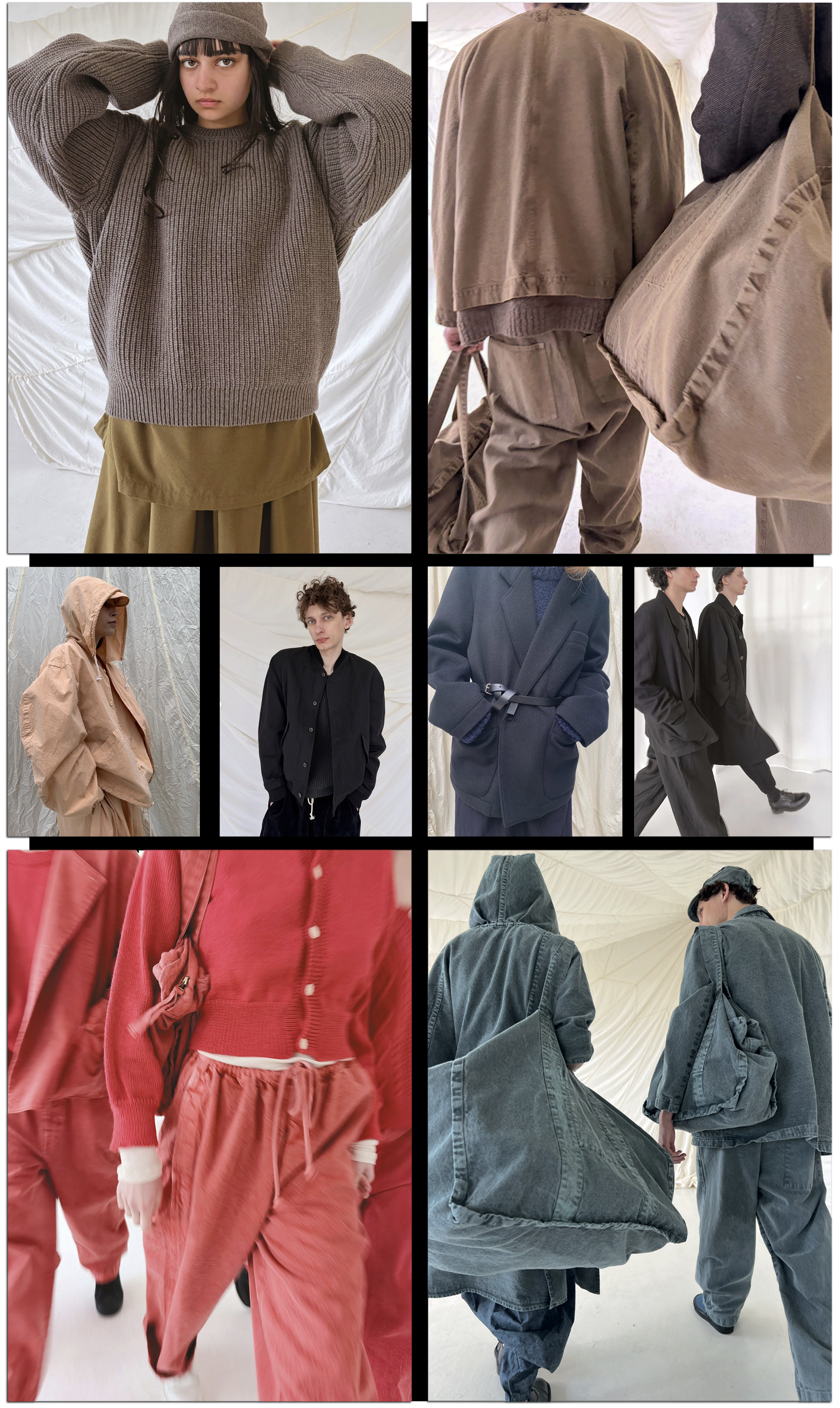
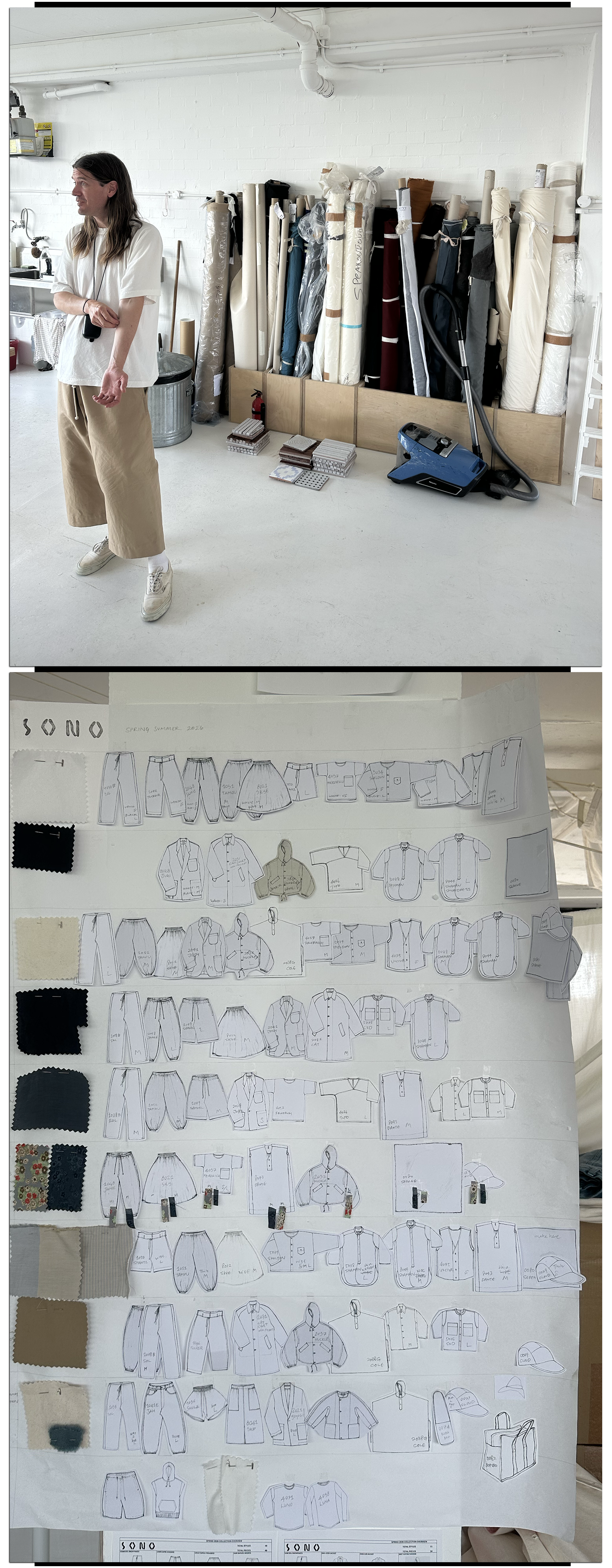
Sono’s cuts, often inspired by vintage finds, are largely unisex. They rarely introduce new styles. The colors they put out this season are designed to go well with the colors they put out two seasons ago, and with the colors that will come out next year. They custom-develop their own fabrics (pigment-dyed organic-cotton denims, recycled-wool twills) with two mills and, on occasion, a weaver whose work they love. They cut patterns and ship out orders at their London studio. And they produce their garments in just two factories — one in the UK, the other in France — which they can visit easily, and where they know the workers are treated well. At the French factory, they share space on the production line with Hermès.
That might make Sono’s clothes sound fancy. But despite their résumés, Sono and Simon have an aversion to “luxury.” Their clothes are high-level and handsome off the rack, but they’re unequivocally hardbody, too, starting out on the tougher-and-bulkier end of the spectrum and only gaining in suppleness over time. “We chose this weird niche of making clothes with very specific suppliers and very specific mills — but making it really non-luxury,” Simon says.
We’ve f--ked heavy with Sono’s vision since we first wrote about them back in 2023. Also? Since they’re principled veterans, they know lots of behind-the-scenes truths about the industry, and they aren’t shy about sharing them.
So I (Jonah) was stoked to get on a call the other day with Simon and Sono, who popped on at the end. We discussed designing clothes you want to wear yourself and then letting other people figure it out; the real reason there’s so much plastic in fabric; what a “Made in Portugal” tag means; the swaggy virtues of twisting your yarns to 1940s-level tensions, and more Turbo Clothesmaking Talk.

Blackbird Spyplane: The last time I saw you, we talked about how there are two kinds of designers: the ones who make clothes for themselves, and the ones who make clothes for other people. You and Sono are definitely the clothes-for-yourselves kind.
Simon Homes: “100%. People talk about a Karl Lagerfeld or someone like that, they talk about their muses, about the hats they put on — it’s almost like method acting, where you become the customer. I’ve had to do that at other places, but now that it’s us, our aesthetic is, ‘If she’ll wear it, and if it I’ll wear it, it’s right.’”
Blackbird Spyplane: One of your core principles is no plastics in the clothes. People are increasingly wary of nylons and polyesters, trying to eliminate them from their wardrobes. Other people will tell you that these materials have their own benefits, in terms of construction, performance and even environmental impact — that the picture isn’t so black and white.
Simon Homes: “This has become, like, a micro-culture-war within fashion.”
Blackbird Spyplane: Are there uses of plastic in clothes that justify themselves?
Simon Homes: “Totally. Take high-performance rain wear. As good as waxed cotton is, it’s a particular thing with a life of its own, very traditional. When it comes to real performance clothing, the use of nylons, all that that family of polymers, and then the high-frequency welding that comes with it, it’s awesome.”
“But when it gets to everyday clothing? If I’m really honest, wool suppliers around Europe are adding more and more polyester to their wools, and they’re telling us it’s because it’s lighter and gives better performance or whatever, but they’re not doing it because of that. They’re doing it because it’s cheaper. It’s kazillions cheaper.
“If you have a cotton-poly, or wool-poly, the essential function of that poly will be to reduce price. All these experiments with blends, it’s always been, ‘How much will the customer notice?’ No matter what people argue, I don’t believe it’s about performance.”
Blackbird Spyplane: I guess there can be a certain science-experiment aspect to it, where people develop a technical material that just looks and feels special. Another common argument you hear is that adding nylon can increase a cloth’s durability.
Simon Homes: “There’s a reason they used to do it for workwear trousers, because nylon in wool can help hold it together in the knee or seat. But that’s if you’re doing really heavy work. And even then, look at Carhartt duck canvas — that’s a very durable fabric, and it’s 100% cotton.”
Blackbird Spyplane: There’s a temptation to get blackpilled about it all. As gnarly as petrochemicals might be, industrial cotton farming is gnarly, too.
Simon Homes: “That’s why organic cotton is a non-negotiable for us. I was shocked when I found out that if you wanna grow enough cotton for a t-shirt, you need 1 square meter of cotton field, and that square meter is taking up 1 kilo of fertilizer and 1 kilo of pesticide, all petrochemical-based. If you use that stuff, you can get away with using less water, which people use as a justification: ‘Oh organic cotton uses so much water.’ Which is true. It’s a downside, and it should put a limit on the places where cotton is farmed. But if you’re farming cotton at that scale, with that much heavy pesticide and petrochemical fertilizers, that much nitrogen, all that goes into the water table, to the communities who live there and work there. So what’s worse?”

Blackbird Spyplane: The factory Sono uses in France also makes shirts for Hermès. You once told us something about how they come in with all these tiny high-powered vacuums to remove contaminants before they make the clothes…
Simon Homes: “So we’re kind of the weirdos on the factory’s production line, but they enjoy working with us because it’s not the average day. A client like Hermès, they’ll make 1,000 white shirts in a single production run. Everyone has to make the shirt, it has to use the same thread across all machines, and they bring in these micro-hoovers and hoover every part of the machines, hoover inside the cutting parts, the floor gets mopped and hoovered a thousand times, it’s insane. I’d eat my lunch off the floor. All our fabrics and any other dark-colored fabrics have to be moved out — anything with any possibility of a dark fluff that could possibly contaminate the white shirts. Then they put on white gloves, use white threads and white cutting mats, and cut thousands of meters of white poplin, just machining white shirts all day.”
Blackbird Spyplane: [REDACTED LABEL] used to make clothes in France, in exactly that kind of factory, but over the past few years they’ve moved a bunch of production to Portugal, among other, farther-flung EU countries. I own perfectly good clothes made in Portugal. But it does seem like a place where some small-to-medium-size brands go when they want to boost margins. What does a “Made in Portugal” tag signal to you?
Simon Homes: “That’s a really good question. With Made in Portugal, the work can be great. They also have one of the lowest minimum wages in the EU, and the cost of living is pretty low. So there’s that aspect to it.
“[REDACTED] still produces things in France, but they’re slowly moving their lion’s share to Portugal. They took on a merchandiser who came from LVMH, funny enough, who’s really smart, he’s a very savvy business guy: He put up the prices at wholesale and moved production to Portugal. Because that’s their brief, to increase that profit margin. Different people have different briefs.”
Blackbird Spyplane: Lots of labels are positioning their clothes as luxury these days, as the middle falls out of the market and prices get either criminally cheap or flabbergastingly high. You guys bring Hermès-tier seamstresses and luxury capabilities to bear on clothes that, while they’re high-level, you’re careful to emphasize aren’t luxury.
Simon Homes: “In luxury, there are all these golden rules: people want cashmere wools to be lighter and fluffier, things like that, touch points, sensory things. And they feel lovely, I agree. But I always think about working with Christophe Lemaire, who doesn’t care about that at all. For Christophe, the most important thing is silhouette: ‘How’d you get that shape? How’d you get it it to hang like that?’
“Because often you’re referring to vintage garments made 60-70 years ago, when the people weaving the fabric had different briefs and values. Those old fabrics feel awesome, because their main brief, probably, was to make it last a long time. Fabrics had to be more robust. People were wearing these woollens every day, in all weather, so they had to really hold the shape of the garment over time. You had to be able to wear it in a non-precious way, even if it was beautifully made.”
Blackbird Spyplane: What’s an example of a beautiful but non-precious fabric at Sono?
Simon Homes: “We wanted to use post-consumer wool, which means getting old 100% virgin-wool jumpers, shredding them, re-spinning them, and making new garments. So we went through the collecting and shredding and re-spinning, and got this grayish multi-flecked yarn. You have to dye it black, dark brown, or navy if you want a consistent color.
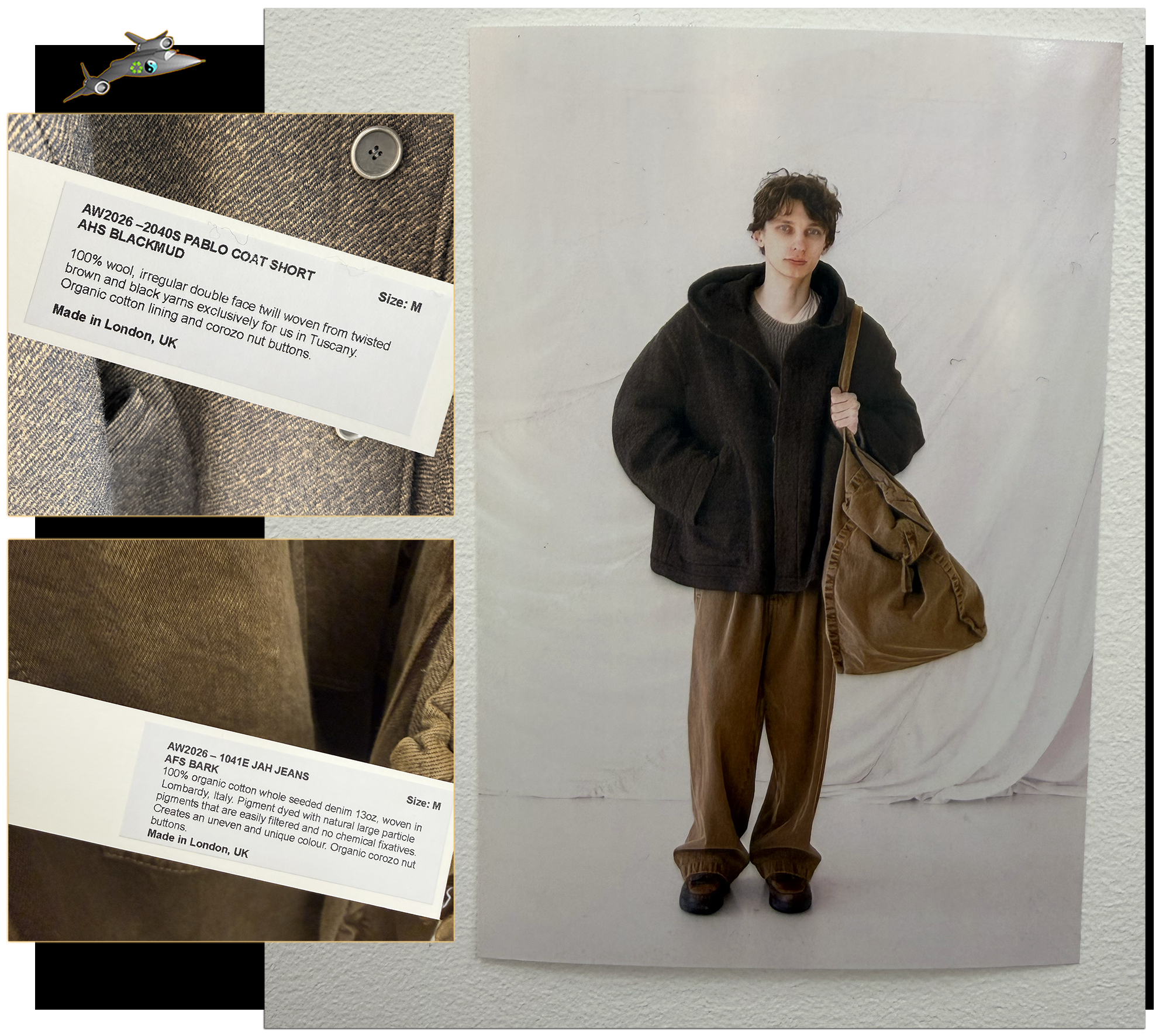
“We brought it to the guy in Tuscany who weaves our double-face wool, but the yarn wasn’t at his level of weaving. So he re-spun it on his terms. That was 6 months of development alone. Then people want double-face to feel really buttery and soft and drapey. And we said, ‘No, put extra yarn, make it more beefy and bulky, give it more attitude.’ We take all our yarns, both wool and cotton, and triple the tension versus the average tension you find now.
“Finally comes weaving, and the question of how many filaments are running through your warp and your weft. As the whole industry has modernized and become much more catered to the luxury customer, the yarns going in there have become softer, lighter, fluffier, less hard-twist, and there are fewer yarns running through the loom. Whereas we get those yarns, twist them up to get all that fluff off, and then we put too many of them on the loom. As it weaves, it becomes a more dense, fuller fabric. That’s roughly how you achieve the hand and silhouette we’re after.”
Blackbird Spyplane: Having worked at Lemaire and The Row, do you want Sono to get as big as those lines?
Simon Homes: “Hell no, mate.”
Blackbird Spyplane: Why not?
Simon Homes: “I love those people, they’re awesome at what they do, and that’s not me. I love working for them and supporting their vision, which is super clear and rings true to them. But for ourselves, I feel like we’re at the maximum point already.
“In order to do this project, Sono and I need to be involved every day. I’m not out shearing the sheep and bringing the wool in, but within the manageable part of it. I’ve worked in so many companies where there’s departments. I still want to be on the factory floor doing quality control, I want to be talking to the person who does the buttonholes.”
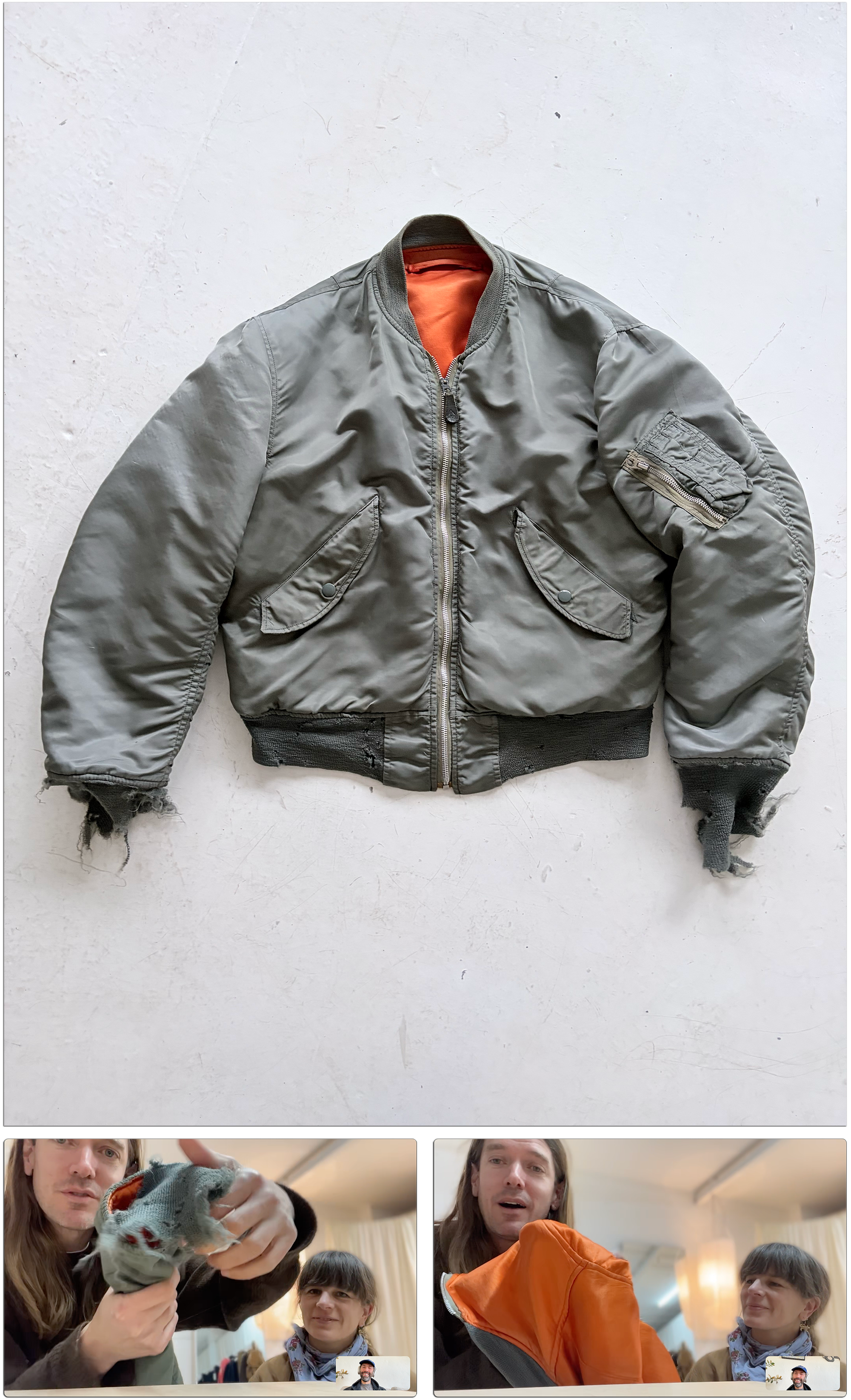
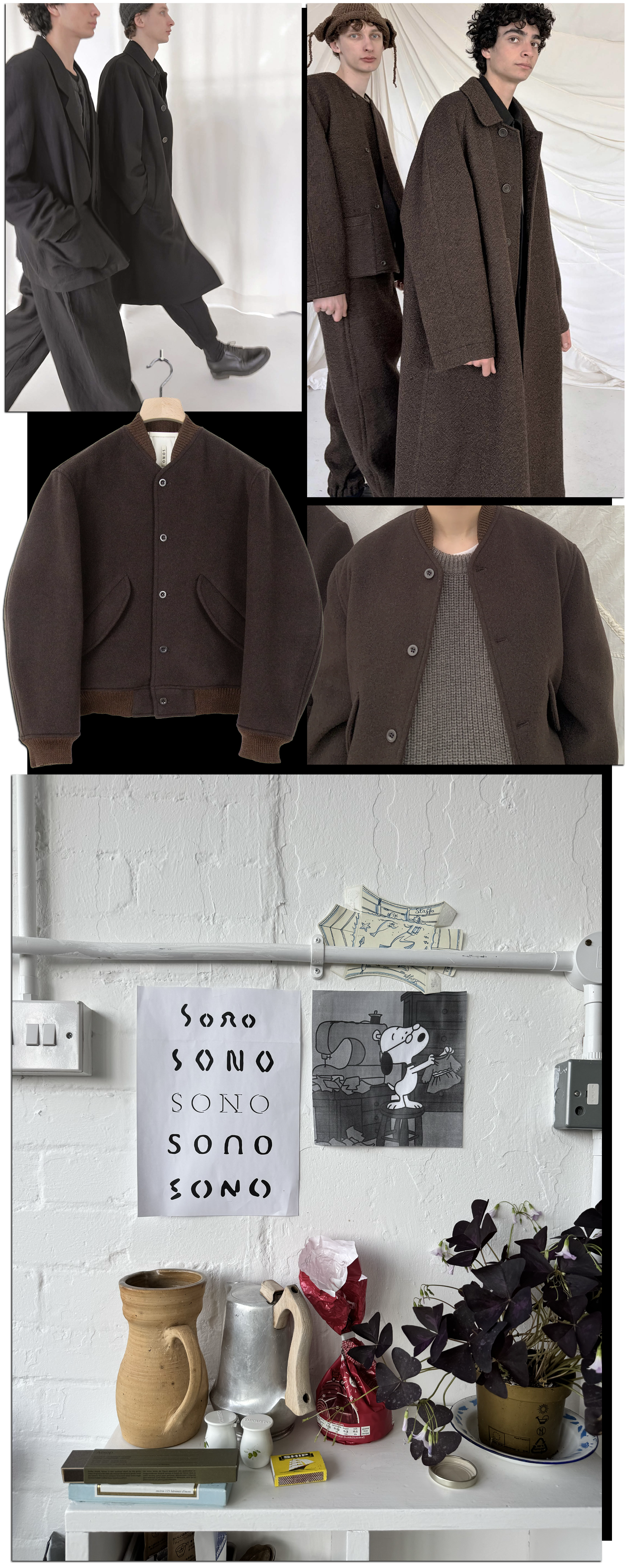
Blackbird Spyplane: All right, finally, I asked you to tell us about a cherished possession, and you chose a vintage Alpha Industries L-2B Air Force Flight Jacket, above. What’s the story?
Simon Homes: “This guy here is the reference for the bomber we make, and it’s been a reference point for every company I’ve ever worked for. Sono really wanted a bomber jacket — we’d just started living together, maybe 23 years ago — and we went to this early morning Sunday flea market in Tokyo, at a rugby stadium they’ve since torn down. It was this car park full of people getting rid of things, as opposed to a beautiful-curation flea market. I paid about £20 for it, and either Sono or I have worn it every day since. Our kids wear it now.
“It’s 100% wool rib, fabric woven in the U.S., made in the U.S. It’s actually an awesome use of an oil-based polymers fabric: This nylon is 52 years old and still looks great. It has a great shape, and every key moment in our lives, it’s been with us — picking up our 7-week-old puppy, 18 years ago, I remember it was snowing, so we shoved him in the bomber and brought him home.”
Blackbird Spyplane: When’s it from?
Simon Homes: “Early ‘70s, I think 1974. It’s funny, the authenticity brands like Buzz Rickson’s will find the ‘perfect year’ of different Alpha Industries pieces, for certain reasons, and this is one of the least-desirable years. But that’s why we like it.”
Sono: “The zipper doesn’t quite match, but it’s still working, it’s not snapped. I just love it. It always hangs on the hook in the hallway at home — so every day someone in the house will grab it.”
Sono’s SS26 collection comes out next month. Their webshop is here, and they’re stocked at shops including C’H’C’M’, Opia, Maidens, Neighbour, Una, Vestige, DPTO, and Rendezvous. Their sustainability page is long, detailed, and bogosity free. They’re on IG here.
Our guide to how to pack for a trip swaggily is here.
The Blackbird Spyplane Profound Essay Archive is here.
I have only a small number of pieces from Sono, but those few things are the benchmarks by which I judge any similar item. In fact, just yesterday I was pondering a blazer from [REDACTED], but when I mentally compared it to my Yuri, I realized I was just setting myself up for disappointment and smashed x on my browser. A girl’s gotta have standards, for chrissakes.
In a world where literally everything feels like a grift and the words “authentic” and “real” have become self-owns, Sono’s ethos is a balm. Thank you so much for this thoughtful, timely interview.
My girlfriend who is the top swaglord in our house wears a sono merino log sleeve almost every day and we are constantly remarking how weird it is that none of the “outdoor” brands (icebreaker excepted) have come to the conclusion that the merino mid layer is superior to every plastic option out there