

Nobody's born a minimalist
The joy & humor of surrealism. Plus, a new jewelry crafter, DIY sandal kits, reworked vintage tees & more
Welcome back to Concorde, Blackbird Spyplane’s “women’s vertical” that the fellas love as well. Every edition is archived here.
Our interviews with Nathan Fielder, Michelle Williams, Seth Rogen, Sarah Squirm, Cameron Winter of Geese, Mac DeMarco, Ryota Iwai from Auralee, SC103, Evan Kinori, Christophe Lemaire, Brendan from Turnstile, MJ Lenderman, André 3000, Matty Matheson, Laraaji, Tyler, The Creator, John C. Reilly, Father John Misty, Steven Yeun, Pusha T, Conner O’Malley, Clairo, Adam Sandler & more are here.
These are the sickest hiking-style sandals.
The best natural fiber activewear is here.
Check out our monumental list of the 50 Greatest Shops across the Spyplane Universe.
We don’t run ads and we never use affiliate links except for one-off secondhand gems we find on eBay and books on the independent bookseller Bookshop. We laid out our anti-spon position here.
Over the past year, I (Erin) have been nurturing a theory: No one’s born a “minimalist.”
Our urge toward ornamentation is innate. It is closely connected to our urge to create pure, senseless joy. Our countervailing urge to strip away and simplify, meanwhile, is learned. It’s a reaction to a culture of noise, decadence and excess.
This reaction makes sense. There’s something obviously appealing about trying to pare down, streamline, de-clutter, and thereby come into more aerodynamic alignment with “what really matters.” But A) this impulse is destined to fail, because ornament always finds its way in. And B) over the past few years, “minimalism” has ossified into a uninspired, preset look: easily graspable, readily starter-packable, and a supposed cure-all for the anxiety that perennially online folks feel about how photos of themselves will age.
I get the power of a white tee and jeans, or a LBD. Looks like this have a spot in my rotation, and I know that, in the throes of decision fatigue, trust-falling into what some putative majority has deemed “tasteful” can feel like a balm.
But where’s the joy in playing it safe? The soul wants more! I remain a firm believer that we all need a splash of bad taste. A little can go a long way — but please, give me a glimpse into the life of your mind! Let me know the lights are on upstairs… Tell me you have a sense of humor… That you have an imagination, an appetite, a respect for the mess and brutality and humility of life…!
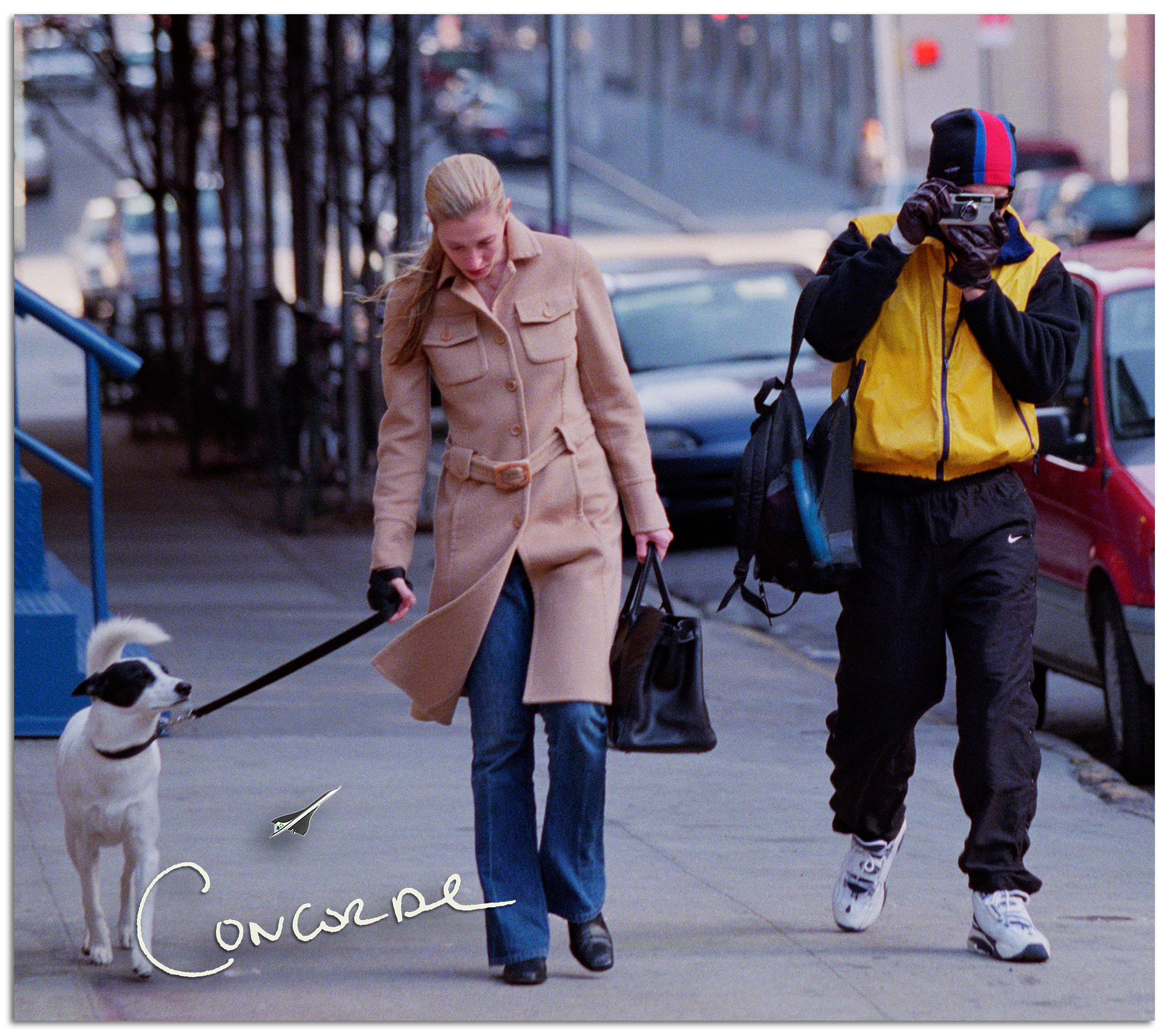
Even fashion’s most hallowed “minimalists” aren’t really minimalists. Jil Sander used decorative prints and fasteners as far back as the ‘80s. The Row has been making novelty hats for years. Everyone trying to do a copy-and-paste on Carolyn Bessette Kennedy’s famously minimalist style, as captured in the pic above, would do well to take a page from JFK Jr., with his headfirst approach to color — and his gorpy jester hats!
In that spirit, today I’m leaning into the pleasure, humor and absurdity of surrealism. We’ve got:
The often-misunderstood genius of designer Elsa Schiaparelli, as captured in a new museum exhibition…
(… which unwittingly highlights the lameness of the current billionaire-backed Schiaparelli reboot.)
Contemporary designers with new work, out now, that’s keeping fun and fantasy alive, along with similarly vibed vintage finds.
An up-and-coming NYC jewelry designer; the best sandal collab this summer; reworked vintage tees; a leather craftswoman who makes beautiful objects for you and your home…
& more !
Let’s get to it —
Last fall, after catching some whiffs of tradwifery and misogyny on the SS26 runways, I had a conversation with Spyfriend Stella Bugbee, the Styles editor at The New York Times, about whether fashion hates women.
This question returned to my mind earlier this month, along with a new one — Should men even be allowed to design clothes for women?? — as I took in the big new Elsa Schiaparelli exhibit at the V&A in London. Schiaparelli was an early 20th century Italian designer who embraced avant-garde ideas. Some were as seemingly innocuous as trousers for women. Others were as outré as a hat that looks like an inverted high heel, or a cellophane-wrapped dress. Her influence is enormous: Without Schiap, we wouldn’t have Margiela, Bless or Kiko Kostadinov, to name just a few.
The V&A show, up through early November, pairs her groundbreaking clothes and accessories, mainly from the 1930s and ‘40s, with “new” Schiaparelli pieces — she died in 1973, but the label was resuscitated in 2014 by a luxury-goods billionaire who bought the name and, in 2019, put Daniel Roseberry in charge of design.
Elsa Schiaparelli means a lot to me. Back in 2003, my parents, who always encouraged my interest in clothes, took me to an exhibit on Schiaparelli at the Philadelphia Museum of Art, the first major retrospective of the designer.
At the time, I wore thrifted handmade sweaters (my favorite had been lovingly embroidered with strawberries, I assume by someone’s grandma). I sewed red rickrack along the pockets of the cropped zip hoodies I’d bought in the boys department. I hot-glued found objects — shells, buttons, vending-machine toys and puzzle pieces — to barrettes and pins, and I called it jewelry.
And so even though I didn’t know who Schiaparelli was, my folks thought I’d dig her sense of humor and eccentricity. And they were right. Schiaparelli’s work was, and still is, extremely my s--t:
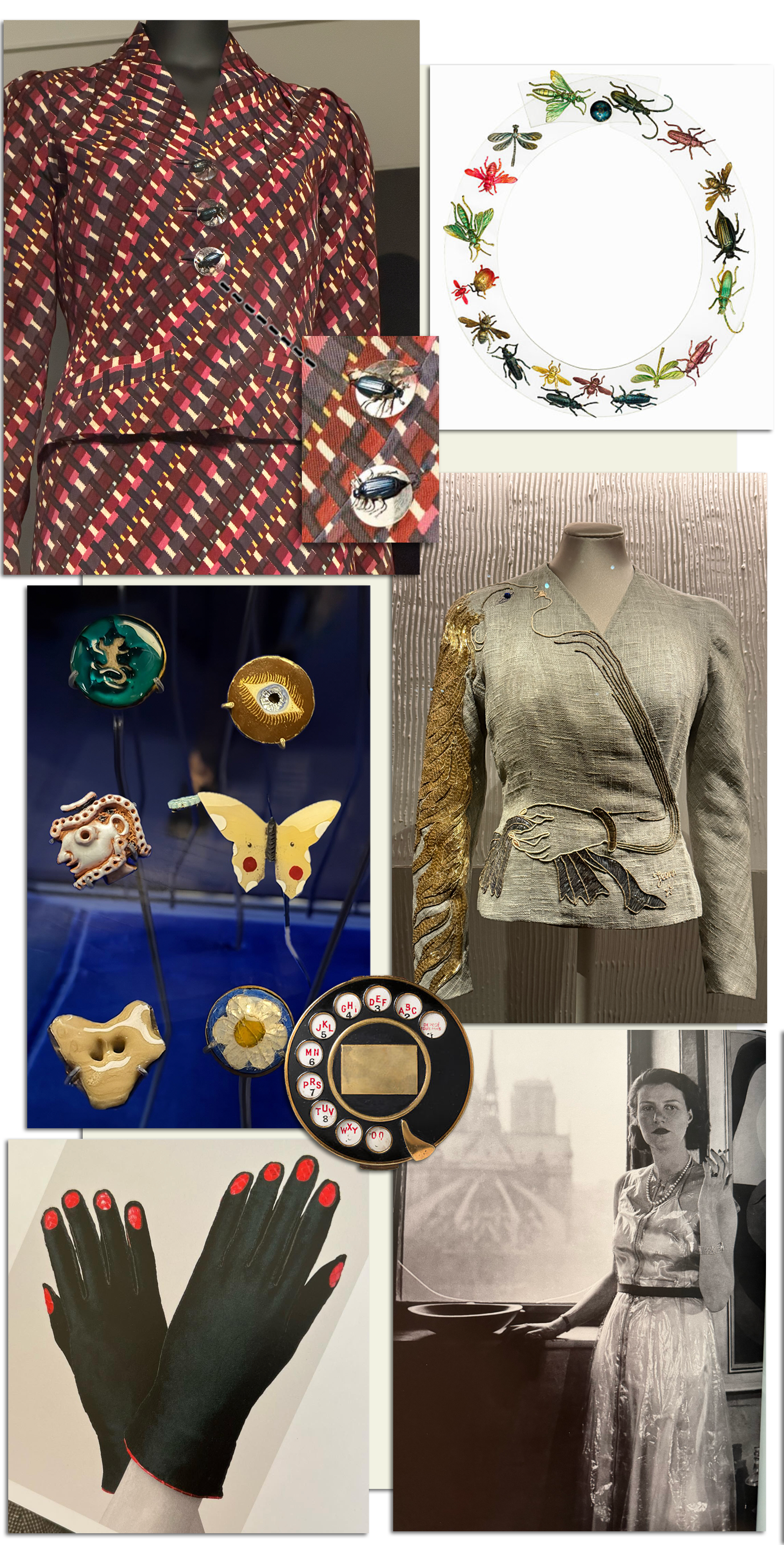
I loved her collaborations with artists like Meret Oppenheim, Jean Cocteau, Man Ray and Salvador Dalí — with whom she famously made an evening dress featuring an erotically charged lobster print, a powder compact that resembled a telephone dial, and the high-heel hat.
Since the bizarre quotient in Schiaparelli’s designs tends to get foregrounded, though, what lots of people are prone to miss — and what the V&A exhibit does a good job of emphasizing — is that the majority of her clothes were deceptively practical:
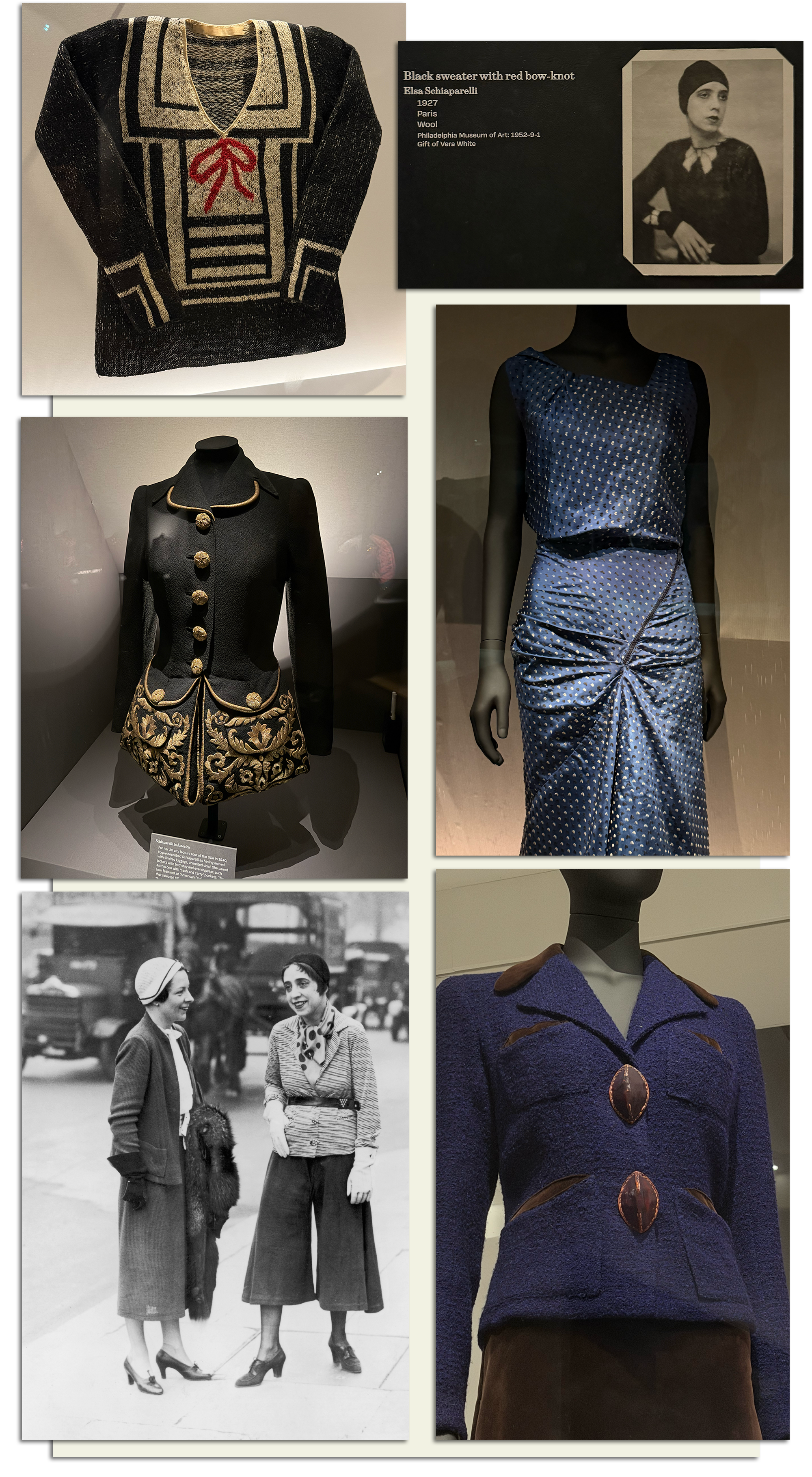
Like Concorde icon Claire McCardell, Schiaparelli prioritized a woman’s comfort and freedom of movement in her designs, opting for exposed plastic zippers that were easy for a woman to get on and off herself. She designed sportswear sweaters and trousers for women in the early ‘30s (she created a scandal in 1931 by dressing a Wimbledon tennis player in culottes instead of a skirt). She gave suit jackets big honking pockets that let her leave the house unburdened by a handbag.
That attention to practicality is there even in her most outlandish designs. Her 1938 skeleton gown, another collaboration with Dalí, below left, is a second-skin slink of silk crepe, embellished with seemingly exposed bones, quilted into the fabric. It’s an extremely covered-up garment — high neck, long sleeves, extended hemline — and yet it manages to create definition, without the pain of a corset. It’s elegant and macabre at once.
And that brings us to Roseberry, several of whose designs for the New Schiaparelli were on display at the V&A show. The side-by-side comparison didn’t do him many favors:
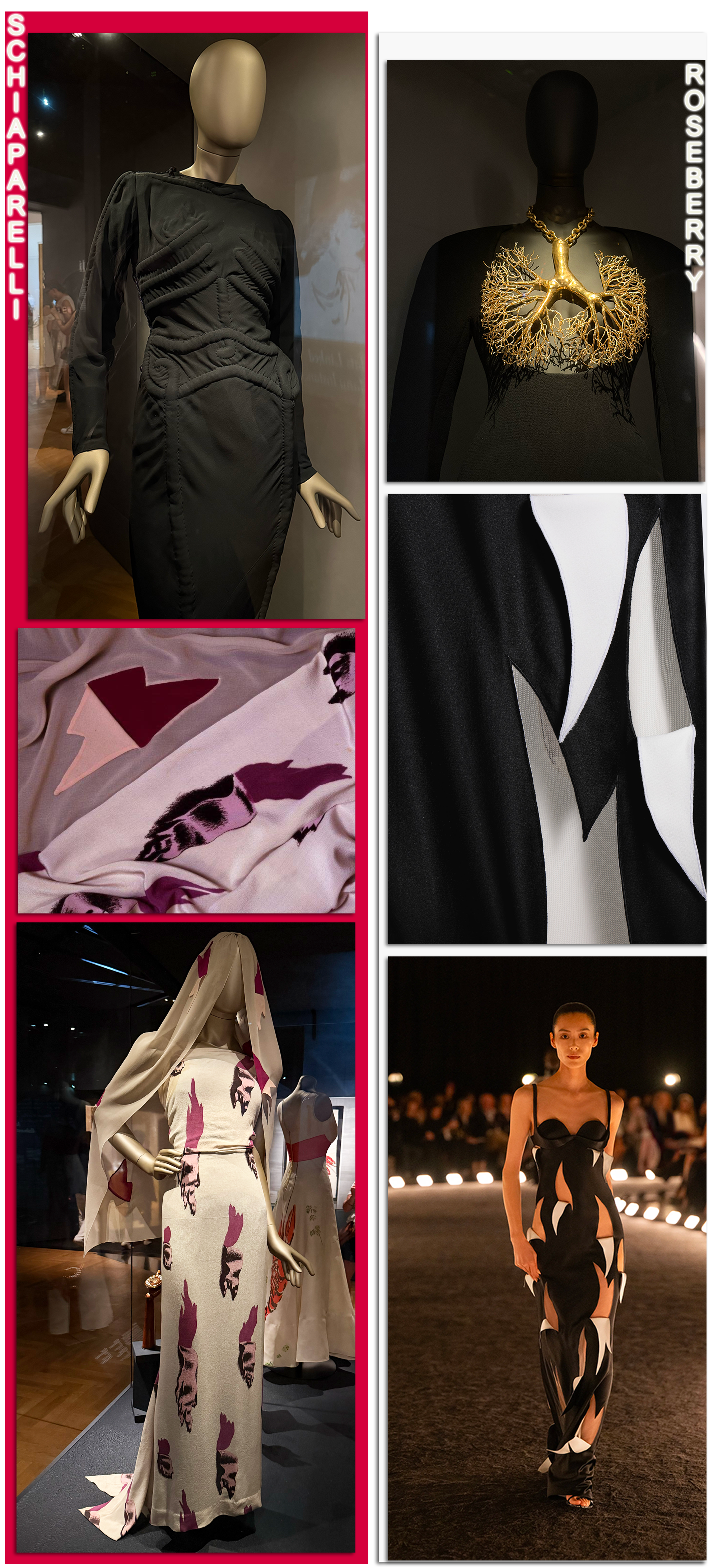
Take his humorless riff on the Skeleton dress, from 2021. He completely cuts out the bodice, exposing the breasts, then cages them in a lung-shaped brass necklace with the texture of a ramen brick. Not only does it look wildly uncomfortable, but it totally misses the point: it takes what was a trompe l’oeil trick and moves it into the realm of the literal.
Her Tears dress, created between World Wars, was meant to invoke open wounds — provocative, but not in any remotely straightforwardly “sensual” way… Yet that’s how Roseberry interprets it, above right. He dumbs down her complex idea by making it “sexy,” and just exposes the skin beneath. We have exited the realm of the mind, and find ourselves entirely in an Ozempified body. This dress, incidentally, is composed of 78% acetate and 22% viscose, it costs $20K, and it reminds me of something you might find at Spirit Halloween.
As I moved through the show, I wondered why there was so much of Roseberry’s Schiaparelli work in this show, until I came across a clue. A placard informed visitors the show was “created in collaboration” with the current Schiaparelli camp. I’m not sure whether this meant they partially financed the exhibit, helped source archival material, or something else, but it does bespeak a clear coziness.
Schiaparelli once said, “When will women learn that it is better to be smart than fashionable, and that smartness makes fashion?” It’s a lesson we’re still learning.
Next up —
On the thinking that a pinch of surrealism is all you need, here are some of my favorite new and vintage pieces by designers who carry on the witty spirit of Schiaparelli: