

Don't trust people who talk about "intention"
Banned words
Check out our monumental list of the 50 Greatest Shops across the Spyplane Universe.
Our guide to the best natural-fiber activewear is here.
Why are we addicted to standing in line for treats? A profound Spyplane investigation.
Our travel chat, full of recommendations for destinations worldwide, is bustling. But Spyfriends need recon on Beijing and Shanghai!
We don’t run ads, and we don’t use affiliate links on any clothing. We do use them for books on the independent bookseller Bookshop. We broke down our position on affiliate links and spon here.
This means the only people we owe anything are our readers.
— Jonah & Erin

Here at the Plane, it’s well established that we love language & then some. Loving language doesn’t just mean having fun with it in every sletter, though. It also means defending it from violators and dummies. So when we see people perpetrating mass linguistic malpractice, we can only stay silent so long before we feel compelled to speak out.
For instance, as we’ve noted before, in the context of Defending Your Dignity circa 2026: Peace to the hardworking people at the company that hosts this newsletter, but Blackbird Spyplane is, indeed, a newsletter, and not a “Substack,” in much the same way that a podcast is not a “Patreon,” a movie isn’t a “Paramount” and a book isn’t a “Simon & Schuster.” To identify otherwise is to be platformcucked.
Relatedly, we never refer to writing, movies, music, photography and other creative work by the deadening blanket term “content,” which people have been conditioned to do over the past decade. This convention originated among online marketers, advertisers and platform owners to refer to any creative material they could monetize, and to differentiate it from the monetizing mechanisms, like banner ads, pre-roll ads, and other elements of platform architecture. “Content,” from this business-brained POV, is the pesky but necessary stuff sitting between the truly important stuff that pays bills and lines pockets.
To use “content” in the context of everyday conversation, then, is to always invoke creative work as existing in a subordinate and indissociable relationship to monetization tools. Along similar lines, we avoid calling artists and other people who make things “creatives.” This is another corporate usage that’s seeped out from conference rooms where people talk about assets that can help them smash their KPIs, i.e., it’s philistine LinkedIn s--t to be avoided, brother.
Maybe the word “content” makes sense in classifying a viral TikTok that captures the tearful moment when a young woman reunites with a donkey she befriended in childhood. But imagine calling Robert Bresson’s 1966 heartbreaking masterpiece Au Hasard Balthazar — about a young woman who drifts apart from a donkey she befriended in her childhood who might, allegorically speaking, be Jesus, fated to suffer and die for our sins — “content.” Profane!
Today we’re officially adding another term to the no-fly list: Intentional.
We’re not talking about the standard usage of this word, which describes “something that someone meant to do,” as opposed to “something they did inadvertently.” We’re talking, instead, about a cursed, increasingly prevalent usage where brands, influencers, recommenders, would-be self-help gurus and others assure us that the products, business strategies and life paths they’re peddling are “intentional.”
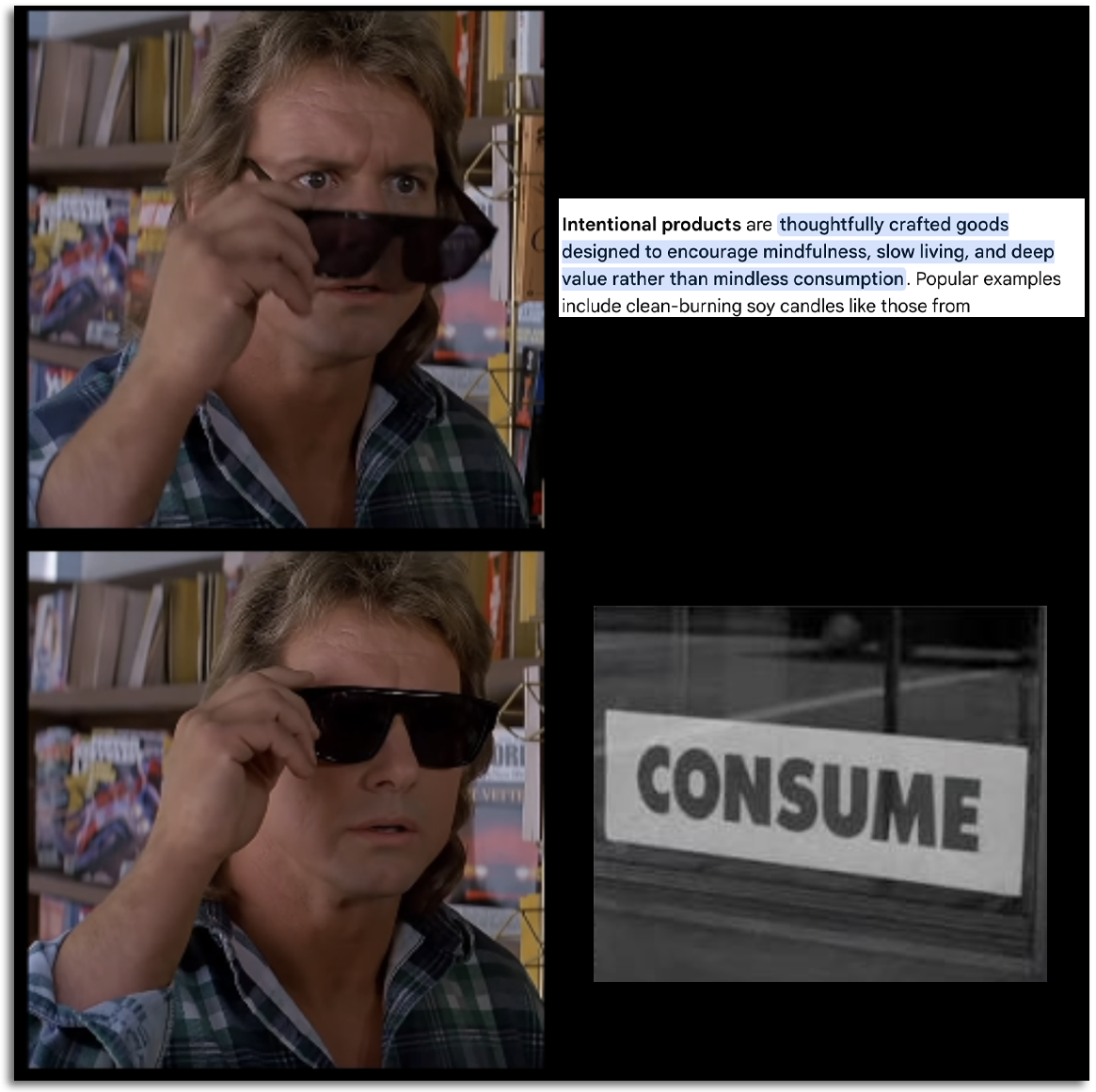
This usage has its origins amid assorted 20th century utopian projects (prominent among them the Back to the Land movement), where likeminded outcasts came together to form micro-societies structured around alternative values forged in explicit opposition to those of the automatons trapped in the societal mainstream, chasing careers and taking out mortgages on suburban homes. Distinct from that soul-stultifying, autopilot way of life, these fledgling utopias were known as “intentional communities.”
That form of “intentional” has mutated and resurfaced more recently in online self-actualization demimondes, where people espouse a rewarding program of “intentionality” across all of one’s choices.
The underlying allure of this pitch is powerful. We’re all distracted, slop is proliferating, lazy people and straight-up grifters out to make a quick buck are everywhere. We find ourselves disoriented by this ceaseless barrage of harmful yet addictive stimuli and snares, liable to react unthinkingly to it — and therefore prone to making bad decisions and experiencing feelings of unfulfillment and mania. And yet! These self-helpers tell us we can find happiness and satisfaction if only we train ourselves to act thinkingly … to move through life with more purpose… focus… clarity… in a word, intention.
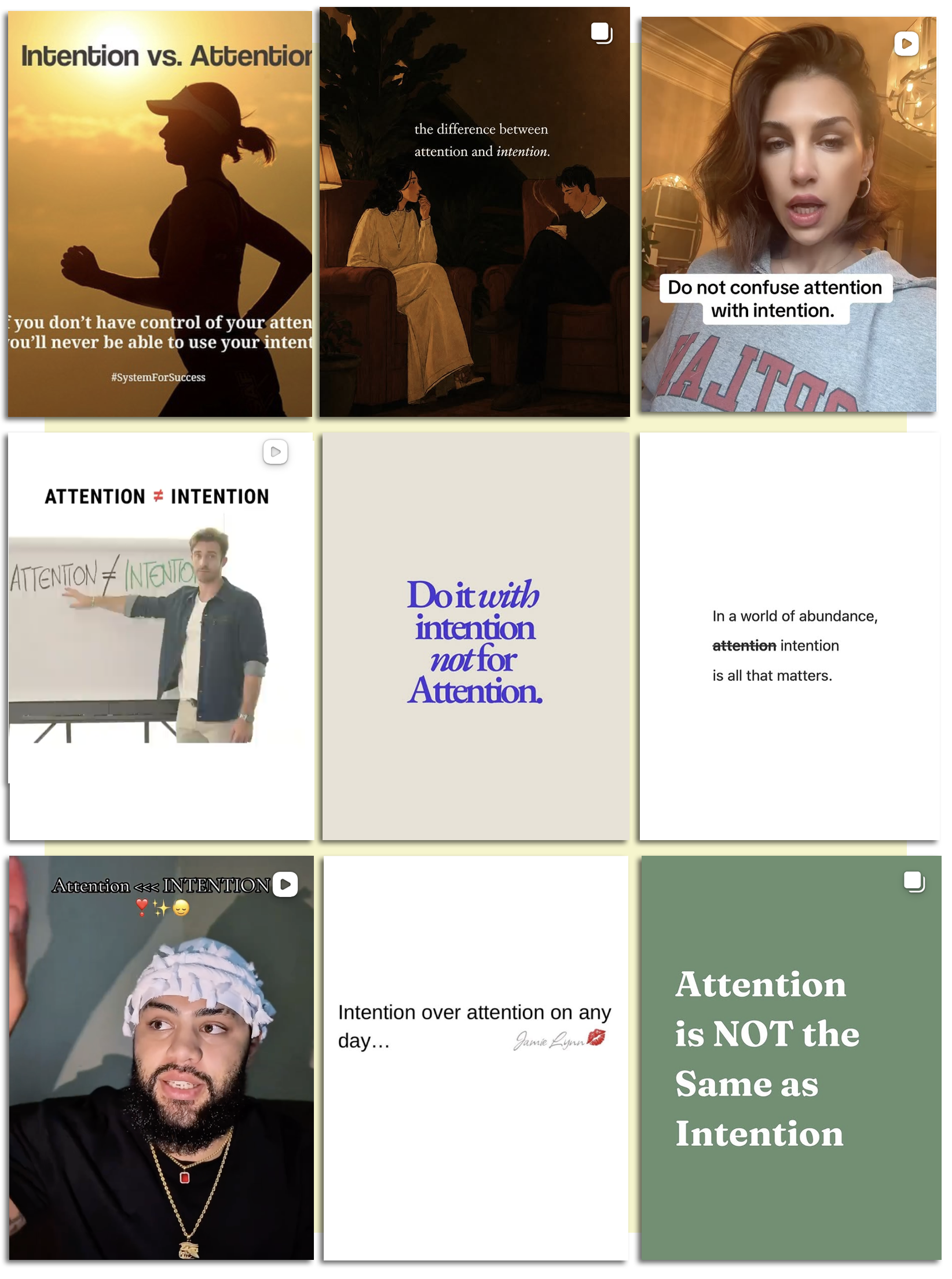
This “intentional” is a “get yours” relative of “manifesting.” There are currently 3.6 million posts hashtagged #intentionalliving on Instagram. Looking through some of them just now, I (Jonah) noticed a subgenre where people affirm the power of distinguishing intention (superior) from attention (inferior), for reasons your boy cannot be arsed to figure out, but which seem to boil down to, “the words are one consonant off, so playing them against each other sounds like wisdom.”
This form of intention has grown popular among not just self-help influencers but also brands, marketers, and the weird corner of the new-media ecosystem inhabited by people who love cheerleading for brands and marketers. (In an era where we’re increasingly pressured to treat all instances of human interaction as sales opportunities and branding exercises, this seems to be a growth sector.) It’s no longer enough to list a product’s virtues. Now people feel the need to talk about the intentionality with which a product was made.
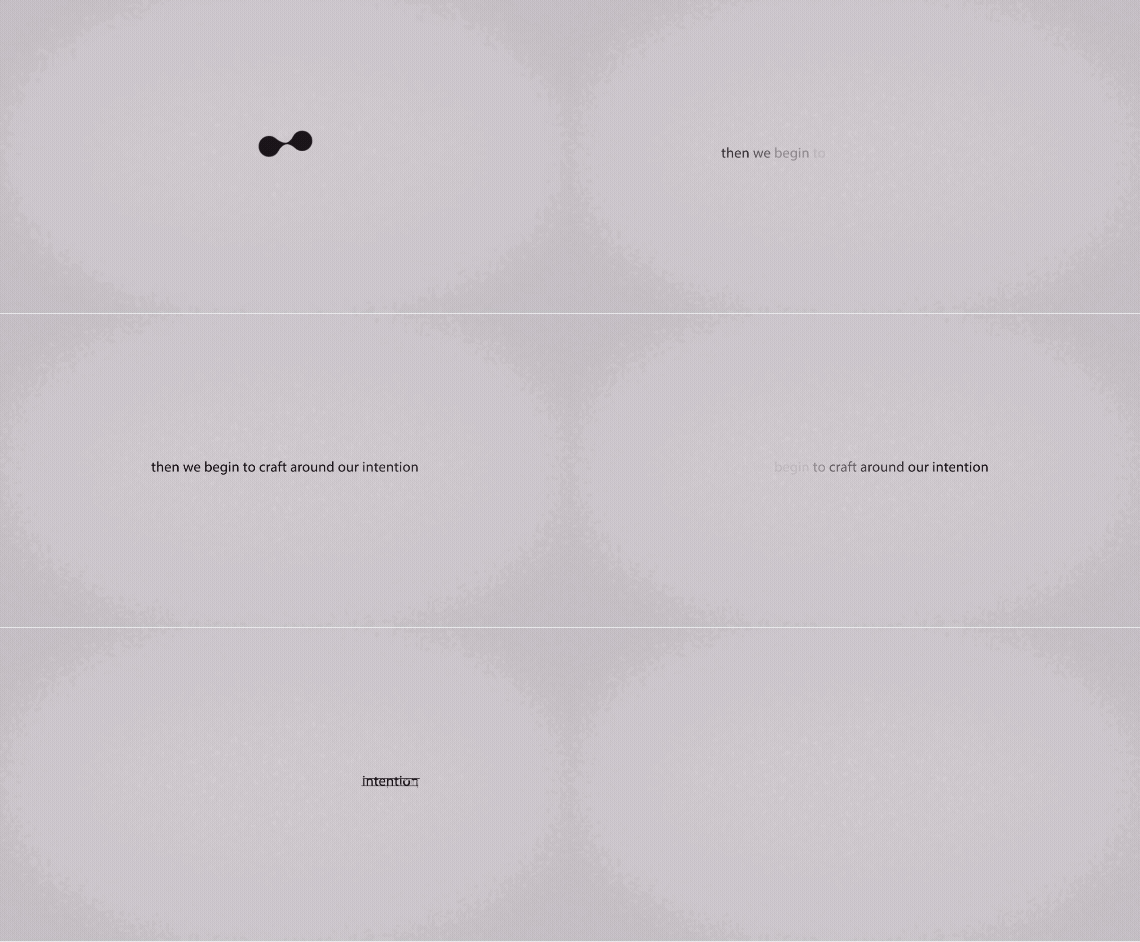
In so doing, these people are (unintentionally?) stealing their whole flow from a developer-facing 2013 Apple ad called “Intention.” “Design intent” is a phrase you encounter commonly when designers evaluate work, i.e. what was the intent with this design, and how successful is the result in communicating and executing on that intent? The Apple ad sought to extrapolate this convention into a broader mindset, setting inspirational piano music to animated lowercase text. “If everyone is busy making everything, how can anyone perfect anything?” the ad begins, going on to explain that “the first thing we ask is, What do we want people to feel? Then we begin to craft around our intention.”
Nearly a decade and a half later, with ever-rising tides of junk, dupes, and now slop sloshing around our knees (necks?), this exact message of “crafting around intention” while everyone’s “busy making everything” has an acute relevance. And so we’re hearing it parroted by all kinds of brands, large and small. I went to search for some prominent examples the other day and found a great NYT article about the rise in use of “intentional,” written last fall by Marie Solis, in which she notes that marketing materials for Hailey Bieber’s Rhode have touted the line’s “intentional skin care and beauty essentials,” and that Kendall Jenner has celebrated her and Alo Yoga’s shared commitment to “being intentional.”
Google a phrase like “intentional fashion brand” and you’ll find other apparel-industry cases, including a remarkably unhinged and severely unpunctuated sentence in a Forbes puff piece about how “a trip to Thailand combined with the healing power of intentionality led a former model to establish a lifestyle brand that’s now branched out and has become a successful wine and tea brand.”
The reason this usage of intention really rankle is that it seeks, at bottom, to impersonate a highly Spyplane-amenable set of values. From the start, we’ve built our coverage around creative people who work at small (and smallish) scales with ingenuity and thoughtfulness, operating from a set of priorities where inefficiency — a profit-unfriendly marker of actual “intentionality” in our books — sits far above margins.
Last summer, we wrote about how you shouldn’t trust people who call themselves “passionate” and saluted some Clothesmaking Real Ones whose passion speaks for itself. There will always be stray exceptions to this rule — some genuinely committed designers might find themselves vulnerable to a bit of buzzy shorthand in an Instagram caption or interview — but it’s a pretty good litmus test. And it definitely applies to intentional.
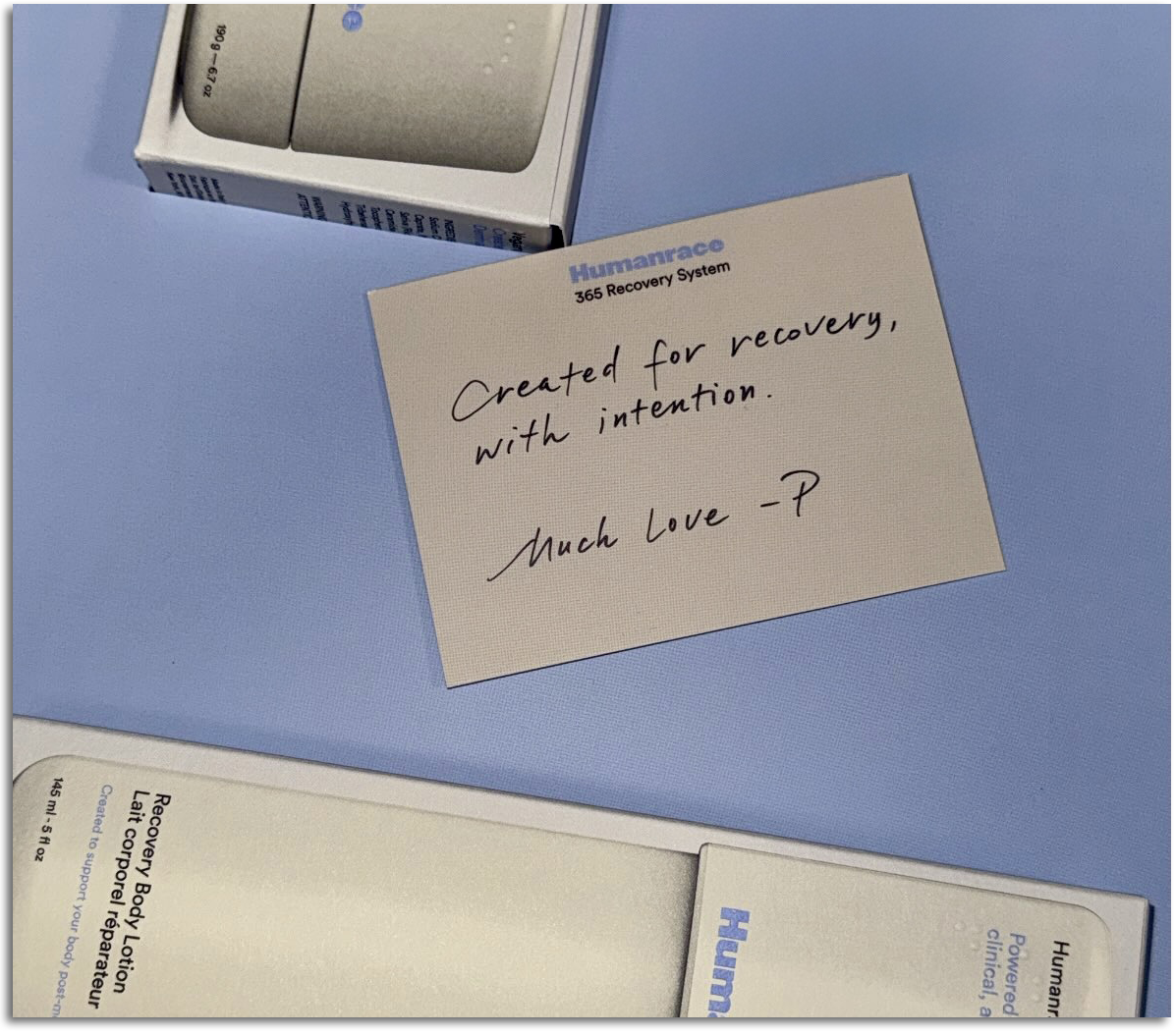
A couple weeks ago I stumbled across an example with perfectly distilled, high-potency meaninglessness: a picture on social media (above) of some body scrub and “recovery body lotion” that Pharrell Williams recently released and seeded to influential people in the hopes of getting out the word. Williams, or a marketing agency pretending to be him, attached a handwritten note, signed “P,” explaining that these products had been “created for recovery with intention.”
The recovery body lotion was created for recovery with intention. The recovery body lotion was created for recovery with intention. Repeat this mantra enough and you can feel the lights start to fade. At this point, when Erin and I hear people insist on the intentionality of their work, we can’t help but hear the exact opposite… a cliché, drained of all vitality… a sales pitch as rote and unthinking as they come… someone talking about focus with their eyes glazed over.
P🧘E👁️A🧘C👁️E🧘 til next time,
— J & E
Enjoy our Spyplane Ultimate Bay Area Guide.
Miuccia Prada is worth $4.8B. How good of a person do you expect her to be? Read our Spyplane Deep Dive.
Our Essay Archive, a curated selection of our Profoundest Thoughts, is here.
Our interviews with Cameron Winter of Geese, Ryota Iwai from Auralee, SC103, Nathan Fielder, Michelle Williams, Sarah Squirm, Evan Kinori, Adam Sandler, Brendan from Turnstile, MJ Lenderman, André 3000, Matty Matheson, Laraaji, Tyler, The Creator, John C. Reilly, Father John Misty, Steven Yeun, Clairo, Pusha T, Conner O’Malley, Christophe Lemaire & more are here.