

Analyze this
Would-be "code unlockers" deserve extreme skepticism
Here’s what you learn about getting dressed when you wear black for a month straight.
Enjoy our extensive new Natural Fiber Workout Gear Report.
We just dropped the smash-hit Spyplane Ultimate Bay Area Guide.
We don’t run ads and we never use affiliate links except for one-off secondhand gems we find on eBay and Etsy, and books on the independent bookseller Bookshop. We laid out our position on affiliate links and spon here.
This means the only people we owe anything are our readers.
— Jonah & Erin
Two readers recently wrote in asking about different approaches to styling clothes.
Question No. 1 takes a bird’s-eye view —
“How often do you trust your intuition (in styling and love)?” — k3elinrose
As far as love: Rules have no dominion over the heart, baby. Lead with intuition as tempered by equanimity, patience, and past lessons in heartbreak and joy.
As far as getting dressed: Strangely enough, even though Blackbird Spyplane is a vocally pro-rules sletter, Erin and I (Jonah) personally tend to rock the clothes we rock rules-free, guided by an inchoate mixture of enthusiasm, openness and, yes, intuition. If there are rules undergirding the way we style a given outfit, it’s rare that either of us explicitly formulates them as such — we’re moreso reflexively referring to a kind of “precognitive pattern language” we’ve built up over decades of just wearing & looking at s--t.
The way I square this circle is that we find cool people who do dress according to rules fascinating, and when the results are inspirationally swaggy, as opposed to deadeningly stiff, we admire these rule-followers precisely because of the distance between their approach and ours.
This brings us to Question No. 2, which is more granular, invoking specific guidelines for dressing that have become increasingly voguish online —
“How much weight do you give to color analysis when it comes to picking fire garms?” — troyjanikowski
I am gonna keep it real: Until a few weeks ago, when we published our delightful new report on How to Wear Colors Well, I’d never heard of “color analysis” at all. A Spyfriend brought it up in the comments on that post, and Erin kindly filled me in.
As I roughly understand it, color analysis is the name for a confusing ~century-old pseudoscience, with earlier roots in painting, that took hold to a degree in 1930s-era Hollywood as a way to taxonomize actors’ complexions and dress them on-screen accordingly. But color analysis really blew up in the 1980s with the publication of a bestselling how-to book, aimed at women, called “Color Me Beautiful,” which Erin’s mom owned.
Today, color analysis aimed at women & men alike has grown popular across the IG & TikTok explainersphere…
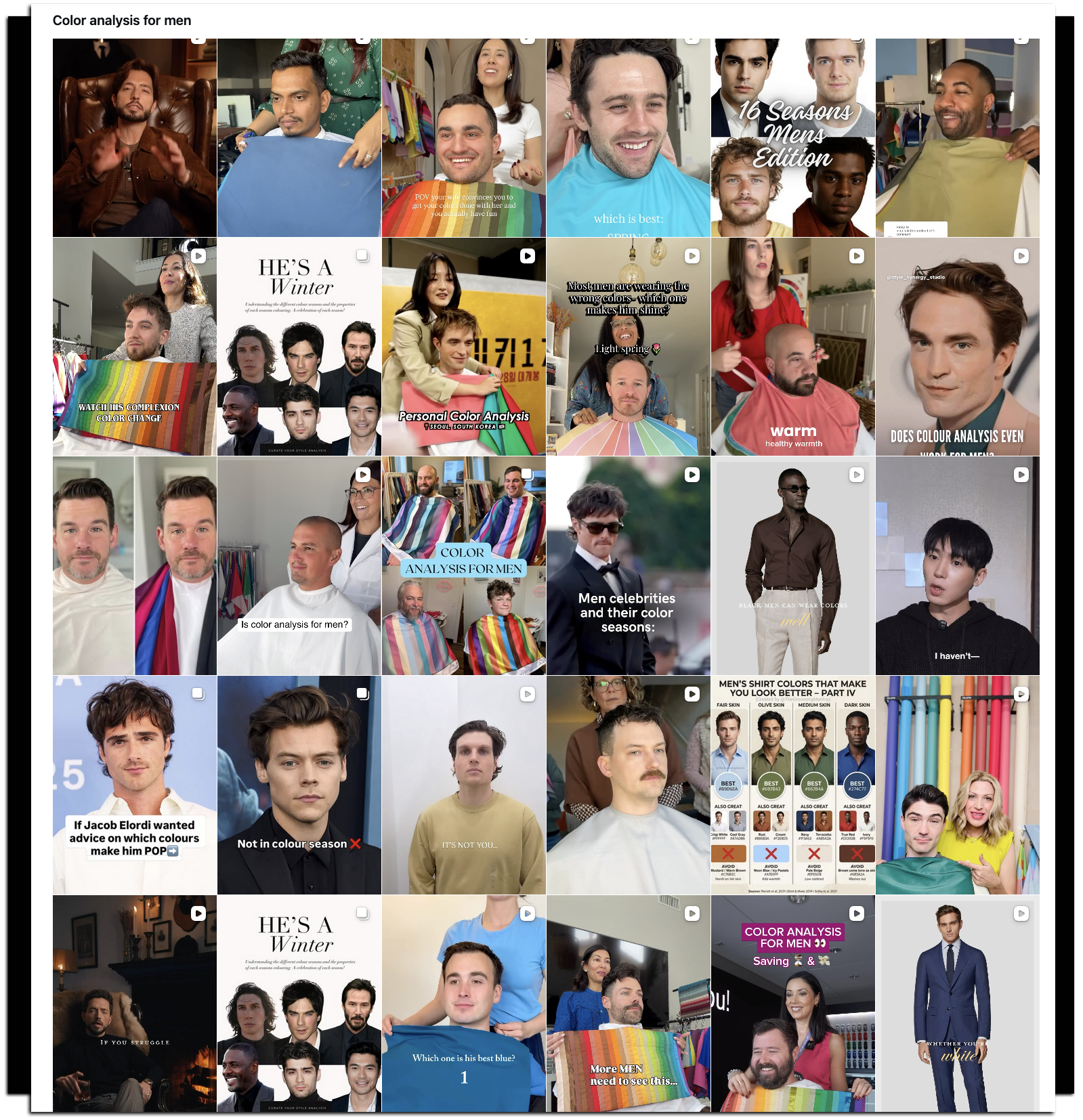
When you perform a color analysis on yourself, you enlist an “expert” to help you identify the combined chromatic effect of your eye color, hair color and skin (under?)tone. This triangulation is known as your “season.” Once you know you are, say, an autumn, you consult seasonally organized charts of the colors that purportedly suit you best. Most color analysts divide the 4 seasons as we know them into 12 sub-seasons or more, i.e. you are not merely an autumn but a warm autumn, your friend is not merely a summer but a cool summer, and so on.
Seen charitably, this is sort of like Myers-Briggs personality-type indicators, except for having fair skin, green eyes and dark hair. But one supposed benefit of color analysis that boosters repeat is that dressing for your “season” as a man will somehow help your jawline look more defined — tying color analysis directly to the Incel Phrenology of looksmaxxing.
The reason I’m not ashamed to admit I’d never heard of any of this s--t is because, even though color analysis seems like the kind of thing I should know about as the co-creator of the western world’s most popular style & culture newsletter, with an avowed interest in Looking Great in Cool Clothes, it strikes me as 99.999999% hogwash.
Naturally, the supply-side endgame of color analysis is $$$: If you see one of these videos and find yourself intrigued, you can book a session with an analyst, you can download an AI-powered analysis app, or you can just smash the fave and share the clip, helping a would-be influencer monetize.
My ignorance of color analysis, then, simply attests to the exalted plane of craggy-brained consciousness that Erin and I call home. This is one of the many things that separates Blackbird Spyplane from all the bozos, charlatans, bogosity merchants, and well-meaning dum-dums out there — and friends, we will never apologize for being “deaf, dumb and blind” to the bulls--t.
“But Jonah,” you might be thinking. “Aren’t you being overly dismissive? Some colors suit certain people better than others. Surely it’s worth thinking in a systematic way about which ones suit you and dressing accordingly?”
I guess so. I’ll concede that what I feel first and foremost when anything like color analysis comes up is antipathy towards its proselytizers. There has long been an abundance of confused and anxious people who wish that some benevolent authority would come “unlock the codes” of self-improvement for them. And the supposedly benevolent authorities who typically slither forth to answer that call have long been malevolent hucksters and/or deluded souls.
This predatory dynamic has gone super turbo in the social-media era. It’s never been easier and cheaper to prey on people’s feelings of isolation and insecurity at scale, and I’d wager that those feelings have never been higher, too.
That said, sure, take some time to feel out which colors you look particularly good in, and which seem to work against you. The thoughtful reader who brought up color analysis in the comments the other day told us, “I love an earthy vibe, but dusty and washed-out colors, especially with orange, yellow, or green undertones, don’t look great on me, so I look for deep purples, saturated forest greens, and greige-y taupes,” adding that “learning about color analysis helped me figure this out,” even as they recognized that the concept is “primarily used by cursed TikTok influencers to make people spend money and buy stuff.”
We’re glad this reader found some utility in color analysis, and we’re glad the utility didn’t erase their fundamental skepticism. This seems like a healthy way to treat color analysis, besides ignoring it entirely: as a wall you can throw different hues of mud at, seeing what sticks.
The color-analysis procedures that proliferate online tend to consist of someone draping swatches of ugly-looking fabric under a client’s chin and extrapolating from there to overarching rules for building a wardrobe. They’re trying to make the process look more “clinical,” I suppose, but the s--t is so aesthetically gross as to torch its credibility as a putative strategy for maximizing beauty…
Instead of going that route, why not base a color analysis on normal lived scenarios and feedback? For instance: compliments you receive from others, and your own sensation of hotness or lack thereof when you catch your reflection (wow I look positively radiant in this burnt-orange hoodie, whereas the kelly-green tee I wore yesterday washed me out). Jot these reactions down in a notebook, if you like, and once you’ve amassed a sufficient “data set,” feel free to draw some broader conclusions for the colors you wear. That sort of ground-up methodology strikes me as immensely superior to a top-down approach.
Case in point: When the talented & saucely Robert Pattinson was doing press for Mickey 17, he didn’t just talk to me about the intricacies and idiosyncrasies of Bong Joon-ho’s directorial approach for a Times Magazine profile of Bong I wrote.
Insanely, Pattinson also agreed to sit for a “Personal Color Analysis,” shot in Seoul, for the movie’s official TikTok account:
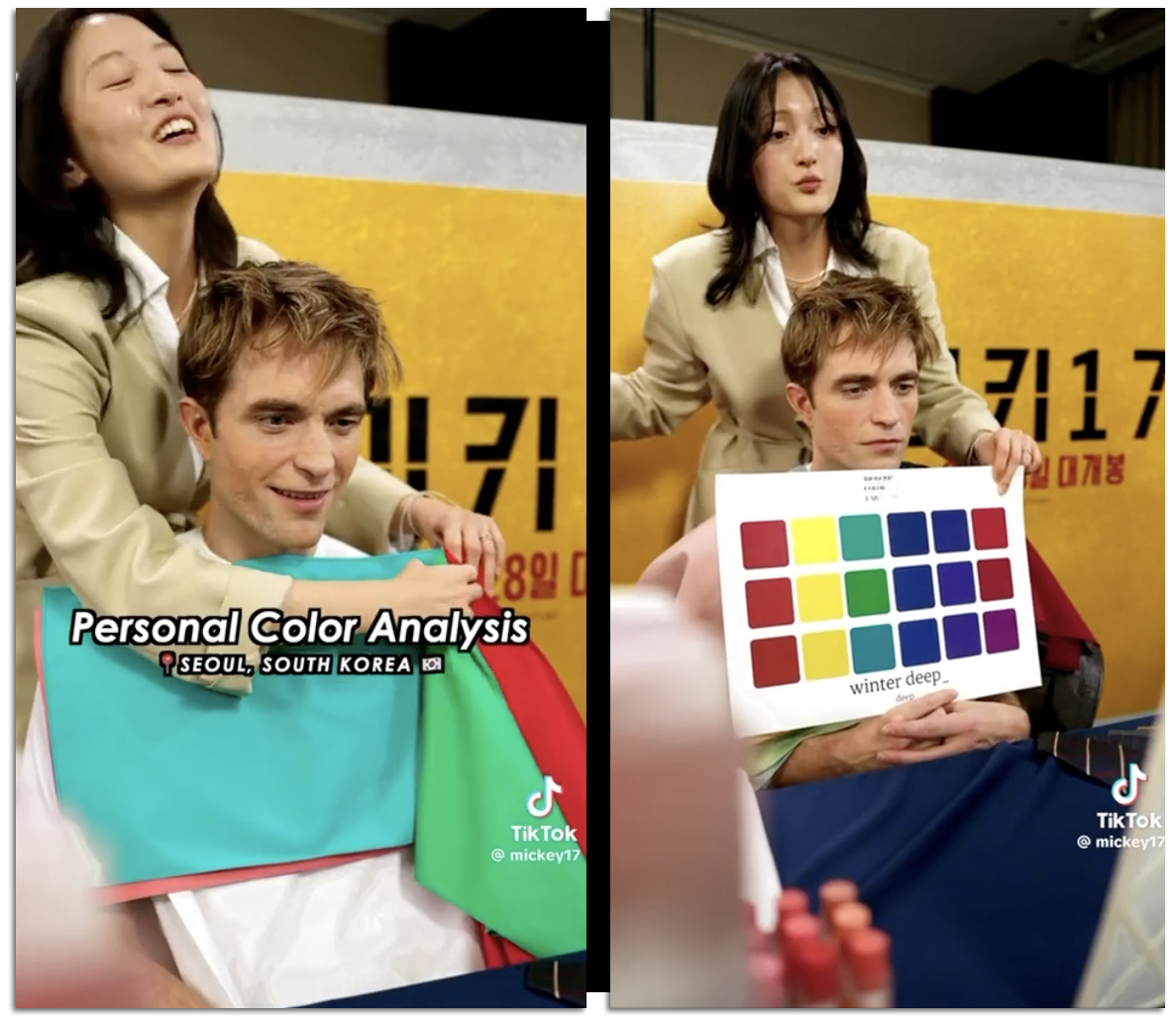
The analyst shows Pattinson colors that supposedly make him look worse. She shows him colors that supposedly make him look better. “Do you see the differences?” she asks him. “No?” he replies, game but skeptical.
She drapes a bunch of lighter colors on his right shoulder and, although they look totally fine, she informs him they are sub-optimal. “That’s not fair,” he says, laughing. “I like these ones!”
I interpret this as his polite way of saying, “FOH,” and I don’t think you need to be Robert Pattinson to reach a similar conclusion for yourself. There are any number of videos of non-famous dudes undergoing color analysis where the “findings” seem just as arbitrary and do not really move the needle one way or the other re: how attractive they look.
Here at the Plane, we’ll continue to do what most people do and take it case by case. Pull on a shirt you’re thinking of buying, make a decision based not on spurious taxonomies but, rather, on how you look in it. Then live & learn. If you really love a certain color but the dictates of color analysis determine that it conflicts with your “season,” you could try wearing it away from your face, in the form of pants, or socks, or a shoulder bag — or, alternatively, you could say f--k it, wear it against your skin anyway, and see if you don’t manage to look good regardless.
Our interviews with Cameron Winter of Geese, Ryota Iwai from Auralee, SC103, Nathan Fielder, Michelle Williams, Sarah Squirm, Evan Kinori, Adam Sandler, Brendan from Turnstile, MJ Lenderman, André 3000, Matty Matheson, Laraaji, Tyler, The Creator, John C. Reilly, Father John Misty, Steven Yeun, Clairo, Pusha T, Conner O’Malley, Christophe Lemaire & more are here.
The Blackbird Spyplane Profound Essay Archive is here.
Mach 3+ city tips for traveling the entire planet are here.
"Seen charitably, this is sort of like Myers-Briggs personality-type indicators" - so, completely made up by people with no actual qualifications who saw a way to make money. Seems right.
My grandma, when I was 13 years old, told me I should only wear brown mascara (never black) because I'm a pale, befreckled redhead.
She may have been correct aesthetically about this color choice, but she didn't seem to consider the joy and creative discovery of *breaking* rules for what is most aesthetically appealing.
There's a time and a place for rule-breaking, color related and otherwise. But I'm skeptical of advice that goes to the extreme: telling me to "always" or "never" do something. Natural fibers, color, drinking, you name it. This has really helped my explore what makes me feel personally fulfilled and whole.
On that note: should I paint my car pastel yellow & tan brown?