

What type of clothes enthusiast are you?
Pathetic slave to a zombie fungus? Or appreciative swaggy master of your own intentions and desires? A new Profound Spyplane
Our interviews with Cameron Winter and Geese, Nathan Fielder, Adam Sandler, Brendan from Turnstile, André 3000, Patrick Radden Keefe, MJ Lenderman, Maya Hawke, Bon Iver, Evan Kinori, Matty Matheson, Laraaji, Ryota Iwai from Auralee, Tyler, The Creator, John C. Reilly, Sarah Squirm, Father John Misty, Kate Berlant, Clairo, Steven Yeun, Conner O’Malley & more are here.
Our brand new Home-Goods Recon Spectacular has intel on furniture, shower curtains, dish racks, rugs, ceramics and more.
Mach 3+ city intel for traveling the entire planet is here.
Last year Outside ran a fascinating feature about a guy who set off on a quest to reunite a centuries-old Japanese katana with its rightful owner. I (Jonah) am intrigued by any and all manifestations of extreme collector behavior, so I was especially interested to learned about the global network of sword obsessives who help the author in his quest.
One paragraph in particular stayed with me, describing the psychology of an American sword collector named Mark Jones, who caught the bug after inheriting a katana from his grandfather:
“He wanted a better one. A cycle of buying and selling more swords as a means of buying and selling more swords followed. He’s trafficked in thousands of blades, and has about a dozen in his possession at any time. He kept the one his grandfather returned with, but he’d also let that one go for the right price. That might sound cold, but this is how collectors maintain their hobby. Their love for what they do is greater than that for any one object.”
In this account of Collector Brain Chemistry, there are several dynamics familiar from the world of Turbo Clothes Enthusiasts.
The “cycle of buying and selling more swords as a means of buying and selling more swords”…? That quasi-automaton state where you become a puppet of your own acquisitive tendencies, like one of those carpenter ants whose brains come under the control of an invasive zombie fungus?
More than a few Slapper Accumulators fit the bill!
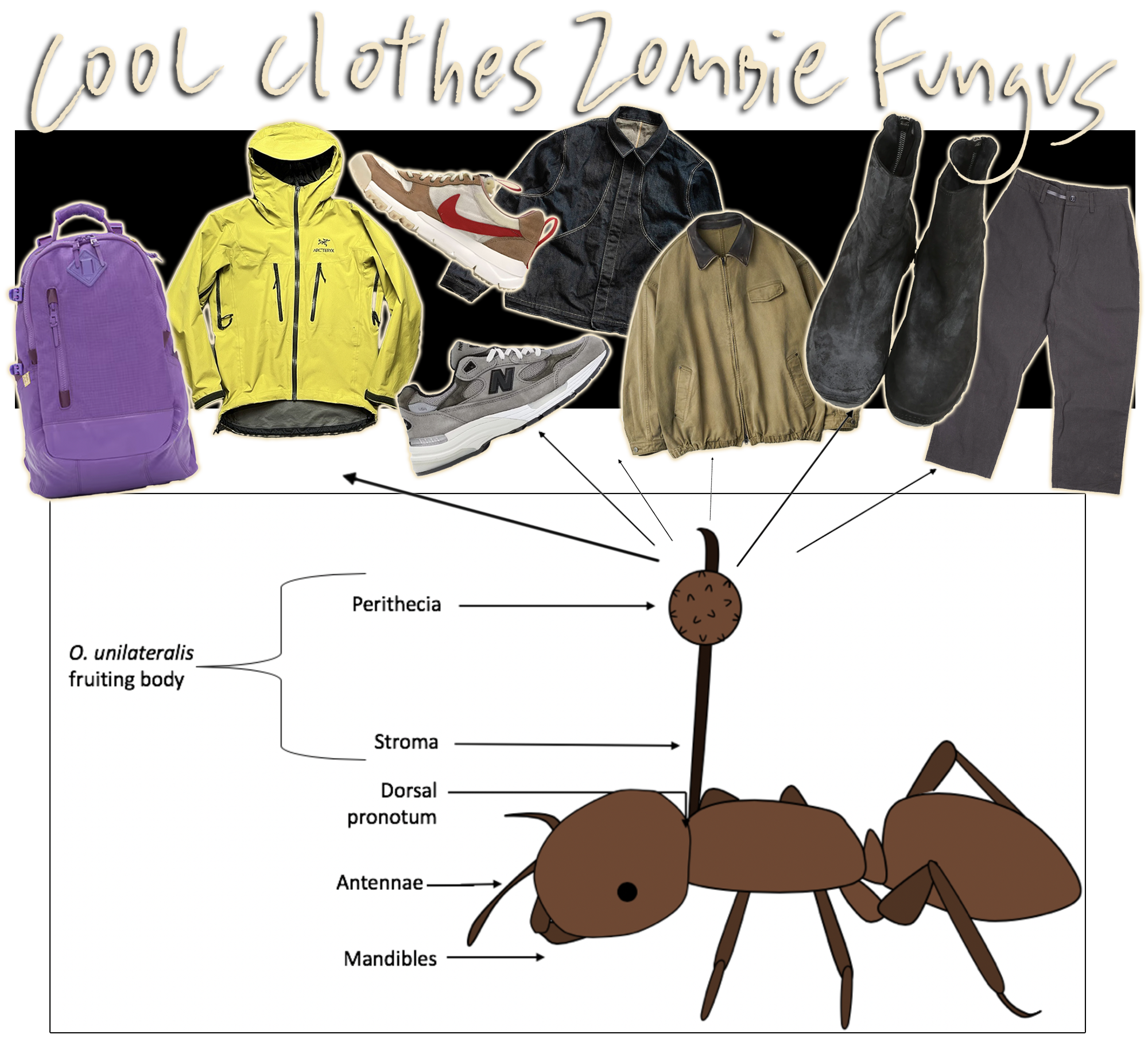
For this type of person, buying clothes they do not own is the paramount concern. The clothes they already own are not, to them, very meaningful in themselves — when push comes to shove, the clothes hanging in their closets represent fuel they can feed into the hearth of their urge to cop, as needed, to keep the flames burning…
People like this send not just tremors of fear and nausea through me, but some uncomfortable flashes of recognition, too.
Grappling with related tendencies in myself, I’ve written about the deep delights of successfully shifting from acquisition mode into enjoyment mode, replacing an “evanescent dopamine hit with more sustained pleasure.”
Here at the Plane, Erin and I advocate for copping slappers judiciously, honoring the immense weight of the labor and natural resources that went into making them, and developing long-term relationships with them, not least because 9 times out of 10 you’re gonna look better in something you’ve worn a ton than something you’ve just bought — a truth evidenced nowhere better than the phenomenon of sui generis dripped-out elders.
I’ve written about the perils of failing to make this shift, thereby trapping yourself in what Spyfriend Issy Wood once described to me, with justified disdain, as “The State of Shopping.” This is a low-sauce vortex where you look eternally box-fresh, more like a physical manifestation of your credit limit than a swaggily lived-in clothes-rocker. When you relate to the clothes you own less as cherished bangers you hope to wear and love for years, and more as temporary holdings you will soon liquidate on the resale market in pursuit of newer holdings, you embody a chain-smoking-style pathology we call the Cursed Liquid Asset Portfolio (C.L.A.P.) Mindset.
Thousands of swords?
Dozens of jackets?
This is some itchy, jittery Howie Ratner Uncut Gems s--t. We know the way his story ends, and it isn’t pretty!
But when I got to the end of that passage from Outside, doubt crept in.
I started to wonder: Do I have things all wrong?

It was the last sentence that tripped me up, about obsessive collectors and how “their love for what they do is greater than that for any one object.”
Am I being too hard on other Turbo Slapper Enthusiasts, and too hard on myself, for simply following the prerogatives of doing a thing we all love?
I can readily wrap my head, after all, around the idea of an artist whose love for painting is greater than any one canvas they paint, selling their work so they can afford to create more work. Ditto, say, someone who loves being part of movie crews so much that the individual projects they work on are ultimately of less importance to them than the experience of bringing them to life.
And so on. This is such a broadly recognized truth that we have a cliché for it, about how the journey matters more than the destination. Collectors, for their part, are gonna collect, and at a certain point, part of collecting means selling swords you own to clear up the space and drum up the money to buy new swords.
When you’re talking about pants, rather than swords, there are additional factors motivating you to cycle out parts of your wardrobe: a silhouette that no longer fits you; a color you got tired of; a seat you wore out and mended one time too many; a closet that got too full; a trend that seduced and excited you before losing its luster; a brand that “wack” people ruined; etc.
Despite our best intentions, our clothes frequently have all kinds of expiration dates lurking in their threads.
This leads us to two crucial questions:
Is the Mach 3+ Clothes Enthusiast a kind of collector?
And if the answer is yes, then…Does collecting represent its own form of creativity?
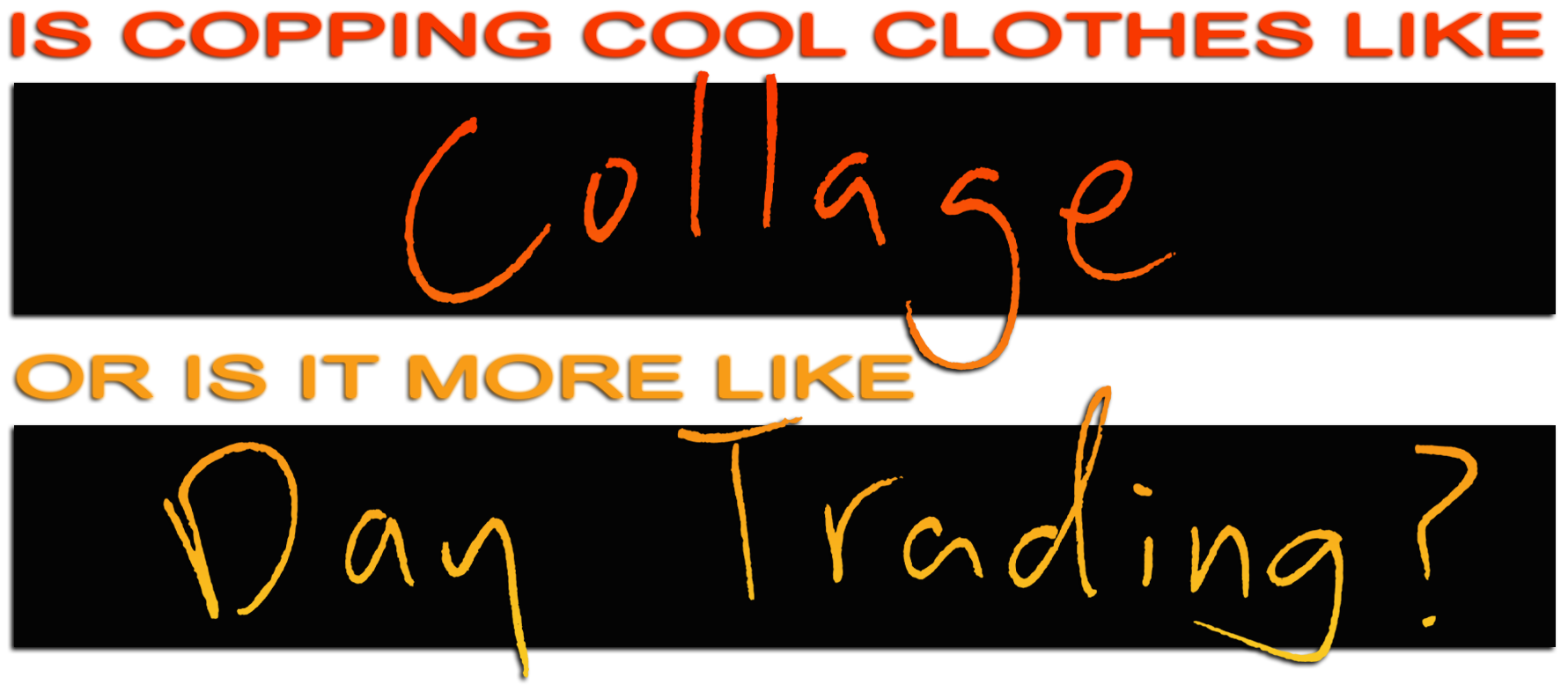
Is collecting a spiritually rewarding pursuit, in other words, like curation and collage, as opposed to a hollow, compulsive one, like gambling and day trading?
I brought this up on a hike the other day with my friend Jeff, who on top of caring about clothes (he’s a big Tender Co. guy) is a business editor at the Wall Street Journal and is used to thinking about economic matters in a more systematic & codified way than I am.
To him, the description of the dude who’s traded thousands of swords over the years — and who would even sell his grandfather’s “for the right price” — smacks of gambling energy.
“Is someone who spends hours of every day on FanDuel ‘doing something they love?’” Jeff asked, dubious.
We agreed that this would stretch the definition of “love” past the breaking point — that some forms of collector behavior are more blessed, and others are more cursed …
Collector behaviors that shade toward the blessed include:
Geeking out about the minutiae and profundities of arcane universes with likeminded people, which increases the levels of enchantment and fellowship in your life.
Traveling to places — flea markets, antique shops, museums, conventions — to explore the universe firsthand, granularly and tactilely.
Coming into possession of some lovely specimen(s) of that universe, which you can look at day in and day out, see new things in them over time, and appreciate in this way for years and years, if not the rest of your life.
Whereas collector behaviors that shade toward the cursed include:
Spending hours of every day looking at online auction listings and thinking about the dollar figures attached to them.
Using your fluency with arcane details of the universe and with the vogues surrounding them to signal your wealth, discernment and superior status to other people in that universe.
Acquiring so many specimens that you can’t possibly appreciate and admire them in any deep, engaged way, especially if you keep them on ice in the equivalent of the tax-shelter airport warehouse in Tenet:

As with so many craggy and big-brained matters, Jeff and I realized, the answers here take the form of spectrums.
Four spectrums to be precise:
There’s a spectrum of collector behavior that runs from creative, where you act with productive intention and are rewarded, to compulsive, where you no longer function with intention but as an automaton.
Another spectrum runs from appreciative, where you f--k with the beauty and worth of fire things, most of which you see in a museum or a cool store or Blackbird Spyplane and do not buy, to acquisitive, where you don’t feel complete unless you come into possession of those fire things — which of course only defers the sense of completeness.
Another spectrum runs from embodied, where you explore your passions and interest as you move through the world, to virtual, where the “exploration” happens on a screen.
And, finally, there’s a self-explanatory spectrum from pro-social to anti-social.
Chart them off each other and you get the Cool Clothes Enthusiast Matrix:
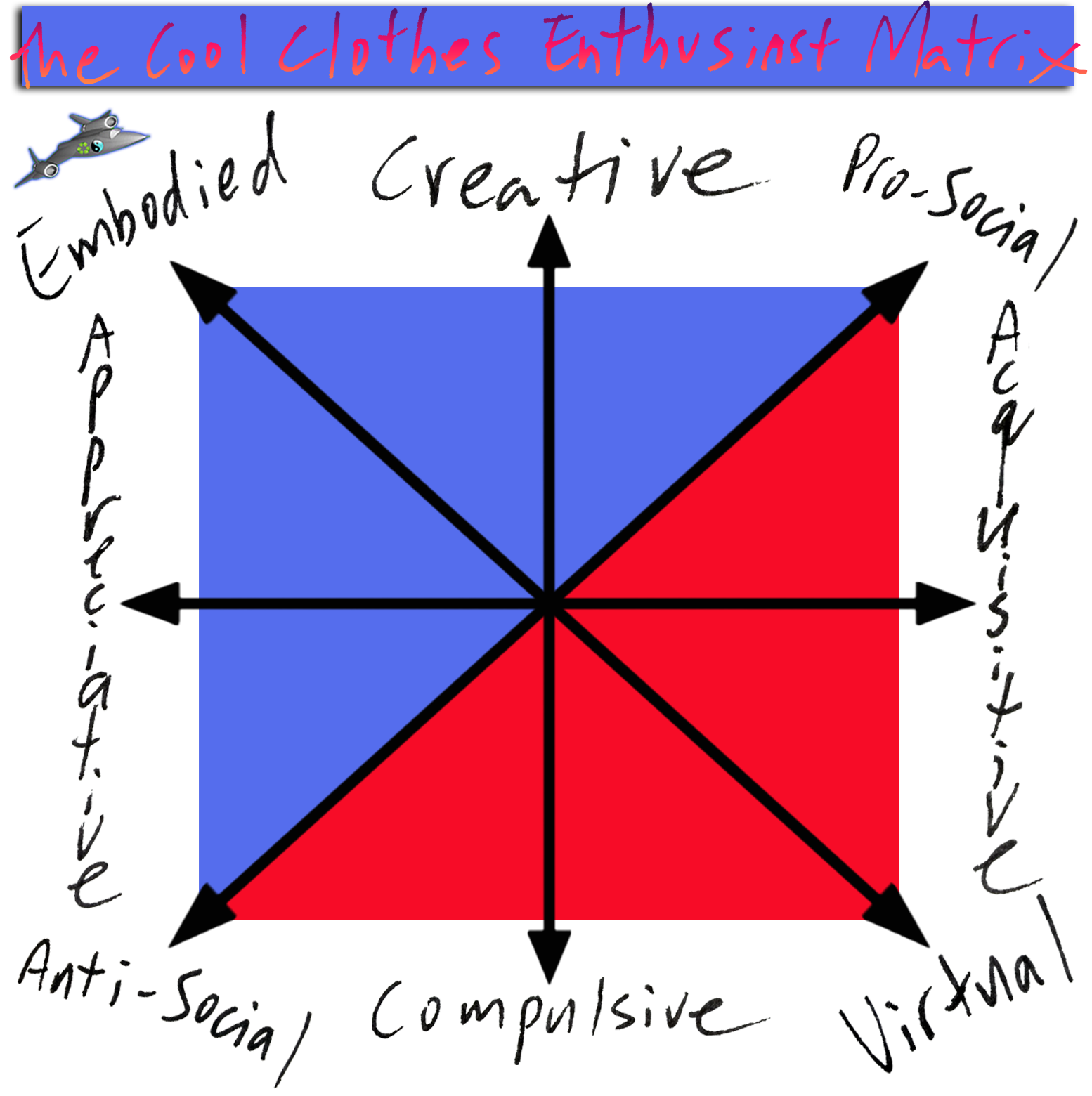
Who is the creative, appreciative, embodied, pro-social Turbo Clothes Enthusiast, occupying the top corner? An admirable real one. She puts together sick, ingenious outfits composed of clothes she knows well, cops judiciously, and loves deeply, and rocks these out in the world among other people while doing cool things that have nothing to do with clothes, including being very neighborly.
That’s the blue part of the matrix. It’s where you wanna be.
Who, by contrast, is the compulsive, acquisitive, virtual, anti-social Turbo Clothes Enthusiast in the bottom corner?
He wears clothes that he intuits from the feed are “next up” and “popping,” only to feverishly sell these clothes and purchase new ones, all while keeping mad browser tabs open to sale pages, new arrivals sections, FedEx tracking numbers, discount codes, auction sites and his Grailed funds-clearance status, sitting hunched over his phone in a dark room, captioning his fit pics “you ain’t up on this #ssstein” while commenting “🧱 you look like a NPC bro 😂” on other people’s snaps.
That’s the red part of the matrix, and it’s where you wanna spend as little time as possible.
This brings us to the beautiful conclusion —
We believe that humans are, like ants, inherently beautiful, noble and collaborative beings. We have much to learn from them.
The cursed zombie ant becomes a slave to the fungus. He wanders off into the forest, dripless, alone and undead.
The blessed ant gets his mind right as he links and builds with the damn colony, baby.
P🧲E🐜A🧲C🐜E til next time,
— J & E
Our guide to how to pack for a trip swaggily is here.
Classified-Tier Spyfriends request, share and receive Mach 3+ recommendations in our SpyTalk Chat Room.
The Blackbird Spyplane Profound Essay Archive is here.
Thanks to Spyfriends Nick Weidenfeld and Amantha Walden for putting us on to the Outside article.
“The collector is such a miserable specimen, interested only in numbers. He’ll never be happy with one object. In his search for a truly unique object, he inevitably ends up with a whole set. A far cry from purity. Elimination is the crucial thing. The idea of collecting is the opposite of purity”
-La collectionneuse (1967), Éric Rohmer
As a archivist, I think a lot about the ethics of collecting! I like to apply archival best practices to clothes acquisition as well. Namely, you need to be aware of how to care for something through the course of its lifecyle when you acquire it. You also shouldn't acquire something just because, but need to metabolize how it will work with the rest of the collection, to get the most use. If it would work better in another's collection, alert them to it! It's not all for you.